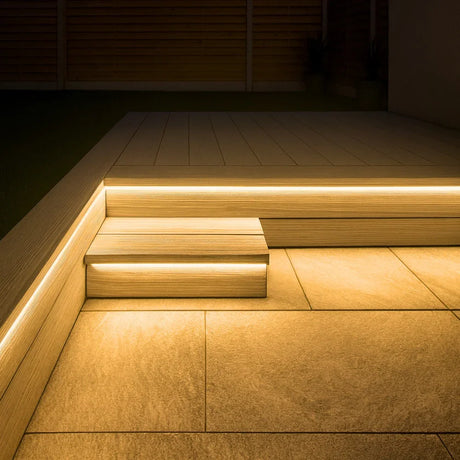
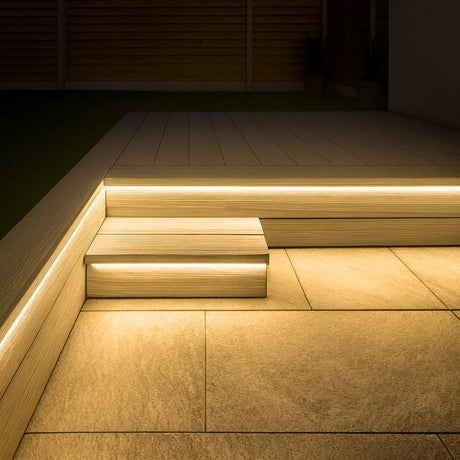
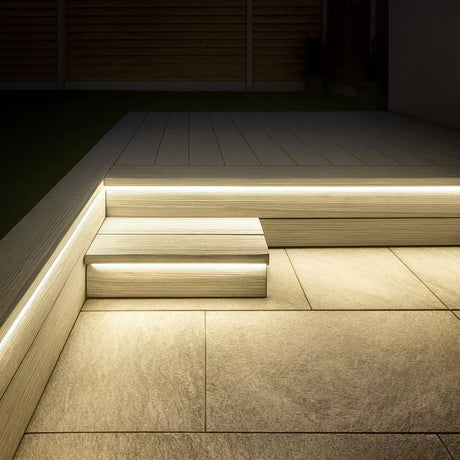
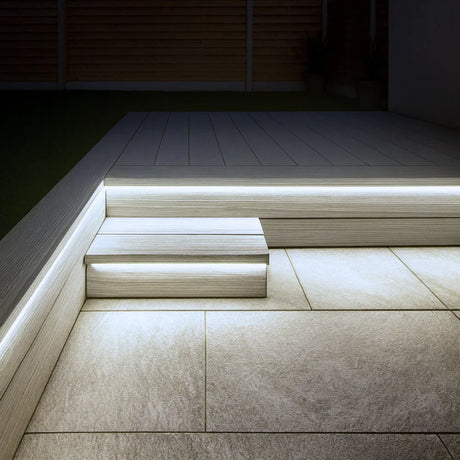
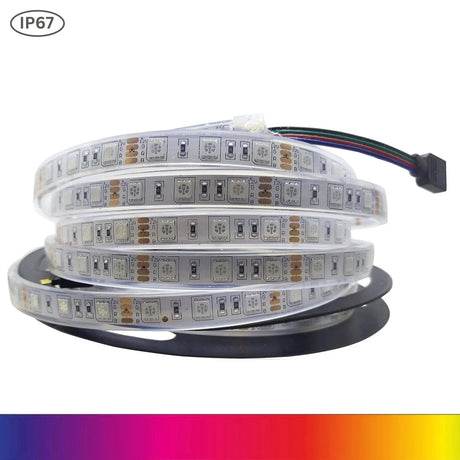
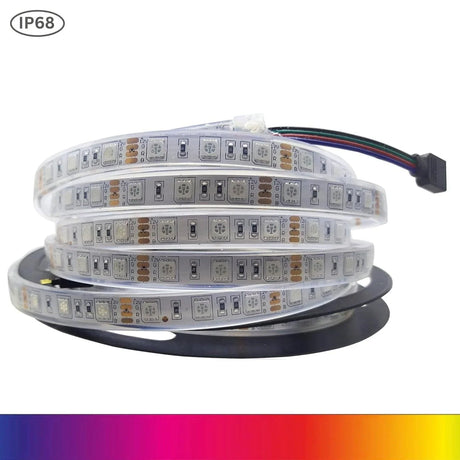
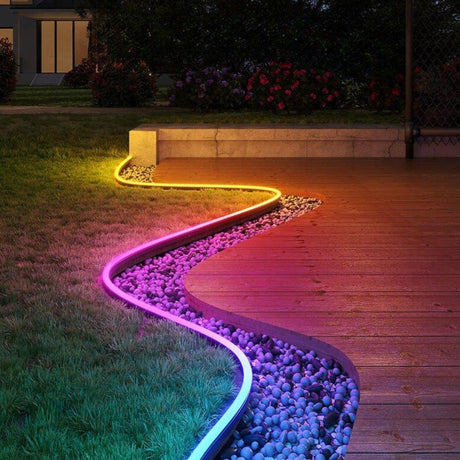
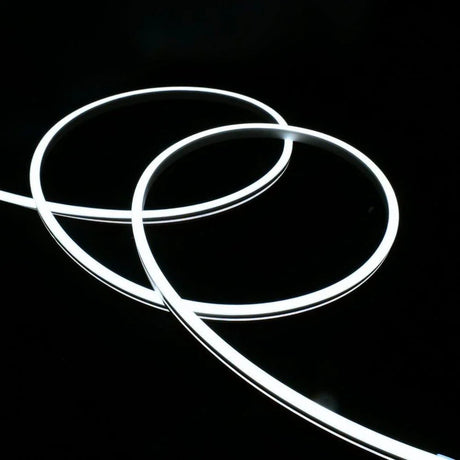
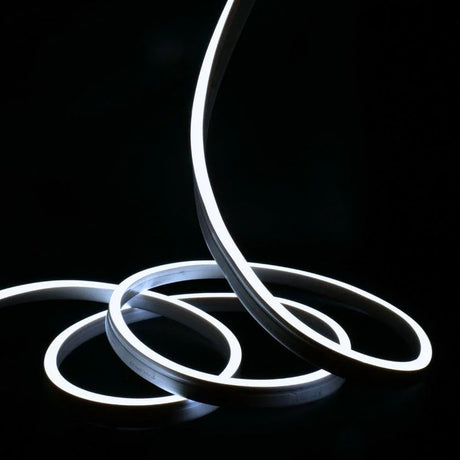
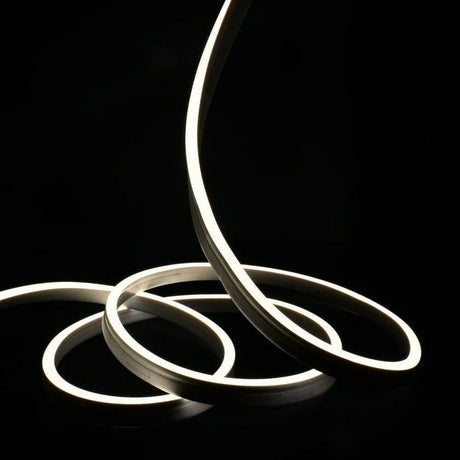
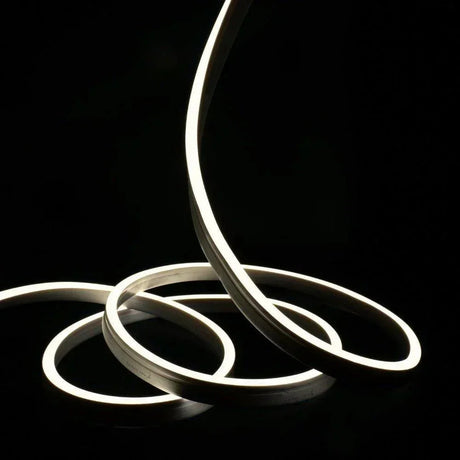
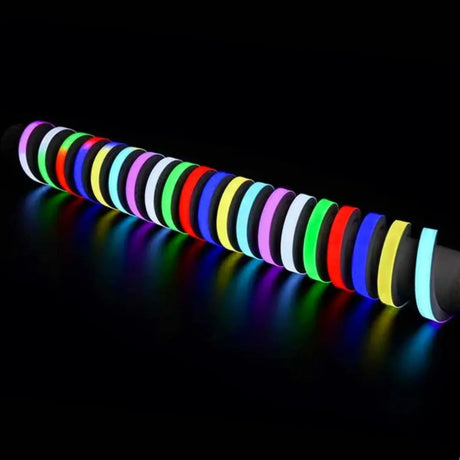
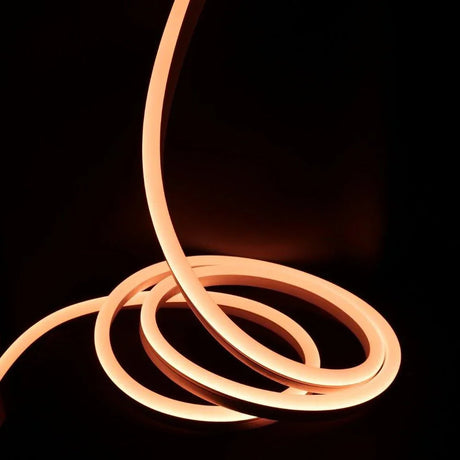
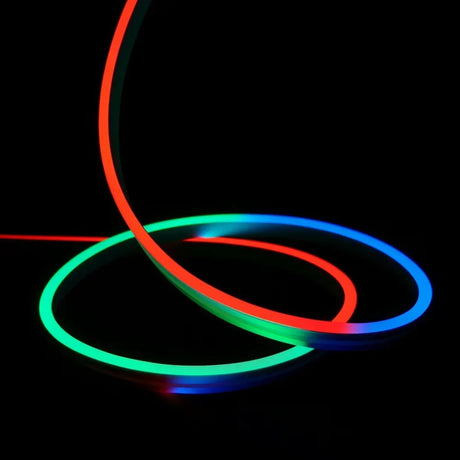
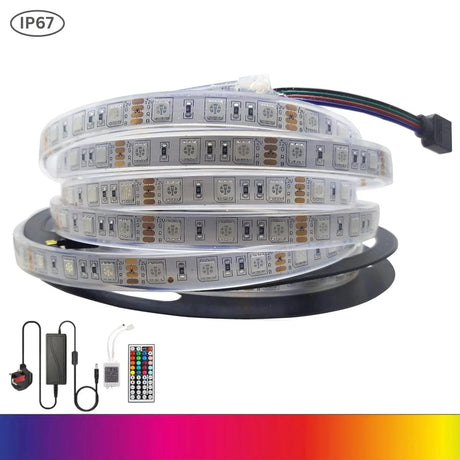
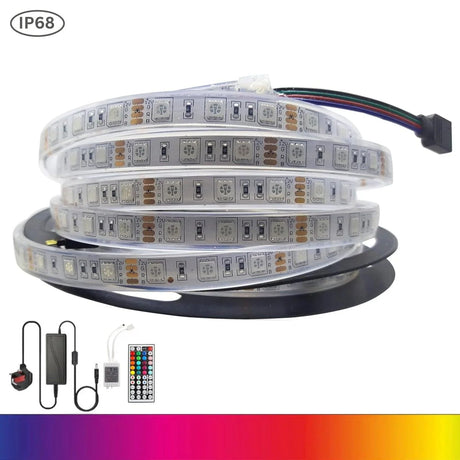
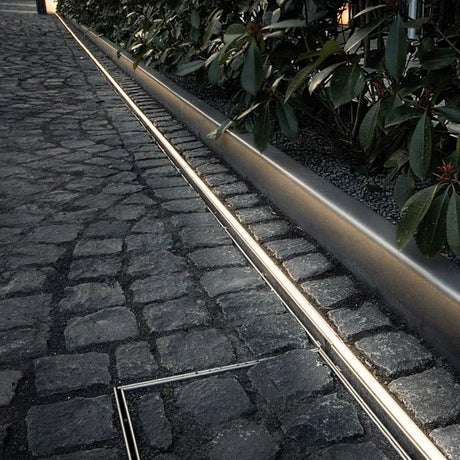
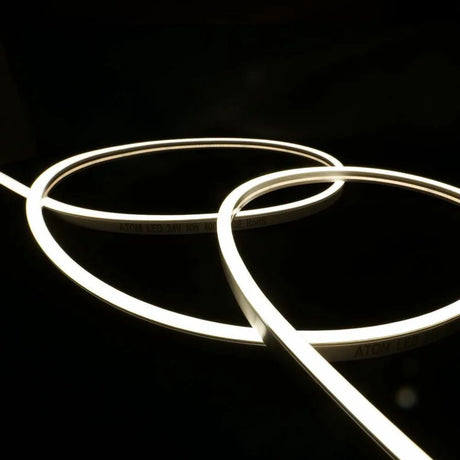
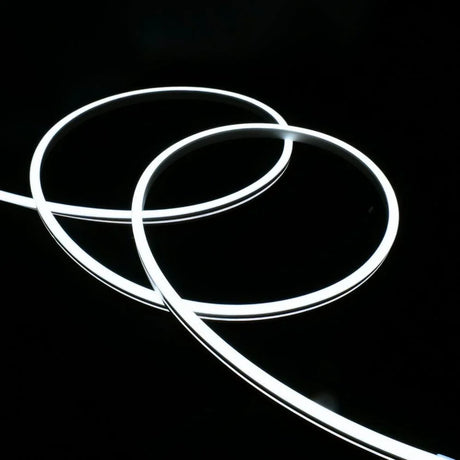
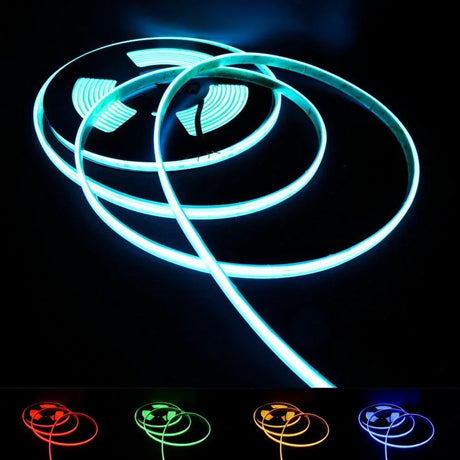
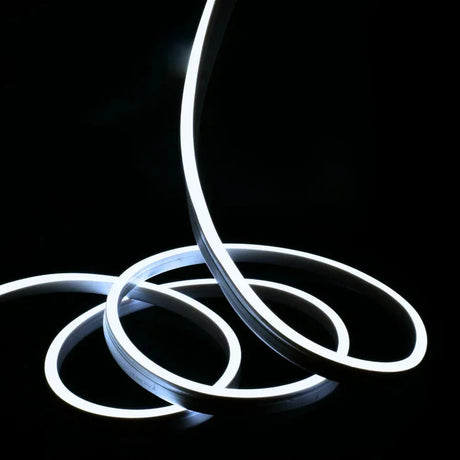
Specify the wrong exterior LED lighting for a commercial facade and you will be back on scaffolding within eighteen months, stripping out failed strip that never had the IP rating, voltage, or driver setup the project demanded. Specify correctly — IP67 minimum, 48V for runs over 20 metres, weatherproof drivers in IP66 enclosures, parallel wiring throughout — and that installation holds for a decade with virtually zero maintenance, even on a fully exposed north-facing elevation in Telford or Edinburgh.
UK LED Lights supplies professional-grade outdoor LED strip lights and outdoor neon flex for commercial facades, architectural lighting, car parks, signage, retail frontages, and long exterior runs. The 2026 range covers IP67 and IP68 waterproof strip and neon flex in 24V and 48V, single colour through to full RGBW, all shipping from our Telford warehouse with free UK delivery and a 5-year warranty. Call 01952 370008 for project-specific technical support from a team that understands contractor timelines.
IP67 & IP68 rated · 24V & 48V DC · UV-stable silicone encapsulated · CRI90+ · Strip & neon flex · BS7671 compliant · 30m+ single-feed runs · 5-year warranty · Free UK delivery · Telford, Shropshire
Quick decision guide — commercial and professional outdoor projects
-
Building facades and architectural feature lighting: 48V IP67 COB strip in outdoor aluminium profile — handles 30-metre continuous runs from a single feed point without visible brightness drop-off.
-
Car park perimeters and commercial boundaries: 48V IP67 strip or neon flex — uniform light output across long linear runs, vandal-resistant when mounted in heavy-duty profile.
-
Retail signage and shopfront outlines: IP67 neon flex — produces a clean, dot-free line visible from the street in daylight hours. Available in single colour, RGB, and RGBW.
-
Hospitality exteriors, hotel frontages, restaurant facades: IP67 RGBW neon flex or strip — white channel for everyday use, full colour for seasonal branding and events.
-
Ponds, fountains, and submerged commercial water features: IP68 neon flex or IP68 strip — the only ratings suitable for continuous submersion.
-
Not sure whether strip or neon flex suits your project? Call 01952 370008 — our team specifies exterior LED lighting for contractors and specifiers across the UK every week.
Who are professional outdoor LED strip lights for?
-
Electrical contractors fitting permanent exterior circuits to BS7671 — including Part P notifiable work on new outdoor circuits.
-
Architects and lighting designers specifying linear exterior lighting for commercial, hospitality, and mixed-use developments.
-
Property management companies upgrading facade, car park, and perimeter lighting across multi-site portfolios.
-
Signage manufacturers sourcing weatherproof neon flex for illuminated lettering, logo outlines, and shopfront features.
-
Facilities managers replacing ageing fluorescent or halogen exterior lighting with low-maintenance LED alternatives.
Who should look elsewhere?
-
Residential homeowners lighting a single patio or short fence run: Our garden LED strip lights page covers domestic projects under 15 metres in detail.
-
One-off event or festival lighting: Temporary installations are better served by plug-in mains-voltage strip or battery-powered alternatives — no driver, no hardwiring.
-
Swimming pool basin illumination: Permanently submerged pool lighting requires dedicated underwater luminaires with appropriate transformer isolation, not strip or neon flex.
-
High-output security floodlighting: LED strip provides architectural accent and perimeter definition, not the 3,000+ lumen concentrated output that PIR-activated floodlights deliver.
Five specification mistakes that cost commercial projects money
-
Specifying IP65 for a permanently exposed facade. IP65 handles surface splash only — it was never rated for sustained UK rainfall, frost-thaw cycling, wind-driven moisture, or the condensation that forms overnight on metal cladding. Every commercial exterior installation needs IP67 minimum. No exceptions, regardless of what the cheapest supplier quotes.
-
Using 24V strip on runs over 20 metres without additional feed points. Voltage drop on 24V strip becomes visible from approximately 10 metres and unacceptable by 20 metres at typical wattages. For facade runs, car park perimeters, and any continuous length over 20 metres, 48V halves the voltage drop at equivalent power — reducing feed points, cable runs, and labour cost.
-
Installing an indoor-rated driver in an exterior location. The driver needs an IP66 or IP67 rating for direct outdoor mounting, or it must sit inside a sealed IP-rated enclosure with ventilation. An IP20 driver behind a service hatch on a building wall will fail once condensation builds up inside the housing — typically within two winters.
-
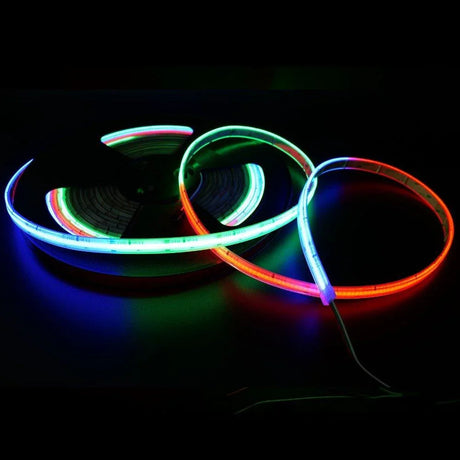
Choosing strip when neon flex would perform better. Strip produces directional light from individual LED chips. Neon flex wraps light through a silicone diffuser body to produce a continuous, dot-free glowing line. For signage, building outlines, and any application where the light source is directly visible to the public, neon flex delivers a far cleaner result. Section 7 below compares both products in detail.
-
Powering strip while still on the reel during testing. Coiled strip cannot dissipate heat. The temperature inside a tightly wound 5-metre reel reaches levels that destroy adhesive bonding, damage phosphor layers on COB strip, and create a genuine fire risk. Always uncoil and mount strip fully before applying any power — even for a quick bench test.
Jump to a section
- What IP rating does commercial outdoor LED strip need in the UK?
- Why do long facade runs need 48V outdoor LED strip?
- What are the BS7671 requirements for permanent exterior LED circuits?
- How do you specify outdoor LED drivers for exposed locations?
- What cable routing and burial methods suit exterior strip installations?
- How do you install outdoor LED strip on a commercial building facade?
- Strip vs neon flex — which suits your outdoor project?
- What colour temperature suits commercial exterior lighting?
- Can RGB and RGBW be used on commercial outdoor installations?
- How do you control and dim exterior LED strip and neon flex?
- What maintenance does outdoor LED strip need on commercial buildings?
- What does a professional outdoor LED strip installation cost?
What IP rating does commercial outdoor LED strip need in the UK?
Every permanent commercial outdoor LED strip installation in the UK requires a minimum IP67 rating. IP67 silicone-encapsulated strip withstands continuous rain, frost-thaw cycling from -20C to +50C, wind-driven moisture, coastal salt spray, and UV exposure year-round. IP68 is required only where strip will sit submerged in water features, fountains, or ground-level drainage channels.
IP65 is the specification most commonly quoted on budget strip imported for the UK market in 2026. It protects against surface splash — a brief rinse from a single direction. It does not protect against the sustained, multi-directional exposure that commercial outdoor installations face. A facade on a warehouse in Manchester or a car park perimeter in Aberdeen is not a splash zone — it is a full-weather environment, and IP65 strip installed there typically fails within 6 to 18 months as moisture penetrates through cut ends, unsealed junctions, and the exposed underside of the circuit board.
The difference is encapsulation method. IP67 strip sits inside a continuous UV-stable silicone tube, sealed at both ends, that blocks moisture from every direction. IP68 strip is fully potted in solid silicone, suitable for permanent submersion. Cheaper IP65 alternatives use epoxy, polyurethane, or nano-coatings that become rigid below 0C, crack under frost-thaw stress, yellow under UV, and allow moisture ingress within one British winter.
| IP Rating |
Protection Level |
Commercial Application |
UK LED Lights Recommendation |
| IP65 |
Surface splash only |
Not suitable for permanent UK outdoor use |
Avoid for any commercial exterior project |
| IP67 |
Temporary immersion, sustained rain, frost |
Facades, car parks, signage, perimeters, retail frontages |
Standard specification for 95% of commercial exterior work |
| IP68 |
Continuous submersion up to 1 metre |
Water features, fountains, below-grade channels |
Required for any submerged application |
| IP69 |
High-pressure wash-down |
Commercial kitchens, food processing exteriors |
Specialist — contact our team for availability |
For coastal installations where salt spray is a factor, IP67 silicone encapsulation handles the salt exposure itself, but all mounting hardware — screws, brackets, profile fixings — must be marine-grade stainless steel. Standard zinc-plated fixings corrode visibly within a single season on the coast. Call 01952 370008 to discuss material specifications for coastal projects.
Why do long facade runs need 48V outdoor LED strip?
48V outdoor LED strip draws half the current of 24V at equivalent wattage, which means voltage drop accumulates at half the rate over the same cable distance. On a 30-metre commercial facade — a standard two-storey retail unit or office frontage — 48V maintains consistent brightness from start to finish on a single feed, where 24V would require multiple injection points, additional cable runs, and more labour.
Voltage drop is the single biggest technical problem on long exterior runs. Every metre of strip and cable between the driver and the furthest LED introduces resistance. That resistance converts electrical energy into waste heat instead of light. On 24V strip running at 14W per metre, visible dimming typically starts from approximately 8 to 10 metres. By 20 metres, the far end can lose 15 to 20 percent of its output — plainly visible on a lit facade after dark.
48V strip halves this problem because the same wattage draws half the amperage. Lower current means less energy lost to resistance per metre of conductor. In practical terms, a 48V facade installation can run 25 to 30 metres from a single driver feed before requiring any additional power injection. For a contractor, that means fewer junction boxes, fewer cable runs through the building wall, and a faster install.
| Specification |
24V Outdoor Strip |
48V Outdoor Strip |
| Maximum practical single-feed run |
Up to approximately 10-15m |
Up to approximately 25-30m |
| Voltage drop rate (same wattage, same distance) |
Standard — baseline |
Approximately half the rate of 24V |
| Typical commercial use |
Short accent runs, individual bay lighting |
Full facades, car park perimeters, long architectural runs |
| Driver cost |
Lower per unit — wide range available |
Slightly higher per unit — growing 2026 range |
| Cable gauge flexibility |
Heavier gauge needed on longer runs |
Lighter gauge acceptable at equivalent distances |
| Feed points required on 30m run |
Minimum 2-3 injection points |
Typically 1 central or end feed |
Both 24V and 48V DC fall within the low-voltage threshold under BS7671 (120V DC ripple-free maximum), provided they are supplied from a suitably isolated, safety-rated driver. This low-voltage classification is a system requirement — it depends on correct driver selection and installation practice, not voltage alone. If you are specifying for a project and need confirmation on driver compatibility, email sales@ukledlights.co.uk with your run lengths and wattage requirements.
What are the BS7671 requirements for permanent exterior LED circuits?
Permanent outdoor LED lighting circuits in England and Wales must comply with BS7671 (the 18th Edition IET Wiring Regulations) and Part P of the Building Regulations. Any new circuit supplying exterior lighting is notifiable work — it must be installed by a Part P registered electrician or inspected and certified by local building control. The circuit requires 30mA RCD protection, correct disconnection times, and cables routed in accordance with Section 522.
This section matters because commercial outdoor LED strip is permanent fixed electrical equipment — not a plug-in product. Once hardwired to a dedicated driver powered from a distribution board, the entire circuit falls under the wiring regulations. Getting this wrong is not just a technical failure — failure to comply with Part P is a criminal offence, and local authorities can require removal of non-compliant work.
-
Part P notification: Any new circuit supplying outdoor lighting must be notified. This applies whether the circuit is low-voltage DC on the strip side or mains-voltage AC on the driver supply side. A Part P registered electrician can self-certify. Non-registered installers must notify building control before starting work.
-
30mA RCD protection: The mains supply circuit feeding the outdoor LED driver must be protected by a 30mA RCD or RCBO. BS7671 requires this for all domestic lighting circuits, and best practice extends it to all commercial exterior circuits regardless of building type.
-
Disconnection times: For TN systems (most commercial supplies), the maximum disconnection time for a final circuit not exceeding 32A is 0.4 seconds. For TT systems (common on farms, rural commercial properties), the maximum is 0.2 seconds. Your electrician must verify disconnection times as part of the commissioning test.
-
Isolation and switching: Outdoor circuits on TT systems should use double-pole isolation. On TN systems, single-pole switching is permitted provided the installation complies with Regulation 714.537.
-
Cable protection: Cables supplying outdoor lighting must be protected against mechanical damage. SWA (steel wire armoured) cable or cable in suitable protective conduit is standard for buried runs — see Section 5 below for burial depths and routing.
For contractors working on commercial projects, the mains-side wiring to the driver is where BS7671 applies in full. The low-voltage DC side between driver and strip is less prescriptive, but correct practice still demands sealed connections, appropriate cable ratings, and parallel wiring on longer runs. Call 01952 370008 if you need to confirm any specification detail before quoting a commercial job.
How do you specify outdoor LED drivers for exposed locations?
An outdoor LED driver must be IP66 or IP67 rated for direct exterior mounting, or installed inside a sealed IP-rated enclosure with ventilation if using a lower-rated unit. The driver must be constant-voltage, matched to the strip voltage (24V or 48V), and rated to at least 120 percent of the total connected strip wattage. For RGB and RGBW circuits, the driver must be non-dimmable — all colour and intensity control happens downstream through a dedicated controller.
The driver is the single most overlooked component in commercial outdoor LED installations. Contractors who correctly specify IP67 strip and outdoor-rated profiles regularly pair them with an IP20 driver mounted behind an access panel — and that driver fails within two winters as condensation builds inside the unrated housing.
-
IP66 driver: Protected against powerful water jets from all directions. Suitable for wall-mounted outdoor locations under building overhangs, in plant rooms with external ventilation, or in dedicated outdoor electrical enclosures.
-
IP67 driver: Protected against temporary immersion. Suitable for fully exposed outdoor mounting including ground-level positions, external wall surfaces without shelter, and locations subject to occasional flooding or heavy wash-down.
-
IP20 driver in IP66+ enclosure: An alternative approach where a high-quality indoor-rated driver is housed inside a sealed outdoor electrical enclosure. This works well when the preferred driver model is not available in an IP-rated version. The enclosure must have ventilation (filtered vents or breather membranes) to prevent internal condensation and allow heat dissipation.
Driver sizing: add up the total wattage per metre across every strip run connected to that driver. Multiply by the total strip length. Then apply a minimum 20 percent headroom factor. A 10-metre run of 14W per metre strip draws 140W — specify a driver rated to at least 168W, rounded up to the next standard size (typically 200W). Running a driver at or near its maximum rating generates excess heat, shortens its lifespan, and is the second most common failure point after unsealed connections.
For RGB and RGBW outdoor strip, the driver must be non-dimmable constant voltage. All dimming and colour mixing is handled by the RGB or RGBW controller positioned between the driver output and the strip. Using a dimmable driver on an RGB circuit causes flicker, colour shift at low levels, and premature component failure. Browse our LED drivers range for compatible outdoor models, or contact sales@ukledlights.co.uk with your project wattage and we will recommend the correct unit.
What cable routing and burial methods suit exterior strip installations?
Cables supplying outdoor LED strip must be SWA (steel wire armoured) for direct burial or standard cable run through protective conduit rated for external use. BS7671 Regulation 522.8.10 requires a minimum burial depth of 500mm in domestic and commercial landscaped areas, 600mm under roads or vehicular traffic zones. Yellow and black electrical warning tape must be placed approximately 150mm below finished ground level, directly above the cable route.
This is the section most online guides skip entirely, and it is where commercial outdoor installations differ most from residential work. A homeowner lighting a 3-metre patio edge might run low-voltage cable through surface trunking. A commercial facade installation feeding 30 metres of strip across two elevations of a retail unit requires proper cable infrastructure from the distribution board to every driver location.
-
SWA cable (direct burial): Steel wire armoured cable provides its own mechanical protection and can be buried directly in a prepared trench. Lay on a 50mm bed of sand or sifted soil, cover with 50mm of sand, then place warning tape at 150mm below finished ground level. SWA glands must be correctly fitted at both termination points to maintain earthing continuity through the armour.
-
Cable in conduit (alternative to SWA): Standard PVC or HDPE conduit rated for direct burial provides mechanical protection for non-armoured cable. Conduit must be sealed at both ends with appropriate glands to prevent water tracking along the cable route. Minimum burial depth remains 500mm.
-
Surface-mounted trunking (above ground): For facade installations where cables run along building surfaces, use UV-rated exterior trunking or galvanised cable tray. All fixings must be stainless steel or hot-dip galvanised. Route cables through wall penetrations using sealed glands — never leave open holes where water can track inside the building envelope.
-
Wall penetrations: Every cable entry through an external wall must be sealed with a fire-rated and weatherproof sealant. Angle the penetration slightly downward from outside to inside to prevent water following the cable into the building. This detail prevents more facade installation callbacks than any other single item.
| Cable Location |
Minimum Burial Depth |
Cable Type |
Protection Required |
| Landscaped areas, footpaths |
500mm |
SWA or cable in conduit |
Sand bed + warning tape |
| Car parks, vehicular areas |
600mm |
SWA recommended |
Sand bed + warning tape + concrete slab cover |
| Building surface runs |
N/A — surface mount |
Standard cable in UV-rated trunking |
Stainless fixings, sealed glands at entries |
| Internal runs to exterior driver |
N/A — internal |
Standard twin and earth or flex |
Appropriate containment per BS7671 |
One detail from site experience: always record and photograph the cable route before backfilling. Hand the documentation to the building owner or facilities manager. Five years from now, someone will dig where the cable runs — a route record prevents a severed supply and an expensive repair. Contact our Telford team for advice on cable routing for specific commercial layouts.
How do you install outdoor LED strip on a commercial building facade?
A professional facade strip installation requires IP67-rated strip mounted in sealed outdoor aluminium profile, fixed to the building surface with stainless steel brackets, powered by an appropriately rated IP66 or IP67 driver, wired in parallel for consistent brightness, and commissioned with full testing of brightness uniformity, connection integrity, and RCD operation. The complete process typically takes one to three days for a standard two-storey commercial frontage, depending on access equipment requirements.
Follow these steps for a BS7671-compliant commercial facade installation in 2026:
-
Survey the facade and confirm access requirements. Measure every run length, note surface materials (render, brick, cladding, composite panel), identify cable entry points, and confirm whether scaffolding, a cherry picker, or rope access is needed. Access equipment often determines the project timeline and budget more than the lighting product itself.
-
Calculate total wattage and specify the driver. Add up wattage per metre across every strip run on the facade. Apply the 120 percent headroom factor. Select an IP66 or IP67 driver, or specify an indoor driver housed in a weatherproof enclosure at an accessible interior location. For multi-elevation projects, a separate driver per elevation simplifies wiring and future maintenance.
-
Select and position aluminium profiles. Choose an outdoor-rated profile with a sealed diffuser and IP-rated end caps. Surface-mount profiles suit flat facades. Corner profiles handle 90-degree transitions between wall planes. Recessed profiles can be built into new cladding systems during construction. Fix profiles using stainless steel screws at 300mm centres — adhesive alone will fail on exterior surfaces subject to thermal movement. Browse our LED strip profiles range for commercial-grade options.
-
Route cables from the distribution board to each driver location. Use SWA cable for buried sections and UV-rated trunking for surface runs along the building exterior. Seal every wall penetration. Install 30mA RCD protection on the supply circuit. Run low-voltage cable from each driver to the nearest strip run — keep low-voltage cable lengths as short as practical to minimise voltage drop on the DC side.
-
Mount strip inside profiles and wire in parallel. Peel adhesive backing and press strip firmly into the clean, dry aluminium channel. For any run over 5 metres, wire strip runs in parallel from the driver rather than daisy-chaining end to end. Parallel wiring feeds each section independently, preventing cumulative voltage drop. Never power strip while it is coiled on the reel — uncoil and mount fully before energising.
-
Seal every connection point to IP67 standard. Use IP67-rated inline connectors or soldered joints sealed with adhesive-lined heat shrink at every strip-to-cable and cable-to-cable junction. Fit sealed end caps to both ends of every profile length. A single unsealed junction on a facade installation will allow moisture ingress within one winter — and that moisture tracks along the entire profile length by capillary action.
-
Commission and test the complete installation. Power on and visually inspect every metre for uniform brightness, correct colour temperature, and absence of flicker. Measure voltage at the driver output and at the far end of the longest run to confirm drop is within acceptable limits (typically under 5 percent). Test RCD operation. Record all readings on the commissioning certificate.
-
Complete Part P certification and handover documentation. Issue an Electrical Installation Certificate or Minor Works Certificate as appropriate. Provide the building owner with driver locations, cable routes, strip specifications, and a maintenance schedule. For commercial properties, this documentation forms part of the building compliance file.
Need help specifying a facade project before you quote? Email sales@ukledlights.co.uk with facade measurements, surface type, and access constraints. Our team will recommend the exact products, quantities, and wiring approach for your specific project.
Strip vs neon flex — which suits your outdoor project?
LED strip and LED neon flex both deliver linear outdoor lighting, but they produce fundamentally different light effects and suit different applications. Strip emits directional light from individual LED chips — ideal for concealed accent lighting inside profiles. Neon flex wraps light through a shaped silicone body to produce a continuous, evenly diffused glowing line — the correct choice for signage, building outlines, and any application where the light source is directly visible.
Most buyers researching outdoor LED lighting in 2026 do not realise these are two distinct products. They search for strip when they actually need neon flex, or they buy strip and discover the visible LED dots look wrong on their shopfront outline. Understanding the difference before ordering saves a costly return and rework.
| Feature |
Outdoor LED Strip |
Outdoor LED Neon Flex |
| Light output pattern |
Directional — emits from one face of the PCB |
Diffused — wraps through shaped silicone body (top, side, or 360-degree bend options) |
| Visible LED dots |
Yes, unless mounted behind a profile diffuser |
No — continuous smooth glow by design |
| Best for concealed installation |
Ideal — mount inside profile, light bounces off surface |
Possible but typically unnecessary — neon flex is designed to be seen |
| Best for visible building outlines and signage |
Poor — visible dot pattern looks unfinished |
Ideal — clean continuous line, reads well from distance |
| Minimum bend radius |
Depends on PCB — typically 30-50mm |
Typically 20-30mm — tighter curves for lettering and logos |
| Maximum single-feed run (48V) |
25-30m |
Up to 30-50m (model dependent) |
| IP rating range |
IP67 and IP68 |
IP67 and IP68 |
| Heat dissipation |
Requires aluminium profile for best performance |
Self-contained — silicone body dissipates heat adequately at rated wattage |
| Colour options |
Single colour, RGB, RGBW, addressable |
Single colour, RGB, RGBW |
| Cut increments |
Every 50-100mm |
Every 25-170mm (model dependent) |
| Cost per metre (typical) |
£8-£25 |
£10-£30 |
When to use strip
-
Facade wash lighting: Strip mounted inside an outdoor profile on a building wall washes light across the surface below or above. The profile hides the LED chips entirely, and the wall texture becomes the visual feature — not the light source.
-
Car park and perimeter accent lighting: Strip in profile along kerb edges, bollard bases, or wall plinths provides wayfinding light without creating glare for drivers.
-
Under-canopy and soffit lighting: Strip recessed into soffit channels lights walkways and entrance areas from above. The diffuser in the profile prevents direct LED visibility at eye level.
When to use neon flex
-
Shopfront outlines and retail signage: Neon flex bent around lettering, logos, and shopfront perimeters produces the clean glowing line that strip cannot replicate without heavy diffusion. Browse our LED neon flex range for outdoor-rated options.
-
Architectural building outlines: Tracing rooflines, window reveals, and structural features. Neon flex reads clearly from across a street or car park at night.
-
Hotel and hospitality branding: Colour-changing RGBW neon flex allows seasonal branding updates without physical replacement — switch from warm white everyday lighting to branded colours for events via controller. Browse our RGB neon flex range.
Not sure which product suits your project? Call 01952 370008 and describe the application. Our Telford team will recommend strip, neon flex, or a combination of both based on the visual effect you need.
What colour temperature suits commercial exterior lighting?
Natural white (4000K) is the most specified colour temperature for commercial exterior LED lighting in the UK because it delivers high visibility and accurate colour rendering without the clinical harshness of cool white or the residential warmth of 3000K. For hospitality and retail facades where ambience matters, warm white (3000K) remains the popular choice. Cool white (5000K-6500K) suits security-focused applications and industrial perimeters.
-
3000K (warm white): Hotels, restaurants, bars, boutique retail, and any commercial exterior where the lighting needs to feel welcoming. Produces a soft amber-toned glow that complements brick, timber, render, and natural stone. Approximately 40 percent of our commercial exterior strip sales in 2025 were warm white.
-
4000K (natural white): Office facades, retail parks, car park perimeters, warehouses, and mixed-use developments where visibility and colour accuracy take priority over atmosphere. Produces a balanced, neutral light that renders signage colours, vehicle paintwork, and branded elements accurately. The standard commercial specification in 2026.
-
5000K-6500K (cool white): Security perimeters, industrial yards, loading bays, and functional commercial areas where maximum visibility per watt matters most. Rarely specified for public-facing facades because the blue-white tone reads as institutional rather than professional.
All outdoor strip in the UK LED Lights 2026 range is rated CRI90+ — colours appear natural and accurate under the light, which matters for branded retail environments where signage, window displays, and exterior finishes must look correct after dark. Lower CRI strip (below 80) distorts reds, greens, and skin tones — visible and unflattering on hospitality frontages. Contact our Telford team on 01952 370008 to discuss colour temperature for your specific facade material and branding requirements.
Can RGB and RGBW be used on commercial outdoor installations?
Yes — IP67 and IP68 rated RGB and RGBW outdoor LED strip and neon flex are widely used on commercial facades, retail signage, hospitality venues, and entertainment buildings across the UK. RGBW is the preferred choice for most commercial projects in 2026 because it adds a dedicated white LED channel that produces clean, true white light — something standard RGB physically cannot achieve.
The critical technical rule for every commercial RGB and RGBW installation: the driver must be non-dimmable constant voltage. All colour mixing, dimming, and effects are handled by a dedicated RGB or RGBW controller positioned between the driver and the strip. A dimmable driver on an RGB circuit causes flicker, colour instability at low output levels, and premature failure of both controller and strip. This is a specification error our Telford team corrects on incoming project enquiries at least twice per week.
-
RGB outdoor strip and neon flex: Three colour channels — red, green, blue. Millions of colour combinations for seasonal branding, event lighting, and architectural accent work. The limitation: RGB cannot produce clean white. The white setting mixes all three channels and produces a cold, violet-tinged output that is not suitable as primary facade illumination.
-
RGBW outdoor strip and neon flex: Four channels — RGB plus a dedicated warm or neutral white LED. The white channel produces clean, colour-accurate white light for everyday use. Switch to RGB mode for branded colours, seasonal themes, and events. The most versatile specification for commercial projects that need both functional white lighting and occasional colour.
-
Addressable (digital pixel) RGB: Individual LED or pixel-zone control enables running effects, colour chasing, and zoned scenes across a facade. Requires a DMX512 or SPI compatible controller. Used on entertainment venues, event spaces, and large-format architectural projects where dynamic lighting effects justify the additional controller cost.
Browse our RGB LED strip lights and LED controllers ranges for compatible commercial outdoor options. For DMX and addressable project specifications, call 01952 370008 with your facade dimensions and we will provide a detailed product and controller recommendation.
How do you control and dim exterior LED strip and neon flex?
Single-colour outdoor LED strip is dimmed using a trailing-edge dimmer paired with a compatible dimmable driver, or via a dedicated PWM controller on the low-voltage side. RGB and RGBW circuits require a dedicated colour controller — never a standard dimmer. For commercial facades, DALI, DMX512, and 0-10V control protocols allow integration with building management systems, timed schedules, and multi-zone scene control.
-
Trailing-edge dimmer (single colour, small installations): The most reliable wall-dimmer method. Compatible with the majority of dimmable constant-voltage LED drivers. If an existing installation uses a leading-edge dimmer and flickers, replacing it with a trailing-edge model costs approximately fifteen pounds and typically solves the problem immediately.
-
PWM controller (single colour, precision dimming): A dedicated PWM unit placed on the DC side between driver and strip. Provides smooth dimming from 100 percent down to near-zero without colour shift or flicker. Ideal for facade installations where light level changes throughout the evening — bright during business hours, reduced after closing.
-
DALI protocol (commercial BMS integration): DALI-compatible LED drivers accept digital control signals from building management systems. Each driver can be individually addressed, grouped into zones, and scheduled via software. Standard on new-build commercial properties and major refurbishments in 2026.
-
DMX512 (dynamic colour and effects): The standard protocol for addressable RGB and complex multi-zone facade lighting. Each pixel or zone receives individual colour and brightness instructions at high refresh rates. Requires a DMX controller and appropriate wiring — Cat5 or dedicated DMX cable between controller and drivers.
-
0-10V analogue dimming (simple commercial control): A low-cost option for basic dimming on commercial circuits. A 0-10V signal from a wall controller or timer adjusts the driver output. Less flexible than DALI but simpler to install and suitable for single-zone applications.
-
Wi-Fi and smart control: Wi-Fi or Zigbee controllers enable app-based and voice-controlled dimming. Suitable for smaller commercial installations — hospitality venues, retail units, and residential-scale facades. The controller must be housed in an IP-rated enclosure if mounted outdoors.
View our full LED controllers and accessories range for compatible options, or call 01952 370008 to discuss the right control approach for your building type and scale.
What maintenance does outdoor LED strip need on commercial buildings?
A correctly installed commercial outdoor LED strip system with IP67-rated components, sealed aluminium profiles, and a quality driver requires minimal maintenance — typically an annual visual inspection and diffuser clean. In that configuration, strip delivers 30,000 to 50,000 hours of rated output, equating to 10 to 17 years at 8 hours per night operation. The most common maintenance requirement is driver replacement, typically at the 7 to 10 year mark.
-
Annual visual inspection: Walk the full run and check for sections with reduced brightness, colour shift, or dark spots. These indicate a failing connection, moisture ingress, or driver degradation. Catching problems early prevents cascade failure along an entire strip run.
-
Diffuser cleaning: Outdoor profile diffusers accumulate dirt, algae, and bird residue that reduces light output by 10 to 20 percent over 12 months on exposed facades. Clean with mild detergent and a soft cloth — no abrasive cleaners or high-pressure washing directly on the profile joints.
-
Connection point check: Inspect every visible junction, end cap, and cable gland for signs of moisture, corrosion, or mechanical damage. Pay particular attention to joints that have been exposed to direct weather since the last inspection.
-
Driver replacement planning: LED drivers have a finite lifespan, typically shorter than the strip itself. Meanwell and other quality driver manufacturers rate their products for 30,000 to 50,000 hours at case temperature under 60 degrees C. Plan for driver replacement at 7 to 10 years. Always specify drivers in accessible locations to keep replacement costs down.
-
Rodent and pest damage (rural and industrial sites): On rural commercial properties, mice and rats chew through cable sheathing exposed at ground level. Armoured cable or cable in heavy-duty conduit prevents this. Check ground-level cable routes annually on agricultural and rural industrial buildings.
For commercial property managers running multiple sites, UK LED Lights offers trade accounts with volume pricing on replacement strip, drivers, and accessories. Call 01952 370008 to set up an account.
What does a professional outdoor LED strip installation cost?
A complete commercial outdoor LED strip installation in the UK typically costs between £30 and £80 per linear metre for materials (strip, driver, profile, connectors, cable) plus contractor labour. A standard 20-metre single-elevation retail facade runs approximately £1,200 to £2,500 all-in, depending on strip specification, access requirements, and whether the building needs new outdoor supply circuits.
-
Strip cost: Professional-grade IP67 outdoor LED strip at UK LED Lights ranges from £8 to £25 per metre depending on LED type (COB or SMD), colour options (single colour, RGB, RGBW), and voltage (24V or 48V).
-
Neon flex cost: IP67 outdoor neon flex ranges from £10 to £30 per metre. The premium over strip reflects the integrated silicone diffuser body.
-
Driver cost: IP67-rated 24V and 48V constant-voltage drivers range from £30 to £120 depending on wattage rating. Budget one driver per elevation or zone for easier maintenance.
-
Aluminium profile: Outdoor-rated profiles with sealed diffusers run £15 to £35 per metre. Budget £5 to £10 per profile length for end caps, brackets, and mounting hardware.
-
Cable and containment: SWA cable for buried runs costs approximately £3 to £8 per metre. Surface trunking runs £5 to £12 per metre including fixings.
-
Contractor labour: Qualified electrician rates for commercial exterior work range from £350 to £500 per day depending on region and access requirements. A standard single-elevation facade typically requires 1 to 2 days of on-site labour.
-
Access equipment: Cherry picker hire adds £150 to £350 per day. Scaffolding erection for a two-storey facade runs £500 to £1,500 depending on elevation width and site access. This cost often exceeds the lighting materials — factor it into the quote from the start.
For project pricing on larger commercial installations, contact our Telford team with facade measurements and we will provide a full materials specification and cost breakdown. Call 01952 370008 for a full breakdown.
Frequently asked questions — outdoor LED strip lights for commercial and professional projects
Can outdoor LED strip lights be used on metal-clad commercial buildings?
-
Yes, but strip must never contact bare metal directly. Mount strip inside an anodised aluminium profile which provides electrical insulation between the PCB and the cladding surface. Direct contact between the strip circuit board and a conductive metal surface causes short circuits.
-
Use stainless steel fixings compatible with the cladding material to avoid galvanic corrosion — mixing metals (e.g., aluminium brackets on steel cladding) accelerates corrosion in outdoor environments.
Do I need planning permission for commercial facade lighting?
-
In most cases, external lighting on commercial premises does not require planning permission unless it involves illuminated advertising signage, listed building restrictions, or conservation area conditions.
-
Illuminated signage typically requires advertisement consent from the local planning authority — separate from Part P electrical compliance.
-
Check with your local authority before installation, particularly on buildings in conservation areas, near residential boundaries, or with existing planning conditions restricting exterior alterations.
How do I weatherproof connections after cutting outdoor LED strip?
-
Every cut end must be sealed immediately with an IP67-rated end cap, adhesive-lined heat shrink, or self-amalgamating silicone tape.
-
Mid-run connections require IP67 inline connectors or soldered joints sealed with adhesive-lined heat shrink tubing and a second layer of self-amalgamating tape.
-
Cutting through IP67 silicone encapsulation breaks the IP rating at the cut point. The cut end is the highest-risk location for moisture ingress on any outdoor installation — seal it before the strip goes back on the building.
What is the maximum continuous run for outdoor neon flex?
-
48V single-colour neon flex supports continuous runs of 30 to 50 metres from a single feed point, depending on the model and wattage per metre.
-
24V neon flex supports approximately 10 to 20 metres before voltage drop affects output.
-
RGB and RGBW neon flex supports slightly shorter runs due to the higher current draw across multiple colour channels — typically 15 to 25 metres on 48V.
-
For commercial building perimeters exceeding 50 metres, use multiple drivers with parallel feeds from central or distributed locations. Contact 01952 370008 for specification help on long-run projects.
Can exterior LED strip survive coastal salt spray?
-
IP67 silicone-encapsulated strip handles salt spray exposure — the silicone body protects the circuit board and solder joints from corrosion.
-
All external hardware must be marine-grade stainless steel — standard zinc-plated screws and brackets corrode within one season in coastal environments.
-
Schedule more frequent visual inspections on coastal installations — every 6 months rather than annually — to catch any hardware corrosion before it affects the lighting.
Is 220V mains-voltage LED strip suitable for commercial outdoor use?
-
220-240V AC mains-voltage strip supports long continuous runs without voltage drop, but must not be permanently hardwired in most applications.
-
Mains-voltage strip carries significantly higher shock risk compared to 24V and 48V DC low-voltage strip, making it unsuitable for locations accessible to the public without appropriate physical protection.
-
For permanent commercial outdoor installations, 24V or 48V DC strip powered through an isolated driver is the recommended and most widely specified approach in the UK market. Browse our mains voltage LED strip page for specific applications where AC strip is appropriate.
How do I specify outdoor LED strip for a multi-storey facade?
-
Divide the facade into zones by elevation, with a separate driver and feed circuit for each floor or section. This limits the impact of any single component failure and simplifies future maintenance.
-
Use 48V strip for horizontal runs exceeding 15 metres and vertical drops where cable routing is constrained.
-
Position drivers at each floor level inside the building rather than at ground level — this minimises low-voltage cable runs and keeps drivers accessible without scaffolding.
-
Factor in access equipment costs from the outset. On a four-storey building, cherry picker or scaffold hire frequently exceeds the cost of the lighting materials.
What warranty does UK LED Lights offer on outdoor strip and neon flex?
-
UK LED Lights provides a 5-year warranty on outdoor LED strip lights and neon flex purchased from our Telford warehouse.
-
The warranty covers manufacturing defects, LED failure, and encapsulation breakdown under normal outdoor use when installed according to our guidelines.
-
Warranty does not cover damage from incorrect installation — including use of incompatible drivers, failure to seal cut ends, or mounting strip on bare conductive surfaces without insulation.
Can outdoor LED strip be retrofitted to existing commercial buildings?
-
Yes — retrofit is one of the most common commercial applications. Strip and neon flex mount to virtually any flat exterior surface using aluminium profiles and mechanical fixings.
-
The main constraint is supply circuit availability. Older buildings may not have a convenient outdoor supply point, requiring a new circuit from the distribution board — which is notifiable under Part P.
-
Surface-mounted cable trunking avoids the need for buried cable runs on retrofit projects where excavation is impractical or prohibited.
Do outdoor LED strip lights affect neighbouring properties?
-
Light spillage onto neighbouring residential properties is a common planning complaint. Use strip in a profile with a directional diffuser to control the beam angle and minimise spill beyond the building boundary.
-
Dimming schedules reduce impact after business hours — a DALI or timer-controlled system can reduce output to 20-30 percent overnight without switching off entirely.
-
Some local authorities impose conditions on exterior lighting in mixed commercial-residential areas. Check before installation to avoid enforcement action after the system is live.
What is the difference between COB and SMD outdoor LED strip for facades?
-
COB (chip-on-board) strip places LEDs in a continuous phosphor line, producing a smooth, dot-free light output. This is the preferred choice for shallow-profile facade installations in 2026 where the strip is visible through the diffuser.
-
SMD strip uses individual LED packages spaced at intervals, which can create visible hotspots when viewed through a clear or lightly frosted diffuser at close range.
-
For concealed installation behind heavy-frost or opal diffusers, the visual difference between COB and SMD is minimal — choose based on wattage, colour temperature, and budget. Browse our COB LED strip lights for the full outdoor range.
How does outdoor LED strip perform in extreme cold?
-
IP67 silicone-encapsulated strip operates at temperatures as low as -20C to -30C depending on the model specification.
-
Silicone remains flexible through freeze-thaw cycling that cracks epoxy and polyurethane encapsulations — the exact conditions Scottish Highlands, northern England, and exposed commercial sites face from November through March.
-
LED output actually increases slightly in cold conditions because lower ambient temperatures improve thermal management. Cold weather is not a performance concern for correctly specified IP67 and IP68 strip.
Can I use outdoor LED strip in covered car parks and multi-storey structures?
-
Covered car parks still require IP67 strip due to condensation, vehicle spray, and cleaning wash-down exposure. A multi-storey car park is not a dry interior environment — moisture is present year-round.
-
Natural white (4000K) or cool white (5000K) is the standard specification for car park and parking structure lighting, prioritising visibility and colour rendering for CCTV coverage.
-
Mount strip in vandal-resistant heavy-duty profiles in publicly accessible parking areas. Standard lightweight profiles can be damaged by vehicle impact or deliberate interference.
Why choose UK LED Lights for commercial outdoor LED strip and neon flex?
-
Commercial specification support from a UK-based technical team: Our Telford office handles project enquiries daily from electrical contractors, architects, and facilities managers. We will review your facade measurements, recommend products, confirm wattages, and provide a full specification before you order. Call 01952 370008, Monday to Friday, 9am to 5pm.
-
Trade accounts and project volume pricing: Contractors and specifiers ordering for commercial installations can access volume discounts, dedicated account management, and priority technical support. Email sales@ukledlights.co.uk to set up an account.
-
IP67 and IP68 strip and neon flex tested for UK weather: Every outdoor product in the 2026 range uses UV-stable silicone encapsulation — not epoxy, not nano-coating, not polyurethane. We stock what survives British winters on commercial buildings, not what passes a lab splash test.
-
Both strip and neon flex in one order: Unlike suppliers that stock one product type, UK LED Lights carries the full range of outdoor strip and neon flex across 24V and 48V, IP67 and IP68, single colour through RGBW. One order, one delivery, one technical contact for the entire exterior project.
-
Free UK delivery from Telford, Shropshire: Every order ships from UK LED Lights Ltd, Unit D4, Stafford Park 4, Telford, TF3 3BA. No minimum order for free delivery.
-
5-year warranty on outdoor products: We warrant every outdoor strip and neon flex reel for five years under normal exterior use. The warranty is backed by a UK registered company (Company No: 12301805) with a physical address and a phone number that reaches a real person — not a chatbot.
Ready to specify your outdoor project?
Browse our full outdoor LED strip lights and outdoor neon flex collections, or contact our Telford technical team for a free commercial project specification:
Last reviewed: March 2026 — UK LED Lights technical team, Telford, Shropshire. Specifications current as of 2026.
🏭 UK LED specialist, Telford, Shropshire · ☎️ 01952 370008 · 🚚 Free UK delivery