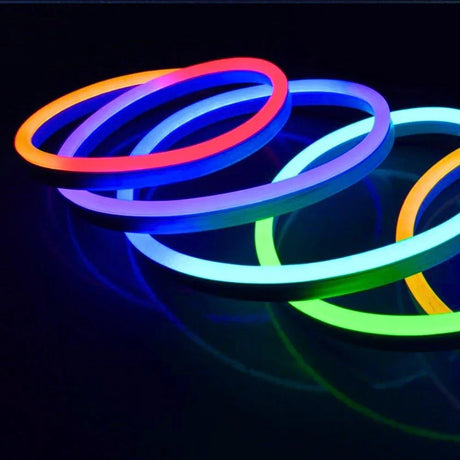
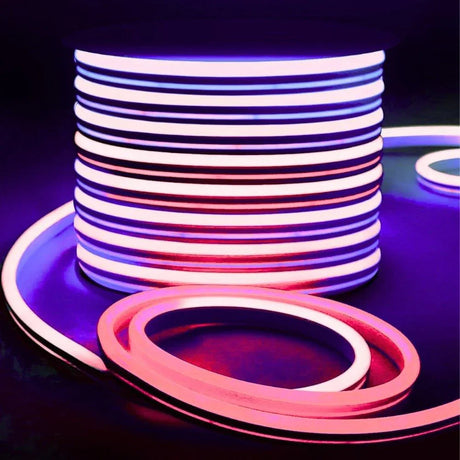
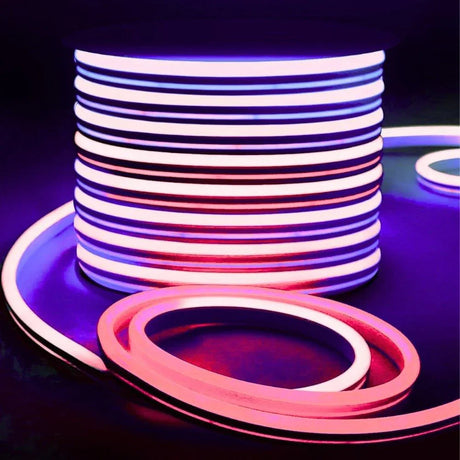
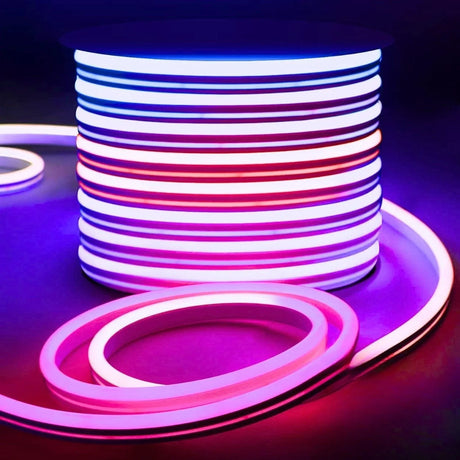
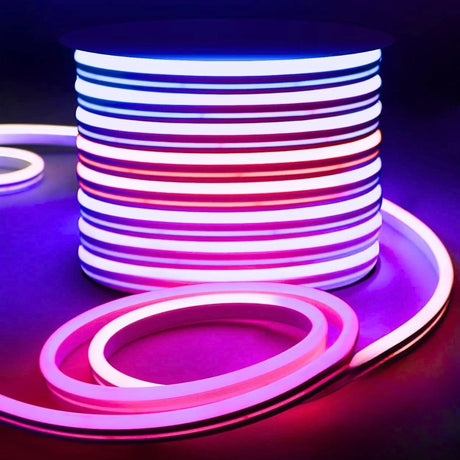
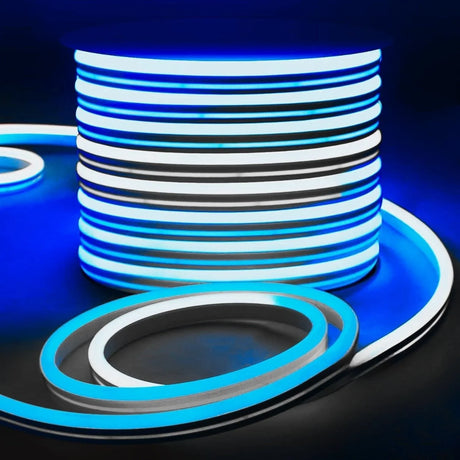
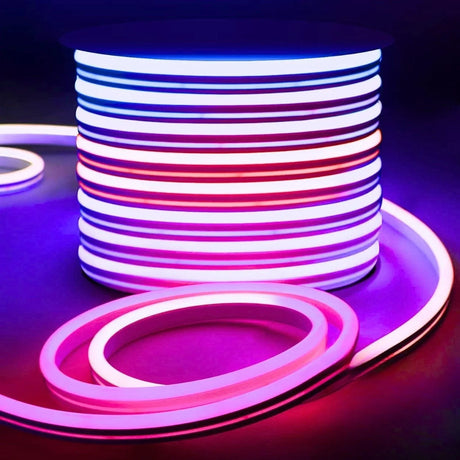
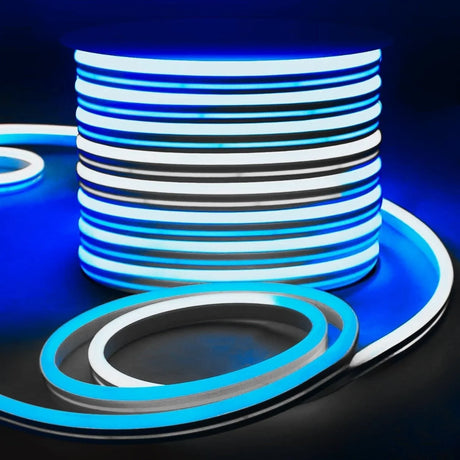
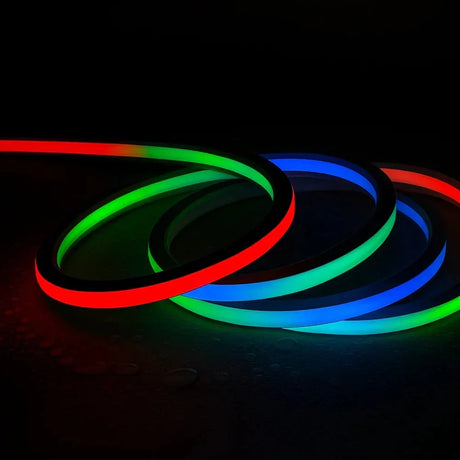
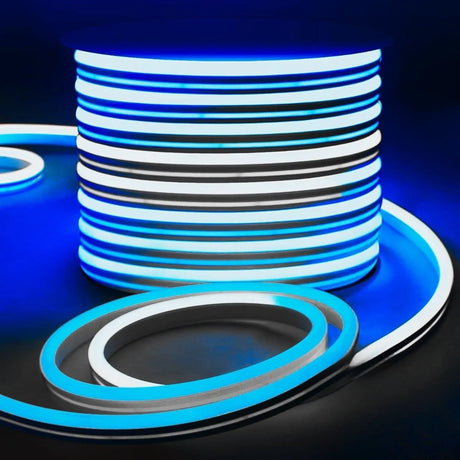
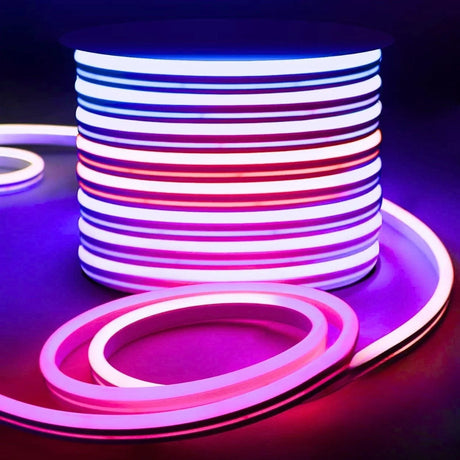
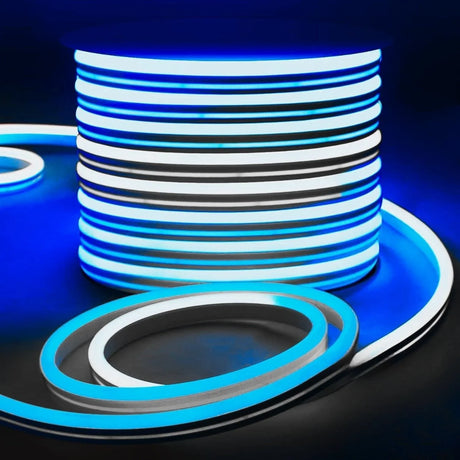
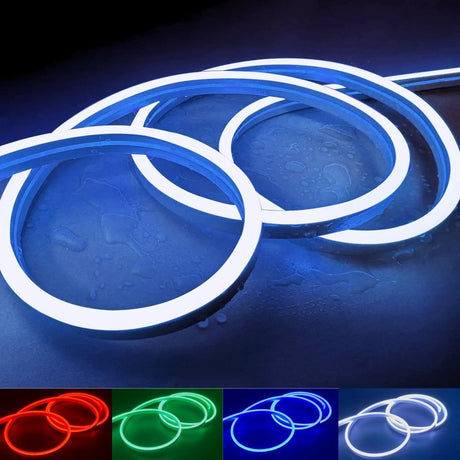
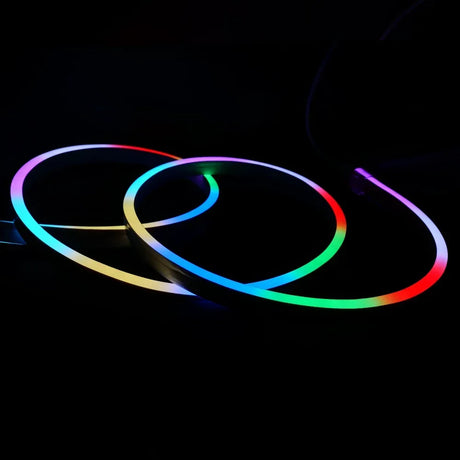
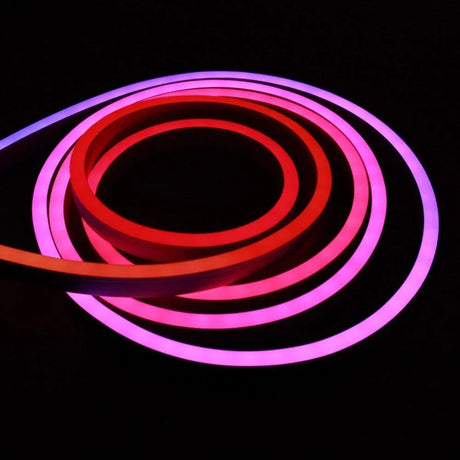
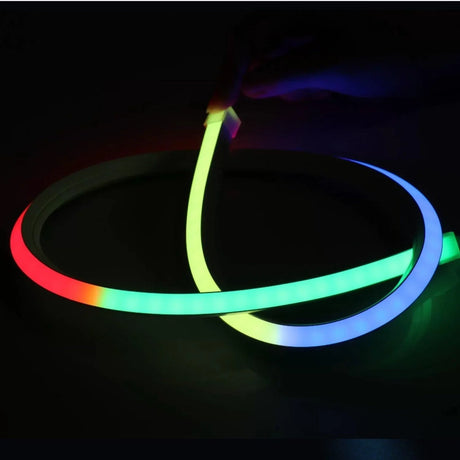
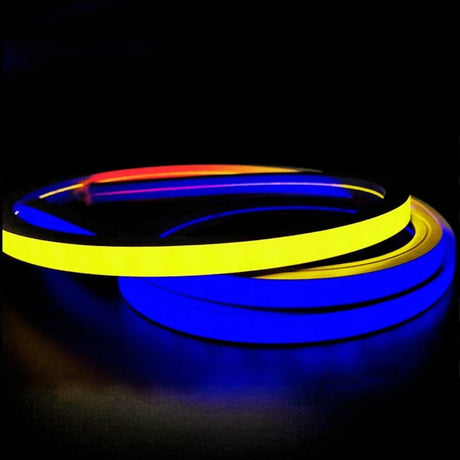
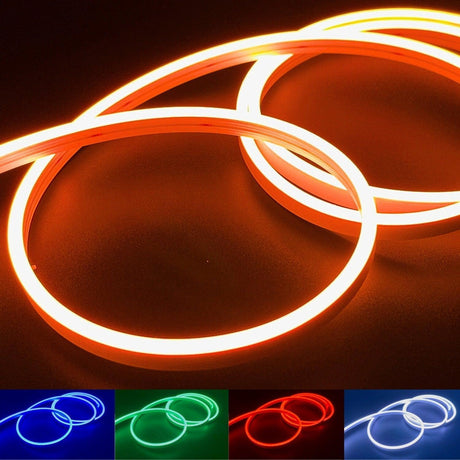
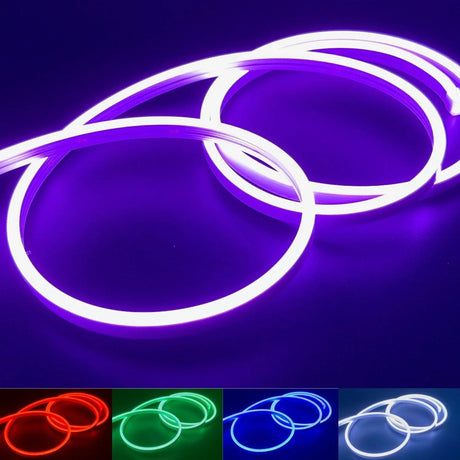
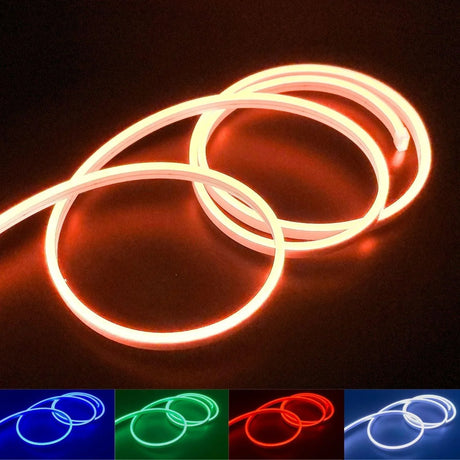
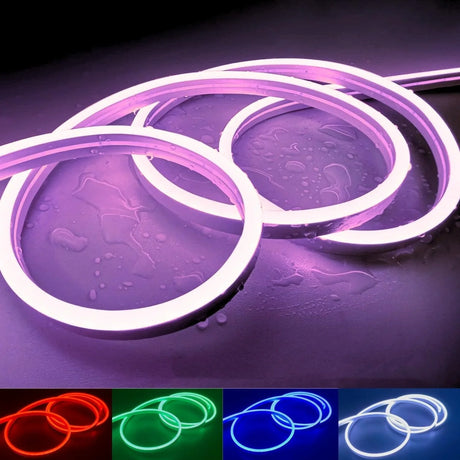
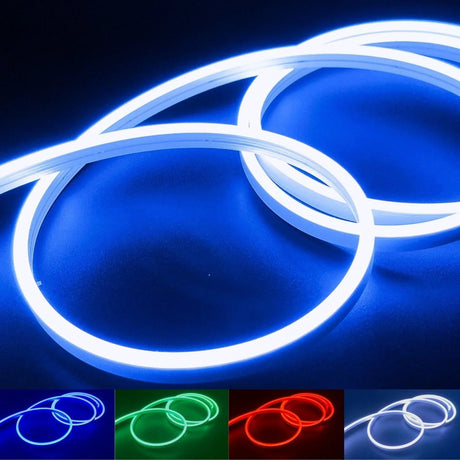
Forty-four colour-changing profiles, every voltage from 12V DC to 240V mains, and every one built to stay outdoors permanently — pick the RGB LED neon flex that fits your project and control it from your phone, your voice assistant, or a professional DMX desk. UK LED Lights stocks the complete RGB and RGBW neon flex range for 2026: standard RGB for dynamic colour effects, RGBW with a dedicated white channel for dual-mode installations, and digital pixel addressable neon flex for independent segment control across signage and facades.
Our collection spans 12V, 24V, 48V, and 220V/240V mains-voltage RGB neon flex, IP67 silicone construction for permanent UK outdoor exposure, and RGBW options that switch between sixteen million colours and clean, accurate white light from a single run. Mini profiles bend to 20mm radius for signage lettering. 48V models run up to 30 metres from one driver. Need help specifying the right voltage, IP rating, or controller? Call 01952 370008 or email sales@ukledlights.co.uk.
RGB · RGBW · Digital Pixel · 12V · 24V · 48V · 220V/240V Mains · IP65 · IP67 · IP68 · Mini 6x12mm · Standard 16x16mm · WiFi · Alexa · Google Home · DMX · Front & Side Emitting · Free UK Delivery
Quick decision guide:
-
Garden border or patio accent — colour changing: 24V RGB neon flex in IP67 with a WiFi controller — control colours and schedules through the app or ask Alexa to set the mood.
-
Shop signage or custom lettering: Mini RGB neon flex 12V or 24V, 6x12mm profile — the 20mm bend radius follows tight curves and letterforms that standard profiles cannot match.
-
Building facade or long architectural outline: 48V RGB neon flex — runs up to 30 metres from a single connection with half the voltage drop of 24V at the same wattage.
-
Bar, restaurant, or entertainment venue: RGBW 24V neon flex — full colour spectrum for atmosphere plus clean warm white 3000K for service lighting from the same installation.
-
Quick plug-and-play colour feature — no electrician needed: 220V/240V mains RGB neon flex with UK plug and remote — plug in, switch on, and run up to 50 metres from a single connection.
-
Dynamic chase effects or pixel-mapped displays: Digital pixel addressable RGB neon flex 24V — each segment is independently controllable for flowing colour sequences, gradients, and animated effects via an SPI controller.
Who RGB neon flex is for: Homeowners creating garden features, patio lighting, and outdoor entertaining areas with app-controlled colour. Signage fabricators building illuminated lettering and logo work. Architects and designers specifying colour-changing facade outlines, feature walls, and commercial perimeter lighting. Hospitality fit-out teams lighting bars, clubs, restaurants, and event spaces where colour sets the atmosphere. Electricians and installers who need a weatherproof colour-changing solution that mounts cleanly without visible LED dots.
Who RGB neon flex is NOT for: If you only need fixed white light — warm, natural, or cool — a single colour neon flex is more efficient and cheaper per metre. If your project is entirely indoors, hidden inside an aluminium profile, and you want maximum brightness per watt, RGB LED strip inside a profile delivers higher lumen output at lower cost. RGB neon flex is purpose-built for visible, decorative, and outdoor colour-changing applications where the smooth silicone glow is the design feature.
Common buying mistakes to avoid:
-
Expecting clean white light from RGB-only neon flex: RGB blends red, green, and blue LEDs to approximate white, but the result carries a visible cold violet tinge. If your project needs both colour effects and usable everyday white light, choose RGBW neon flex — its dedicated white channel produces accurate, natural-looking white independently of the colour channels.
-
Using a dimmable driver with RGB or RGBW neon flex: Colour-changing neon flex requires a non-dimmable constant-voltage driver paired with a separate dedicated RGB or RGBW controller. A dimmable driver interferes with the controller's PWM signal, causing visible flicker, erratic colour behaviour, and premature LED failure across all channels.
-
Choosing IP65 for permanent outdoor installations in UK weather: IP65 handles surface splashes only — it does not withstand sustained UK rainfall, frost-thaw cycling, or ground-level standing water. IP67 is the minimum for any permanent outdoor RGB neon flex installation exposed to UK conditions year-round.
-
Using a 3-channel RGB controller with RGBW neon flex: RGBW neon flex has four channels — red, green, blue, and white. A standard 3-channel RGB controller cannot activate the white channel, leaving you with no usable white output. Always match RGBW neon flex with a 4-channel RGBW controller.
-
Powering RGB neon flex while still coiled on the reel: The silicone body retains heat more than bare strip. Running neon flex while coiled prevents heat dissipation — adhesive fails, LEDs overheat, and there is a real fire risk. Always uncoil, mount, and secure before powering on.
Jump to a section:
- What is RGB LED neon flex and how does it produce colour-changing light?
- What is the difference between RGB and RGBW neon flex?
- Which voltage is right for your RGB neon flex project — 12V, 24V, 48V, or mains?
- What IP rating does outdoor RGB neon flex need in the UK?
- What driver and controller does RGB neon flex require?
- Can you control RGB neon flex with Alexa, Google Home, or a phone app?
- How do you install RGB neon flex correctly?
- What is digital pixel addressable RGB neon flex?
- Where does colour-changing neon flex work best — application by application?
- How does RGB neon flex compare to RGB LED strip in a profile?
- How long does RGB neon flex last and what affects its lifespan?
- Why buy RGB neon flex from UK LED Lights?
What is RGB LED neon flex and how does it produce colour-changing light?
RGB LED neon flex is a flexible silicone extrusion housing red, green, and blue LED chips that blend together to produce millions of colour combinations. A dedicated RGB controller mixes the three channels at varying intensities, allowing you to set any colour, fade between shades, or run dynamic effects — all from a single continuous run of neon flex that delivers a smooth, dot-free glow without visible individual LEDs.
The silicone body serves two functions. First, it diffuses the light from the individual RGB chips into a uniform line of blended colour — where standard RGB strip shows separate red, green, and blue dots at close range, neon flex merges them into a continuous, unbroken ribbon. Second, the silicone acts as a weatherproof enclosure. Professional-grade UV-stable silicone resists yellowing, cracking, and brittleness across years of outdoor exposure, making it the preferred material for any permanent colour-changing installation in 2026.
Unlike traditional glass neon tubes — which required toxic gas fills, high-voltage transformers, fragile glass bending, and specialist installation — RGB LED neon flex runs on safe low-voltage DC (12V, 24V, or 48V), cuts to length at marked intervals, and bends to follow curves, lettering, and architectural lines without any glasswork. The 220V/240V mains-voltage variant simplifies wiring for long commercial runs while still providing colour-changing capability through an integrated controller.
-
Colour range: Sixteen million colours from three-channel RGB mixing, with smooth transitions between any two shades via PWM control.
-
Light output: Typically 8–18W per metre depending on voltage and LED density, producing a visible decorative glow rather than high-lumen task lighting.
-
Diffusion: The silicone body eliminates visible LED dots entirely — the colour line appears continuous from any viewing angle and any distance.
-
Lifespan: 30,000–50,000 hours rated life at full output, equivalent to 10–17 years at 8 hours of daily use.
-
Material: UV-stable silicone construction as standard on all UK LED Lights outdoor-rated RGB neon flex — no PVC jackets that yellow within 12–18 months of outdoor exposure.
What is the difference between RGB and RGBW neon flex?
RGBW neon flex adds a fourth dedicated white LED channel alongside the red, green, and blue chips, producing clean, accurate white light that RGB alone cannot achieve. Standard RGB neon flex blends all three colour channels to approximate white, but the result carries a noticeable cold violet tinge. RGBW solves this by producing white light from a purpose-built white LED chip — warm white 3000K, natural white 4000K, or cool white depending on the variant.
This distinction matters for any installation that needs to serve two roles: atmospheric colour lighting in the evening and functional white light during working hours. A restaurant bar that runs deep blue during service but switches to warm white for morning prep. A garden patio that cycles through colours during a party but provides clean white light for everyday evening use. A retail display that draws attention with colour accents but needs neutral white to show products accurately. RGBW neon flex handles both from a single installed run — no second product, no second circuit, no second set of mounting clips.
| Feature |
RGB Neon Flex |
RGBW Neon Flex |
| Colour channels |
3 (Red, Green, Blue) |
4 (Red, Green, Blue, White) |
| White light quality |
Cold violet-tinged approximation |
Clean, accurate white from dedicated LED |
| Controller required |
3-channel RGB controller |
4-channel RGBW controller |
| Wiring |
4 wires (R, G, B, V+) |
5 wires (R, G, B, W, V+) |
| Typical wattage |
10–15W/m |
12–18W/m |
| Best for |
Colour-only features, signage, accents |
Dual-mode: colour effects + everyday white |
| Cost per metre |
Lower |
Higher (additional white channel) |
| Driver type |
Non-dimmable constant voltage |
Non-dimmable constant voltage |
The decision is simple: if you will ever need white light from your neon flex installation — for any reason, at any time — choose RGBW. The additional cost per metre is modest compared to the cost of removing and replacing an entire RGB installation later. If the installation is purely decorative and will only ever display colour effects, standard RGB is the cost-effective choice. Our technical team at UK LED Lights can advise on the right option for your specific project — call 01952 370008.
Which voltage is right for your RGB neon flex project — 12V, 24V, 48V, or mains?
Choose 24V for most residential and commercial RGB neon flex installations up to 10 metres per run. Choose 48V for long architectural runs, building outlines, and commercial perimeters up to 30 metres from a single driver. Choose 12V only for short signage and lettering runs under 3 metres. Choose 220V/240V mains for simple plug-and-play colour runs up to 50 metres where professional wiring is not required.
Voltage selection determines three things that shape every project: maximum run length before voltage drop becomes visible, cable sizing, and safety classification. Getting this right at the specification stage avoids colour inconsistency, dim far-ends, and unnecessary rewiring.
| Voltage |
Max RGB Run Length |
Best Application |
Voltage Drop Rate |
Safety Note |
| 12V DC |
Up to 3m |
Short signage, lettering, display accents |
Highest — visible over 3m |
SELV when supplied from isolated driver |
| 24V DC |
Up to 10m |
Residential gardens, patios, interior features, hospitality |
Moderate — manageable to 10m |
SELV when supplied from isolated driver |
| 48V DC |
Up to 30m |
Building facades, commercial perimeters, long architectural runs |
Half the rate of 24V at same wattage |
Falls within SELV threshold under BS7671 when supplied from suitably isolated, safety-rated driver |
| 220V/240V AC |
Up to 50m |
Plug-and-play garden, event, and temporary commercial runs |
Minimal over distance |
Mains voltage — must not be permanently hardwired in most residential applications |
48V advantage for long runs: Voltage drop occurs at half the rate of 24V when running the same wattage over the same distance. A 20-metre facade outline that would show noticeable colour shift at the far end on 24V maintains consistent colour and brightness on 48V. For commercial projects, building outlines, and architectural perimeters in 2026, 48V RGB neon flex is the professional specification. Wire in parallel — not series — to further minimise voltage drop across multiple runs.
Mains voltage limitations: 220V/240V RGB neon flex is convenient but has restricted colour-control options compared to low-voltage variants. The integrated controller handles basic colour modes and remote control, but it does not support WiFi app control, Alexa or Google Home integration, or professional DMX systems. For full smart-home integration or advanced colour programming, specify 24V or 48V DC with a dedicated WiFi or DMX controller.
What IP rating does outdoor RGB neon flex need in the UK?
IP67 is the minimum IP rating for any permanent outdoor RGB neon flex installation in the UK. IP67 withstands sustained rainfall, frost-thaw cycling, ground-level standing water, and jet washing — the conditions that every UK outdoor installation faces year-round. IP65 covers surface splashes only and is not suitable for exposed UK outdoor conditions under BS7671 guidelines.
IP ratings are not interchangeable, and selecting the wrong one is the most common cause of premature outdoor neon flex failure in the UK. Each rating reflects a specific level of water and dust protection tested under controlled conditions:
-
IP65 — surface splash only: Protects against low-pressure water jets from any direction. Suitable for sheltered indoor wet zones and covered canopy areas only. Not rated for direct rainfall, standing water, or frost exposure. Do not specify IP65 for any UK outdoor RGB neon flex installation exposed to the elements.
-
IP67 — temporary immersion: Withstands immersion in water to 1 metre for 30 minutes. Handles sustained UK rainfall, frost, snow, ground-level water pooling, and jet washing. The correct specification for garden borders, patio perimeters, fence lines, building facades, and all exposed outdoor neon flex in UK conditions.
-
IP68 — continuous submersion: Rated for permanent immersion beyond 1 metre. Required for pond surrounds, fountain features, water features, and any installation where the neon flex will be submerged or partially submerged on a permanent basis.
Every outdoor-rated RGB neon flex in the UK LED Lights 2026 collection uses UV-stable silicone rather than PVC. PVC jackets become brittle in sub-zero temperatures, yellow under UV exposure within 12–18 months, and crack at bend points — allowing moisture into the internal circuitry. Silicone maintains flexibility from -30C to +60C, resists UV degradation across the rated lifespan, and seals the LED assembly against moisture ingress at every bend and mounting point. When specifying outdoor colour-changing neon flex for a UK project, material matters as much as IP rating.
What driver and controller does RGB neon flex require?
RGB neon flex requires two separate components: a non-dimmable constant-voltage driver to supply power, and a dedicated RGB controller to mix colours and run effects. RGBW neon flex needs a 4-channel RGBW controller instead. Using a dimmable driver causes flicker, colour shift between channels, and premature LED failure — the controller handles all dimming and colour mixing independently of the driver.
This two-component system is the most misunderstood aspect of colour-changing neon flex wiring. Many buyers assume they can dim RGB neon flex with a standard trailing-edge dimmer, or that a dimmable driver gives them brightness control. Neither works. The colour controller sends rapid PWM (Pulse Width Modulation) signals to each colour channel independently — adjusting the ratio of red, green, and blue at high frequency to blend colours and create effects. A dimmable driver attempts to regulate the same power output that the controller is already modulating, creating conflicting signals that manifest as visible flicker and erratic colour behaviour.
Driver sizing for RGB neon flex:
-
Calculate total wattage: Multiply watts per metre by total length. A 10-metre run of 15W/m RGB neon flex draws 150W total.
-
Add a 20% safety margin: Size the driver at minimum 120% of total calculated wattage. For the 150W example, specify a 180W driver minimum.
-
Match voltage exactly: A 24V neon flex must have a 24V driver. A 12V driver on 24V neon flex will not illuminate. A 24V driver on 12V neon flex will destroy the LEDs immediately.
-
Position the driver for ventilation: LED drivers generate heat. Mount in a ventilated, accessible location. For outdoor installations, use an IP65-rated driver enclosure or mount the driver indoors and run cable to the outdoor neon flex.
Controller types for RGB and RGBW neon flex:
-
WiFi RGB/RGBW controller: Connects to your home network for app control on your phone and voice control through Alexa or Google Home. Set colours, schedules, scenes, and timers from anywhere. The most popular choice for residential installations in 2026.
-
RF remote controller: Handheld remote with colour wheel and effect buttons. No WiFi required — signal passes through walls. Reliable for garden and patio installations where WiFi range is limited.
-
DMX decoder/controller: Professional-grade control for commercial venues, entertainment installations, and architectural projects. Supports precise channel-level programming, timed sequences, and synchronised multi-zone colour scenes.
-
SPI pixel controller: Required for digital pixel addressable RGB neon flex only. Controls individual segments or pixels independently for chase effects, gradients, and animated colour sequences.
Not sure which driver wattage or controller type you need? Our technical team at UK LED Lights specifies the complete electrical package for your project — call 01952 370008 or email sales@ukledlights.co.uk with your run lengths and application details.
Can you control RGB neon flex with Alexa, Google Home, or a phone app?
Yes — pair any 12V, 24V, or 48V DC RGB or RGBW neon flex with a WiFi-enabled controller to enable full voice control through Amazon Alexa, Google Home, and smartphone app control from anywhere. Set colours by voice command, create timed schedules, save custom scenes, and adjust brightness without touching a switch. WiFi controllers connect to your existing home network and work with the free companion app on iOS and Android.
Smart control has become the default specification for residential RGB neon flex projects in 2026. The WiFi controller sits between the driver and the neon flex — it receives power from the driver and sends colour-mixed output to the neon flex based on commands from the app, voice assistant, or preset schedules. Setup typically takes under five minutes: connect the controller to your WiFi network through the app, assign it to a room, and link it to Alexa or Google Home.
What you can control:
-
Colour selection: Choose any colour from a 16-million-shade colour wheel, or tap preset colour palettes for quick selection.
-
Brightness: Dim from 1% to 100% through the app or voice commands — no separate dimmer switch required.
-
Scenes and effects: Save custom scenes (evening garden, party mode, relaxed warm glow) and activate with one tap or one voice command.
-
Schedules and timers: Set neon flex to switch on at sunset, change colour at a specific time, and switch off at midnight — fully automated.
-
Group control: Link multiple RGB neon flex zones to a single command — "Alexa, set garden lights to blue" changes every zone simultaneously.
-
White channel (RGBW only): Independently control the dedicated white channel for functional lighting, adjusting white brightness separately from colour effects.
Mains voltage limitation: 220V/240V mains RGB neon flex uses an integrated controller with an included RF remote. It does not support WiFi, Alexa, Google Home, or app control. If smart-home integration is a priority, specify low-voltage DC neon flex (24V or 48V) with a WiFi RGBW controller from our WiFi LED controllers range.
How do you install RGB neon flex correctly?
RGB neon flex installs in seven steps: plan your layout and power injection points, mount the driver and controller in a ventilated location, fix mounting clips or channels to the surface at 300mm intervals, lay the neon flex into the clips following the marked bend radius, make all wired connections with waterproof connectors, seal every cut end and joint with silicone end caps, then test all colours and effects before finalising the installation.
Step 1 — Plan the layout and calculate power requirements: Measure each run length accurately. Multiply total metres by watts per metre to calculate the driver wattage needed, then add a 20% safety margin. Mark the positions of the driver, controller, and any power injection points. For runs over 10 metres on 24V, plan parallel wiring from the driver to multiple injection points rather than a single feed from one end — this prevents voltage drop and colour inconsistency at the far end of the run.
Step 2 — Mount the driver and controller: Position the driver in a well-ventilated, accessible location. For outdoor installations, mount the driver indoors or inside an IP65-rated enclosure and run cable to the neon flex. Mount the WiFi controller within range of your home WiFi network. Ensure the driver output voltage matches the neon flex voltage exactly — 24V driver for 24V neon flex, no exceptions.
Step 3 — Fix mounting clips or channels at 300mm intervals: Use the manufacturer-matched neon flex mounting clips or an aluminium mounting channel. Space clips at 300mm maximum intervals along straight runs and add extra clips at every curve point. The neon flex must sit firmly in the clips without being pinched or compressed — over-tightening distorts the silicone and creates uneven light output.
Step 4 — Lay the neon flex into the mounting clips: Uncoil the neon flex fully before installation. Never power neon flex while still on the reel — the coiled silicone body retains heat and cannot dissipate it effectively, risking adhesive failure and LED damage. Press the neon flex gently into each clip, following curves at or above the minimum bend radius stated for your profile. Forcing tighter bends cracks the internal PCB and creates dead segments.
Step 5 — Make wired connections with waterproof connectors: Connect the neon flex to the controller output using the correct polarity — match R, G, B (and W for RGBW) wires to the corresponding controller terminals. Use waterproof connectors rated for outdoor use on every outdoor joint. Test each connection with a multimeter before applying power to confirm correct polarity and continuity across all channels.
Step 6 — Seal every cut end and joint: Every cut end must be sealed with a silicone end cap bonded with waterproof adhesive. An unsealed end allows moisture ingress that corrodes internal copper tracks within weeks in UK conditions, voiding the IP rating entirely. For additional protection at outdoor joints, apply heat-shrink tubing over each connector point.
Step 7 — Test all colours, effects, and connections: Power on and cycle through red, green, blue, and white (if RGBW) on each channel individually to confirm all four wires are connected correctly. Run the full colour wheel to check for dead pixels, colour inconsistency, or flickering at any point along the run. Confirm WiFi or remote control is responding. For professional installations, conduct a 48-hour burn-in test and document voltage readings at each connection point.
For installations over 15 metres, complex multi-zone layouts, or commercial DMX-controlled systems, our technical team can provide a wiring diagram and specification sheet for your project — contact sales@ukledlights.co.uk or call 01952 370008.
What is digital pixel addressable RGB neon flex?
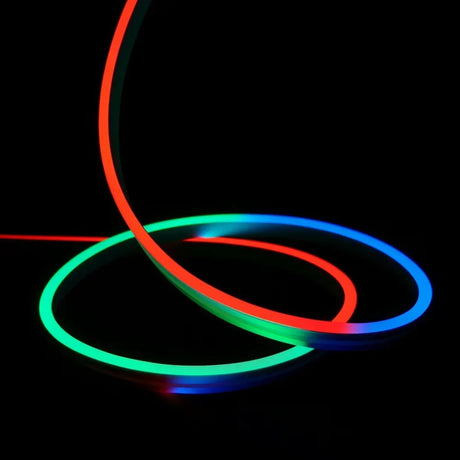
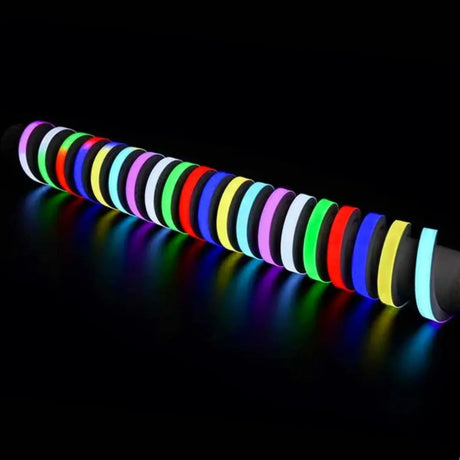
Digital pixel addressable RGB neon flex divides the continuous light line into individually controllable segments — each pixel or group of LEDs responds independently to colour and brightness commands, enabling flowing chase effects, colour gradients that travel along the run, animated patterns, and synchronised multi-zone displays that standard RGB neon flex cannot produce.
Standard RGB neon flex changes the entire length to one colour at a time. If you set it to blue, every centimetre is blue. Digital pixel neon flex breaks that single line into dozens or hundreds of addressable segments, each capable of displaying a different colour simultaneously. A 5-metre run might contain 150 individually controllable pixels — enough to create a smooth rainbow gradient, a colour chase that flows from one end to the other, or a pulsing wave of colour that responds to music.
The technology uses SPI (Serial Peripheral Interface) communication rather than standard PWM control. An SPI pixel controller sends data signals to each pixel in sequence, updating colour and brightness values hundreds of times per second for smooth, flicker-free animation. This is the same protocol used in professional stage lighting and architectural LED installations across entertainment venues, retail flagship stores, and building-scale media facades worldwide.
Where digital pixel RGB neon flex outperforms standard RGB:
-
Retail window displays: Create animated colour sequences that draw attention from the street — flowing gradients, pulsing accents, and synchronised brand-colour effects.
-
Entertainment venues: Bars, clubs, and event spaces use pixel-mapped neon flex for music-reactive colour effects and dynamic ceiling and wall features that change with the programme.
-
Architectural facades: Building outlines with individually addressable segments can display time-based colour schedules, seasonal themes, and coordinated lighting across multiple zones from a single controller.
-
Custom signage: Letters and logos with internal colour animation — each segment of a letter can display a different colour or run a chase effect independently.
UK LED Lights stocks digital pixel addressable RGB neon flex in 24V with IP65 and IP68 ratings. Browse the full range in our digital pixel RGB neon flex collection, or contact our technical team for specification advice on pixel density and controller requirements for your project.
Where does colour-changing neon flex work best — application by application?
RGB and RGBW neon flex suits any application where you need a smooth, continuous, colour-changing light line that is visible as the design feature — garden borders, building facades, signage, hospitality interiors, entertainment venues, and commercial displays. The silicone diffusion body eliminates visible LED dots, making it the preferred colour-changing product wherever the light source itself is on show.
Residential applications:
-
Garden perimeters and patio borders: IP67 RGB neon flex in 24V follows fence lines, raised bed edges, and patio perimeters. Mount using surface clips at ground level or recess into a channel along the border edge. Pair with a WiFi controller for colour schedules that change with the seasons — warm amber in autumn, cool blue in summer, festive red and green in December.
-
Driveways and pathways: Side-emitting RGB neon flex mounted along driveway edges provides both decorative colour and practical low-level guidance lighting. Set to white for daily use and colour for entertaining.
-
Home cinema and media rooms: RGBW neon flex behind the screen or around the ceiling perimeter provides immersive ambient colour that adjusts to the on-screen mood via app control, plus clean white for when the lights come up.
-
Outdoor entertaining areas: Hot tub surrounds, pergola outlines, and decking perimeters — IP67 minimum. The 2026 WiFi controllers let guests change colours from their own phones.
Commercial and architectural applications:
-
Building facade outlines: 48V RGB neon flex runs up to 30 metres from a single connection — ideal for outlining rooflines, window reveals, and architectural features on commercial buildings. UV-stable silicone withstands permanent outdoor exposure without yellowing or cracking over time.
-
Retail signage and window displays: Mini RGB neon flex with a 20mm bend radius creates custom lettering, logos, and brand shapes. The smooth neon-style glow attracts attention from a distance while appearing professional at close range.
-
Bars, restaurants, and hospitality: RGBW neon flex provides atmospheric colour for evening service and clean warm white for morning prep, cleaning, and maintenance — one installation serves both needs without compromise.
-
Event and exhibition spaces: Digital pixel addressable neon flex delivers animated colour effects for stage borders, booth outlines, and feature walls. Temporary installations use mounting clips without adhesive for quick setup and breakdown.
-
Gyms and leisure facilities: Colour zones using RGB neon flex define workout areas, highlight architectural features, and create energetic environments. IP67 rating withstands humidity in pool areas and wet zones.
How does RGB neon flex compare to RGB LED strip in a profile?
RGB neon flex produces a smooth, diffused, dot-free colour line from its integral silicone body — no profile or diffuser needed. RGB LED strip mounted inside an aluminium profile with a frosted diffuser achieves a similar dot-free effect but delivers higher lumen output per watt, better heat dissipation, and lower cost per metre. Choose neon flex when the product itself is visible as the design feature; choose strip-in-profile when the light source is concealed and maximum brightness matters.
| Characteristic |
RGB Neon Flex |
RGB LED Strip in Aluminium Profile |
| Dot visibility |
Zero — integral silicone diffuser |
Zero with frosted diffuser cover |
| Weatherproofing |
IP67/IP68 as standard — fully sealed silicone body |
Requires IP-rated strip + sealed profile + end caps |
| Lumen output per watt |
Lower — silicone absorbs approximately 15–20% of light |
Higher — aluminium conducts heat and less light is absorbed |
| Heat dissipation |
Moderate — silicone insulates |
Excellent — aluminium acts as heatsink |
| Bend flexibility |
Curves, letters, and organic shapes from 20mm radius |
Straight runs only unless using flexible profile |
| Installation weight |
Light — clips directly to most surfaces |
Heavier — profile adds aluminium weight and bulk |
| Cost per metre |
Higher (silicone extrusion manufacturing) |
Lower (strip + profile bought separately) |
| Best for |
Outdoor, signage, visible features, curves |
Indoor coves, under-cabinet, concealed channels |
For indoor concealed installations — cove lighting, under-cabinet runs, wardrobe interiors — RGB LED strip in an aluminium profile is the more efficient and cost-effective solution. For outdoor-exposed runs, curved features, signage, and any application where the light source is visible and needs to look clean without visible components, RGB neon flex is the professional choice.
Some projects use both. A restaurant might specify RGBW neon flex along the exterior window reveal and bar front (visible, decorative, weather-exposed) while using RGBW LED strip inside aluminium profiles for the ceiling cove and under-counter lighting (concealed, functional, higher output). Our technical team can specify the right product for each zone — get in touch for a free consultation.
How long does RGB neon flex last and what affects its lifespan?
Professional-grade RGB neon flex with UV-stable silicone construction has a rated lifespan of 30,000 to 50,000 hours — equivalent to 10 to 17 years of use at 8 hours per day. Actual installed lifespan depends on thermal management, driver quality, installation method, IP rating integrity, and environmental exposure. A properly installed, correctly powered, and adequately ventilated RGB neon flex installation will typically outlast the first driver replacement cycle.
Factors that extend lifespan:
-
Proper thermal management: Mount neon flex on surfaces that allow ambient airflow. Avoid recessing into sealed, unventilated cavities where heat accumulates. Heat is the primary enemy of LED lifespan — every 10C reduction in operating temperature can extend rated life by up to 25%.
-
Correct driver sizing: An under-sized driver running at full capacity generates excess heat and degrades faster. Size the driver at minimum 120% of the calculated total wattage load for reliable long-term operation.
-
UV-stable silicone material: Silicone resists UV degradation, maintains flexibility across the full temperature range, and does not yellow or crack. PVC alternatives typically show visible yellowing within 12–18 months of direct outdoor exposure in UK conditions.
-
Sealed end caps and waterproof connections: Every unsealed cut end or poorly sealed joint is an entry point for moisture. Once water reaches the internal copper tracks, corrosion begins within weeks — even on IP67-rated products if the cut end is left open.
Factors that reduce lifespan:
-
Running at full white on RGB: Full-white mode activates all three channels at maximum intensity simultaneously, drawing peak wattage and generating maximum heat. In colour modes, typical power draw is 40–60% of rated wattage — significantly reducing thermal stress.
-
Powering while coiled: A coiled reel of neon flex cannot dissipate heat. Running a coiled product even briefly causes localised overheating that permanently degrades the LEDs and weakens the silicone bond.
-
Mounting on uninsulated metal: Bare metal surfaces can short-circuit exposed PCB traces on the underside of the neon flex. Always mount on an insulated substrate or inside a purpose-designed mounting channel.
-
Voltage mismatch: Supplying 24V to a 12V neon flex product doubles the current and destroys the LEDs within seconds. Always verify driver voltage matches product voltage before powering on.
Why buy RGB neon flex from UK LED Lights?
UK LED Lights is a specialist LED lighting supplier based in Telford, Shropshire (Company No: 12301805), carrying 44 RGB and RGBW neon flex products across every voltage, IP rating, and control option available in the UK market in 2026. Every product ships from UK stock with free UK delivery, backed by a 3-year warranty for outdoor use and 5 years for indoor use, with direct access to our in-house technical team who specify the driver, controller, and wiring layout for your project.
-
Complete voltage range: 12V, 24V, 48V, and 220V/240V mains — we carry every voltage option so you can specify the right one for your run length, control requirements, and installation type rather than compromising with whatever a general retailer stocks.
-
RGB, RGBW, and digital pixel in one place: Standard colour-changing, dual-mode RGBW with clean white, and individually addressable pixel neon flex — all from the same supplier, with compatible controllers, drivers, and accessories.
-
UV-stable silicone as standard: Every outdoor-rated RGB neon flex in our 2026 range uses high-specification UV-stable silicone, not PVC. Your installation maintains colour accuracy and structural integrity across years of UK weather exposure.
-
Technical specification service: Tell us your project dimensions, application, and control requirements. Our technical team provides a complete specification: neon flex product, driver wattage, controller type, wiring layout, and accessory list — before you spend a penny. Call 01952 370008 or email sales@ukledlights.co.uk.
-
Free UK delivery on every order: No minimum order value. Delivered from UK stock to your door.
-
Warranty you can rely on: 3-year warranty on outdoor-rated products, 5 years on indoor products. If there is a manufacturing defect, we replace it.
-
RGB neon flex has become the standard for commercial signage and architectural facades — we supply colour-changing neon to sign makers and fit-out contractors.
-
We test every RGB neon flex unit for colour consistency across the full length — no colour shift between the first and last metre.
Browse our full RGB neon flex collection to find the right product for your project, or call 01952 370008 (Monday to Friday, 9am–5pm) for free technical advice from our Telford team. Need drivers, controllers, or mounting accessories? Browse LED drivers, WiFi LED controllers, and neon flex accessories.
How does RGB neon flex compare to RGB LED strip in a profile?
RGB neon flex and RGB strip in an aluminium profile both deliver colour-changing light, but the visual effect, weatherproofing, and flexibility differ significantly.
| Feature |
RGB Neon Flex |
RGB Strip in Profile |
| Appearance |
Bold neon-tube colour glow |
Slim architectural colour line |
| Curve capability |
Bends to 20mm radius (mini) |
Rigid — straight runs only |
| Weatherproofing |
IP67/IP68 built in |
Requires sealed profile and IP-rated strip |
| Colour blending |
Excellent — silicone diffuses RGB channels smoothly |
Good with milky diffuser, moderate with clear |
| Lumen output |
Lower — silicone absorbs 20-35% |
Higher — clear diffuser preserves 95% |
| Best for |
Signage, garden borders, facades, decorative curves |
Indoor coves, shelving, display cabinets |
Choose RGB neon flex for outdoor, curved, and bold decorative applications. Choose RGB strip in a profile for indoor, straight, high-output colour installations. Contact 01952 370008 for project-specific advice.
What are the most common questions about RGB LED neon flex?
Can RGB neon flex be cut to custom lengths on site?
- Yes — RGB neon flex can be cut at designated cut marks, typically at 50mm, 100mm, or 125mm intervals depending on the product. Cut only at the marked points using a sharp blade for a clean, straight cut. Every cut end must be sealed with a silicone end cap and waterproof adhesive before outdoor use to maintain the IP rating.
Does RGB neon flex work in cold UK winter conditions?
- UV-stable silicone neon flex operates from -30C to +60C without loss of flexibility or light output. Our IP67-rated products withstand frost, snow, sub-zero temperatures, and freeze-thaw cycling throughout UK winters. PVC-based neon flex becomes brittle in freezing conditions and is not recommended for permanent UK outdoor installations.
How much power does RGB neon flex use per metre?
- RGB neon flex typically draws 10–18W per metre at full output, depending on LED density and voltage. In normal colour modes, actual power draw is 40–60% of rated wattage — full white mode draws the most power because all three colour channels operate at maximum intensity simultaneously. RGBW variants draw 12–18W/m.
Can you join multiple lengths of RGB neon flex together?
- Yes — use the manufacturer-matched joiners and waterproof connectors from our neon flex accessories range. Every joint must be sealed with waterproof adhesive for outdoor installations. Do not exceed the maximum run length for your voltage — exceeding it causes voltage drop and visible colour inconsistency at the far end.
Is RGB neon flex safe to install in a bathroom?
- IP67-rated RGB neon flex is suitable for most bathroom zones under BS7671 wiring regulations. IP65 is not sufficient for bathroom wet zones — it handles surface splashes only. Always use a low-voltage DC system (12V or 24V) supplied from an isolated driver located outside the bathroom zones. Consult a qualified electrician for zone classification and compliance in your specific bathroom layout.
What is the minimum bend radius for RGB neon flex?
- Standard RGB neon flex profiles have a minimum bend radius of approximately 50–80mm. Mini neon flex profiles (6x12mm) bend to approximately 20mm radius — suitable for signage lettering and tight decorative curves. Forcing tighter bends than the rated minimum cracks the internal PCB and creates dead segments that cannot be repaired.
Can RGB neon flex be used for permanent outdoor signage?
- Yes — mini RGB neon flex in IP67 is the standard product for outdoor illuminated signage, lettering, and logo work in 2026. The tight bend radius follows letterforms, the silicone body provides a smooth neon-style glow, and the UV-stable construction maintains colour and clarity across years of outdoor exposure. 48V is preferred for large signage to minimise voltage drop across long character outlines.
Do I need an electrician to install RGB neon flex?
- Low-voltage DC neon flex (12V, 24V, 48V) does not require a qualified electrician for the neon flex itself, but the driver must be connected to the mains supply by a qualified person in accordance with Part P of the Building Regulations. Mains-voltage 220V/240V neon flex with a UK plug is plug-and-play and does not require professional electrical installation.
Why does my RGB neon flex flicker when dimmed?
- Flickering on RGB neon flex is almost always caused by using a dimmable driver instead of a non-dimmable constant-voltage driver with a separate controller. RGB neon flex must be powered by a non-dimmable driver — the RGB controller handles all dimming and colour mixing. A trailing-edge dimmer or dimmable driver conflicts with the controller's PWM signal and causes visible flicker on all channels. Replacing a dimmable driver with a non-dimmable equivalent typically costs under £25 and resolves the issue immediately.
Can I run RGB neon flex outdoors all year round in the UK?
- Yes — IP67-rated RGB neon flex with UV-stable silicone construction is designed for permanent, year-round outdoor use in UK conditions. It withstands rainfall, frost, snow, UV exposure, temperature cycling from -30C to +60C, and ground-level moisture. Seal every cut end and connection point with waterproof end caps, and use an IP65-rated driver enclosure or mount the driver indoors.
What is the difference between RF remote and WiFi RGB controllers?
- RF (radio frequency) controllers use a handheld remote that communicates directly with the controller — no network required, and the signal passes through walls within approximately 20 metres. WiFi controllers connect to your home network, enabling smartphone app control from anywhere, voice control through Alexa and Google Home, scheduling, scenes, and multi-zone grouping. WiFi is the more capable option for 2026 smart-home installations; RF is simpler and more reliable in areas with poor WiFi coverage.
How do I prevent colour inconsistency along a long run of RGB neon flex?
- Colour inconsistency (where one end appears brighter or a different shade from the other) is caused by voltage drop over distance. The solution is parallel wiring: run power cables from the driver to multiple injection points along the neon flex rather than feeding from one end only. On 24V, inject power every 5–7 metres. On 48V, the drop rate is halved, allowing injection every 10–15 metres. Wire in parallel — never in series — for consistent colour across the full length.
Does RGB neon flex produce enough light for pathway safety lighting?
- RGB neon flex produces a decorative glow suitable for low-level guidance and accent lighting along pathways, borders, and step edges. It is not a replacement for dedicated pathway bollards or area floodlights where minimum lux levels are required for safety compliance. Use RGBW neon flex set to white mode for better visibility, or combine RGB neon flex with separate decking and pathway lights for both decorative colour and functional safety illumination.
Can mains 220V/240V RGB neon flex be hardwired permanently?
- 220V/240V AC mains neon flex should not be permanently hardwired in most residential applications. It is designed for plug-and-play use with the included UK plug. For permanent hardwired colour-changing installations, specify low-voltage DC neon flex (24V or 48V) powered from a permanently wired driver connected to the mains supply by a qualified electrician.
What is the difference between RGB and RGBW neon flex?
- RGB neon flex contains red, green, and blue LEDs only — it produces millions of colour combinations but cannot generate clean white light. RGBW adds a dedicated white LED channel that delivers accurate warm or natural white independently. Choose RGBW for any installation where you need both colour effects and usable everyday white illumination from a single product.
How much does RGB neon flex cost to run per month?
- Running costs depend on wattage per metre and daily usage. A typical 10-metre garden border at 14W/m in colour mode draws approximately 60–80W actual load (colours use 40–60 percent of rated wattage). At 2026 UK electricity rates of approximately 24.5p per kWh, running that installation for 5 hours per evening costs roughly £2.50 to £3.50 per month.
Can I control RGB neon flex with Alexa or Google Home in 2026?
- Yes — pair low-voltage RGB or RGBW neon flex with a WiFi-enabled controller. Once connected to your 2.4GHz home network, the controller appears in the Alexa or Google Home app for voice-controlled colour changes, dimming, scenes, and scheduling. Mains-voltage 220V/240V RGB neon flex does not support smart home integration — it uses RF remote control only.
Does UK LED Lights offer trade pricing on RGB neon flex?
- Yes — electricians, sign makers, installers, and lighting designers can apply for trade accounts with volume pricing across our full RGB and RGBW neon flex range, drivers, controllers, and accessories. Email sales@ukledlights.co.uk with your company details or call 01952 370008 to set up a trade account.
What warranty covers RGB neon flex from UK LED Lights?
- Outdoor-rated RGB neon flex carries a 3-year warranty and indoor-rated products carry a 5-year warranty. Warranty covers manufacturing defects and premature LED failure under normal operating conditions. Damage from incorrect drivers, voltage mismatch, coiled operation, or unsealed cut ends is not covered. Contact 01952 370008 for warranty claims — replacements are dispatched from our Telford warehouse.
Can RGB neon flex be used for swimming pool or hot tub lighting?
- IP68-rated RGB neon flex can be installed around pool and hot tub perimeters above the waterline. For any installation at or below the waterline, a dedicated IP68 submersible product rated for continuous immersion is required — standard IP67 neon flex is not suitable. All pool-zone electrical installations must comply with BS7671 zone requirements and be carried out by a qualified electrician.
Why UK LED Lights for your RGB neon flex project
UK LED Lights is a dedicated LED lighting specialist based in Telford, Shropshire — not a general electrical wholesaler, not a marketplace reseller. Every RGB and RGBW neon flex product in our 2026 collection is tested, stocked in the UK, and backed by our technical team who specify the complete system for your project: neon flex, driver, controller, mounting accessories, and wiring layout. Free UK delivery on every order, 3-year outdoor warranty, and direct phone support on 01952 370008 Monday to Friday, 9am–5pm.
Browse the full RGB neon flex collection · All LED neon flex · WiFi LED controllers · LED drivers · Neon flex accessories · Digital pixel neon flex
Last reviewed: March 2026 — UK LED Lights technical team, Telford, Shropshire. Specifications current as of 2026.
🏭 UK LED specialist, Telford, Shropshire · ☎️ 01952 370008 · 🚚 Free UK delivery