Colour on demand — from a single warm glow to sixteen million shades at the tap of a screen. UK LED Lights stocks the full RGB LED strip range for 2026: RGB COB, SMD 5050 RGB, RGBW with dedicated white channel, RGBCCT with tuneable white from 2700K to 6500K, and 220V mains-powered RGB with UK plug. Every strip ships from our Telford warehouse with free UK delivery, and our technical team specifies the right controller, driver, and profile for your project — not just the strip.
Our RGB LED strip lights collection covers 24V COB RGB in 8mm and 10mm widths, RGBW and RGBCCT variants with clean white output, and 12V/24V SMD 5050 RGB for budget-friendly colour runs. Available in IP20 for dry interiors, IP67 for permanent outdoor use, and IP68 for full submersion. Need a bespoke length or help choosing between COB and SMD? Call 01952 370008 or email sales@ukledlights.co.uk.
RGB COB · SMD 5050 RGB · RGBW · RGBWW 3000K · RGBW+NW 4000K · RGBCCT 2700K–6500K · 12V · 24V · 220V Mains · IP20 · IP67 · IP68 · 8mm–12mm widths · WiFi & voice control · Bespoke lengths · Free UK delivery
Quick decision guide:
-
Bedroom or living room mood lighting only — no white needed: RGB COB 24V in IP20. Pair with a WiFi controller for Alexa or Google Home voice control. Smooth dot-free colour output.
-
Room that needs both colour effects and everyday white light: RGBW 24V strip with dedicated warm white 3000K or natural white 4000K channel. One strip does both jobs without compromise.
-
Maximum flexibility — colour plus tuneable white: RGBCCT 24V strip. Full RGB spectrum plus adjustable white from 2700K warm to 6500K cool. Morning cool white, evening warm amber, party colours at the weekend.
-
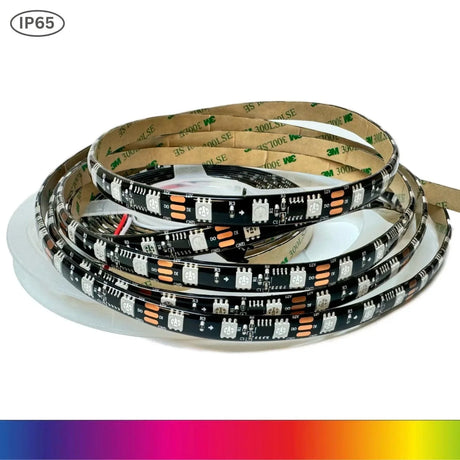
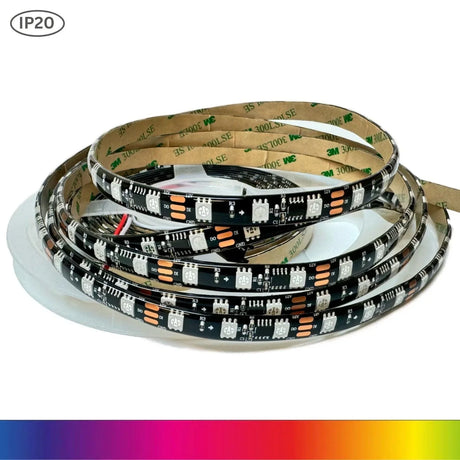
Budget colour wash for a garage, workshop, or teen bedroom: SMD 5050 RGB in 12V or 24V. Lower cost per metre than COB, widely available, does the job where dot visibility does not matter.
-
Outdoor garden or patio colour feature: RGB COB 24V in IP67 minimum. Max 10-metre continuous run. Pair with an outdoor-rated driver in an IP65 enclosure.
-
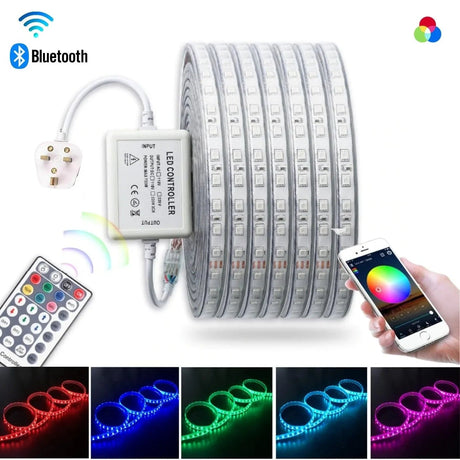
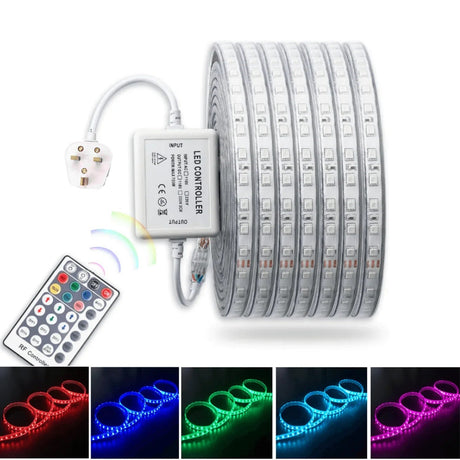
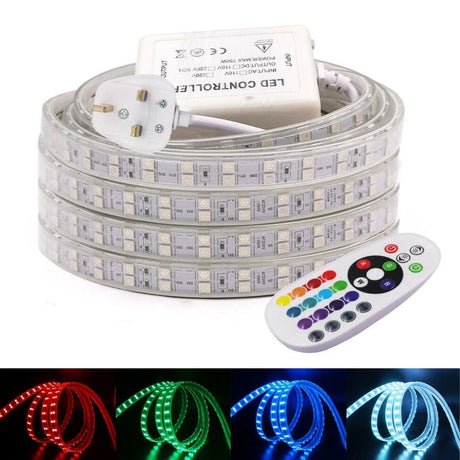
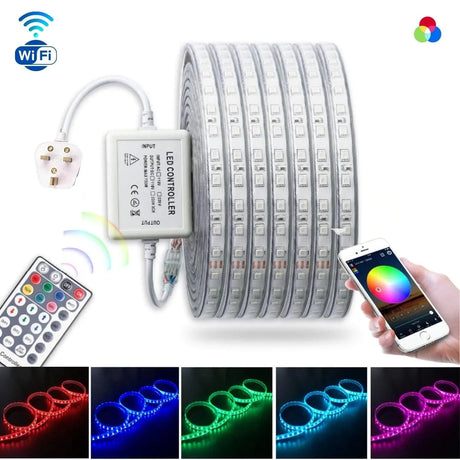
Quick plug-and-play colour strip — no electrician: 220V mains RGB strip with UK plug. Plug in, switch on, control with the included remote. Runs up to 50 metres from a single plug.
Who RGB LED strip lights are for: Homeowners adding mood or accent lighting to living rooms, bedrooms, home cinemas, and kitchens. Interior designers specifying colour-changing feature lighting for hospitality and retail projects. Electricians and installers looking for reliable 24V RGB strip with proper controller and driver compatibility. Commercial fit-out teams lighting bars, restaurants, event spaces, and retail displays where colour sets the atmosphere.
Who RGB LED strip lights are NOT for: If you only need fixed white light — warm, natural, or cool — a single colour COB LED strip is more efficient, thinner, cheaper, and produces higher lumen output per watt. Do not buy RGB strip expecting clean white illumination — RGB alone produces a cold violet-tinged approximation that looks unnatural for everyday use. You need RGBW or RGBCCT for usable white alongside colour.
Common buying mistakes to avoid:
-
Buying RGB and expecting clean white light: This is the single most common mistake we see. RGB strip blends red, green, and blue LEDs to approximate white, but the result has a visible violet-cold tinge that looks wrong next to any true white light source. If you need white light from the same strip, choose RGBW or RGBCCT — both include a dedicated white LED channel that produces accurate, natural-looking white independently of the colour channels.
-
Using a dimmable driver with RGB strip: RGB and RGBW strip must be powered by a non-dimmable constant-voltage driver paired with a separate dedicated RGB controller. A dimmable driver interferes with the controller signal, causing visible flicker, erratic colour behaviour, and premature component failure. This applies to every RGB variant — COB and SMD alike.
-
Choosing IP65 for permanent outdoor installations: IP65 handles surface splashes — equivalent to a garden hose spray. It does not withstand sustained UK rainfall, frost-thaw cycling, or ground-level damp. IP67 is the minimum for any colour-changing strip exposed to the elements year-round.
-
Running RGB strip while still on the reel: Heat builds up in coiled strip with no airflow. The adhesive softens, LEDs overheat, and you risk permanent damage. Always uncoil, mount on a surface or inside a profile, and only then power on.
-
Mounting strip directly on bare uninsulated metal: The PCB underside has exposed copper traces. Direct contact with conductive surfaces — steel brackets, metal ducting, aluminium frames — can short-circuit the strip. Always mount inside an aluminium profile or on an insulated substrate.
- What is the difference between RGB COB and SMD 5050 RGB strip?
- Why can RGB strip not produce clean white light?
- Which RGB strip type should you choose — RGB, RGBW, or RGBCCT?
- What voltage and maximum run length do RGB LED strips support?
- Which IP rating do you need for RGB strip — IP20, IP67, or IP68?
- What driver and controller does RGB LED strip require?
- Which WiFi controllers work with RGB strip for smart home control?
- How do you install RGB LED strip lights correctly?
- When should you choose 220V mains RGB strip instead of 24V?
- Why buy RGB LED strip lights from UK LED Lights?
What is the difference between RGB COB and SMD 5050 RGB strip?
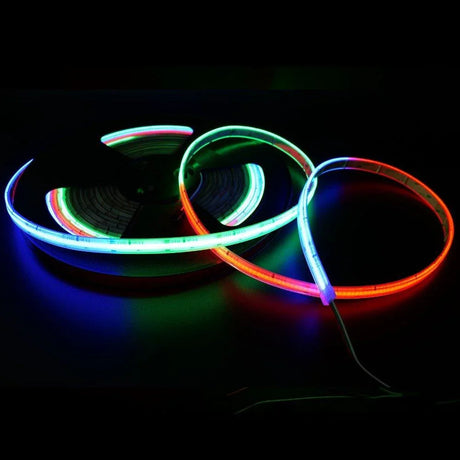
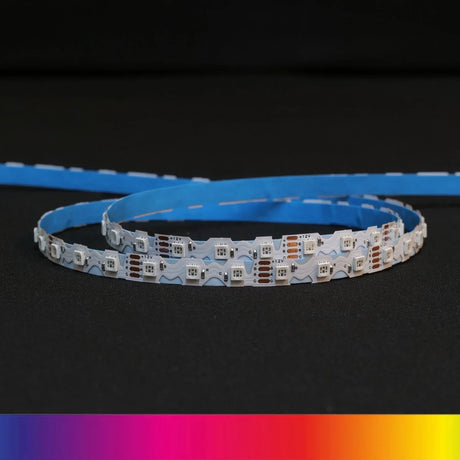
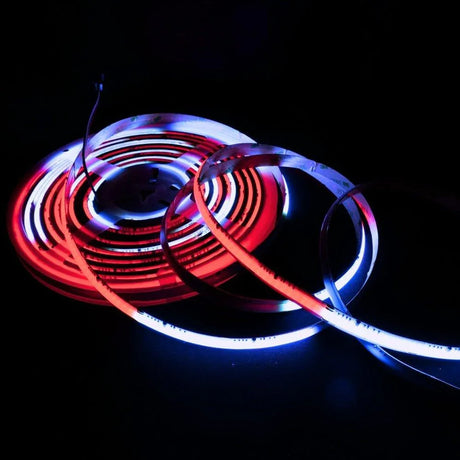
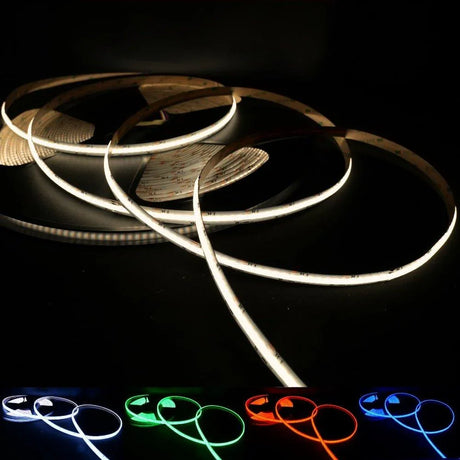
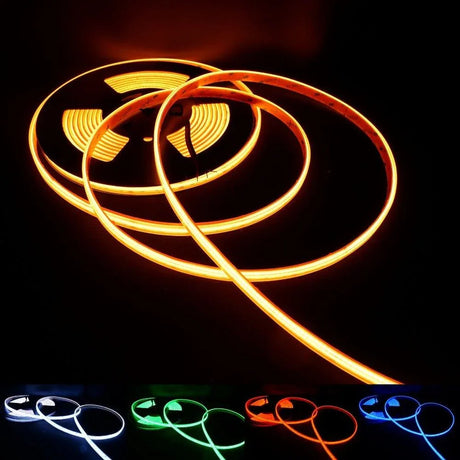
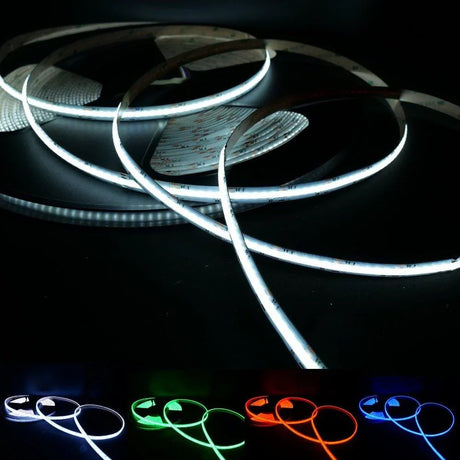
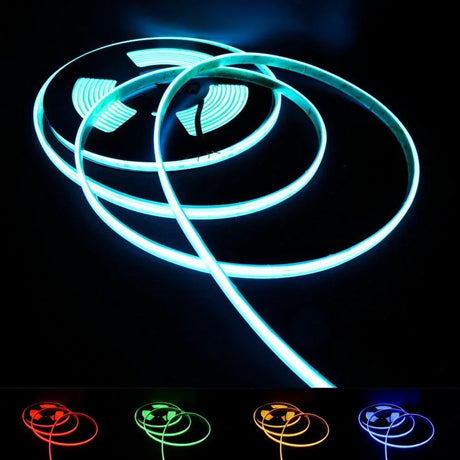
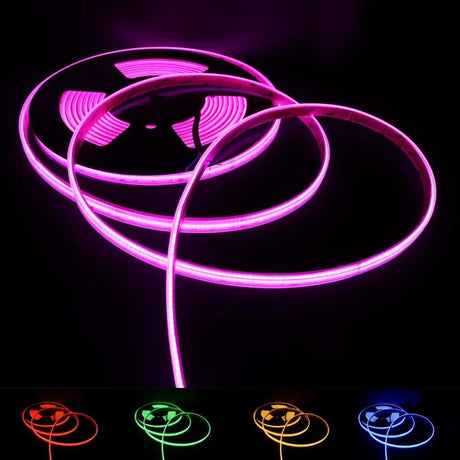
RGB COB strip places hundreds of micro LED chips directly onto the flexible circuit board in a continuous line, producing smooth, dot-free colour output across the entire length. SMD 5050 RGB strip mounts individual 5050-size LED packages at fixed intervals, creating a repeating pattern of visible colour dots separated by darker gaps. COB costs more per metre but delivers a visibly superior result — particularly inside aluminium profiles and on reflective surfaces.
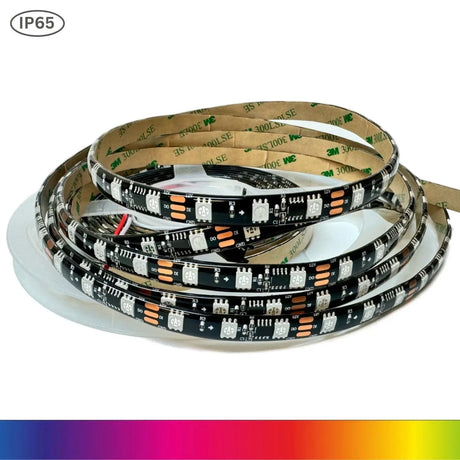
The technical difference shapes how each strip performs in real installations. COB RGB produces colour that blends smoothly across the full length of the strip — when you set it to blue, you see a continuous ribbon of blue light with no variation in intensity from one point to the next. SMD 5050 RGB shows individual points of blue light with visible dark spaces between them. At distances over 3 metres, or behind a heavily frosted diffuser, the dots become less noticeable. At close range — under a shelf, inside a display cabinet, reflected in a worktop — the dot pattern is impossible to miss.
UK LED Lights stocks RGB COB strip in both 8mm and 10mm widths on 24V, making it compatible with the majority of standard aluminium LED profiles. Our SMD 5050 RGB range is available in both 12V and 24V with a wider selection of lengths and IP ratings for projects where budget matters more than dot-free appearance.
| Feature |
RGB COB Strip (24V) |
SMD 5050 RGB Strip (12V/24V) |
| Light output pattern |
Continuous, dot-free colour ribbon |
Visible individual colour dots with gaps |
| Available widths |
8mm and 10mm |
10mm and 12mm |
| Voltage options |
24V |
12V and 24V |
| Beam angle |
180 degrees |
120 degrees |
| Appearance in profiles |
Uniform colour glow through diffuser |
Dot pattern visible through diffuser |
| Reflective surface result |
Clean single colour line |
Dotted colour reflection |
| Flexibility |
Higher — thinner substrate |
Moderate — larger chip packages |
| Cost per metre |
Higher |
Lower — best budget option |
| Best application |
Profiles, kitchens, living rooms, retail displays |
Garages, workshops, hidden runs, budget installs |
| Max continuous run (24V) |
10 metres |
10 metres (24V) / 5 metres (12V) |
One angle that most suppliers skip entirely: COB RGB also produces noticeably better colour mixing at close range. Because the red, green, and blue chips are packed so densely, the colours blend on the strip surface itself rather than relying on distance or a diffuser to merge them. SMD 5050 RGB at close range can show distinct red, green, and blue dots rather than a unified mixed colour — particularly visible when producing secondary colours like cyan, magenta, or amber. This matters in 2026 installations where strip is mounted inside slim profiles at eye level — behind bathroom mirrors, under floating shelves, or inside display cabinets.
Why can RGB strip not produce clean white light?
RGB strip creates white by blending red, green, and blue LEDs at equal intensity, but the combined output has a visible cold violet tinge that looks artificial next to any true white light source. This happens because the colour spectrum of blended RGB light has gaps — it lacks the broad, continuous wavelength spread that a dedicated phosphor-coated white LED chip produces. For usable white light alongside colour effects, choose RGBW or RGBCCT strip with a separate white channel.
This is not a quality issue or a sign of cheap strip — it is a fundamental limitation of how additive colour mixing works with LEDs. Even the highest-specification RGB strip from any manufacturer produces the same violet-cold white. The red, green, and blue phosphors each emit a narrow wavelength band. Mixing them at full power creates what is technically called "tri-stimulus white" — three narrow spikes on the spectrum rather than the smooth curve your eye expects from natural or incandescent white light.
The practical impact is immediate and obvious:
-
Kitchen task lighting: RGB "white" makes food look grey and unappetising. Skin tones appear pale and unhealthy. A dedicated warm white 3000K channel renders colours accurately — crucial over worktops and dining tables.
-
Bathroom mirror lighting: Makeup application, shaving, and grooming require accurate colour rendering. RGB white distorts reds and warm tones. Natural white 4000K from an RGBW strip solves this.
-
Living room ambient lighting: If the strip sits alongside lamps, ceiling lights, or candles that produce warm white, the RGB "white" clashes visibly. It reads as a different colour temperature entirely — cold and sterile against the warmth of the room.
-
Retail and hospitality: Product displays, restaurant table lighting, and hotel room features all require faithful colour rendering. RGB white scores poorly on the CRI scale — typically below 30 in white mode. RGBW and RGBCCT strips score CRI 80+ on the dedicated white channel.
The solution is simple: if you want colour effects and white light from the same strip, choose a strip with a dedicated white channel. RGBW adds one fixed white temperature. RGBCCT adds a tuneable white that adjusts from 2700K to 6500K. Both produce clean, accurate white light that works alongside every other light source in the room. Browse our RGB COB LED strip range to see RGBW and RGBCCT options, or call 01952 370008 for advice on which type suits your project.
Which RGB strip type should you choose — RGB, RGBW, or RGBCCT?
Choose plain RGB if the strip will only ever be used for colour effects and never needs to produce white light. Choose RGBW if you need colour effects plus one fixed white temperature — either warm 3000K or natural 4000K. Choose RGBCCT if you want colour effects plus tuneable white that adjusts from 2700K warm to 6500K cool throughout the day. RGBCCT is the most versatile option in the 2026 range and suits any room where lighting needs change between morning and evening.
The decision comes down to one question: will this strip ever need to produce white light? If the answer is no — a home cinema backlight, a gaming setup colour wash, a DJ booth effect — plain RGB is sufficient and the most cost-effective. If the answer is yes, even occasionally, spend the extra on RGBW or RGBCCT and avoid the disappointment of violet-tinged RGB "white" described above.
| Feature |
RGB |
RGBW |
RGBCCT |
| Colour channels |
3 (Red, Green, Blue) |
4 (RGB + White) |
5 (RGB + Warm White + Cool White) |
| White light quality |
Violet-tinged, unusable for task lighting |
Clean, accurate, single temperature |
Clean, accurate, tuneable 2700K–6500K |
| White options |
None (blended only) |
Warm 3000K or Natural 4000K (fixed) |
Adjustable from 2700K to 6500K |
| Controller required |
3-channel RGB |
4-channel RGBW |
5-channel RGBCCT |
| Strip width (typical IP20) |
8–10mm |
12mm |
12mm |
| Cost per metre |
Lowest |
Mid-range |
Highest |
| Best application |
Colour-only: cinema, gaming, decorative |
Colour + fixed white: bedrooms, kitchens |
Colour + tuneable white: any room, commercial |
| Max continuous run (24V) |
10 metres |
10 metres |
10 metres |
A practical example from a 2026 residential project: a homeowner wanted colour-changing accent lighting behind a bedroom headboard. They initially ordered plain RGB. The colour effects looked great — but every time they switched to "white" for reading, the light had a distinctly cold, bluish cast that clashed with the warm-toned bedside lamps. They switched to RGBW with warm white 3000K. Now they have full colour effects for evening relaxation and clean warm white for reading — controlled from one WiFi app. The additional cost of RGBW over plain RGB was under ten pounds per metre.
For rooms where lighting needs shift throughout the day — home offices that double as living spaces, open-plan kitchen-diners, or commercial spaces that host different events — RGBCCT is the most future-proof choice. Cool white 5000K–6500K for morning focus, natural white 4000K for daytime tasks, warm white 2700K–3000K for evening relaxation, and full RGB for events or mood lighting. One strip, one controller, one installation. Call 01952 370008 if you need help deciding which variant suits your specific room.
What voltage and maximum run length do RGB LED strips support?
All RGB COB, RGBW, and RGBCCT strips in the UK LED Lights 2026 range operate on 24V DC with a maximum continuous run of 10 metres from a single power point without visible voltage drop. SMD 5050 RGB is available in both 12V (5-metre max run) and 24V (10-metre max run). 220V mains RGB strip runs up to 50 metres from a single UK plug connection. Always match the driver voltage exactly to the strip voltage — mismatched voltage will damage the strip or driver.
The 10-metre limit on 24V RGB strip is shorter than single colour COB strip (which supports up to 20 metres on 24V) because colour-changing strip draws more current per metre. Each colour channel carries its own current, and when all three channels are active at full brightness — producing white or light pastel colours — the total draw is significantly higher than a single colour equivalent. Higher current means faster voltage drop over distance.
If your project requires more than 10 metres of RGB strip:
-
Split into sections wired in parallel: Run two or more 10-metre (or shorter) sections from the same driver, each with its own pair of power cables back to the driver output. This keeps each section within its voltage drop limit. Wire in parallel — never in series, which multiplies drop across every connection.
-
Use a signal amplifier: For colour-changing strip, a signal amplifier repeats the controller signal to additional strip sections beyond the first 10 metres. This helps ensure consistent colour across all sections. Without an amplifier, distant sections may show different colours or brightness levels than the first section.
-
Consider 220V mains RGB strip: For very long exterior runs — garden perimeters, commercial building outlines, event lighting — 220V mains RGB strip runs up to 50 metres from a single plug. No driver required. Trade-off: thicker strip, fewer colour options, and the strip operates at mains voltage rather than safety-rated low voltage.
For planning runs longer than 10 metres, our technical team can specify the exact driver size, cable gauge, amplifier placement, and wiring layout. Email sales@ukledlights.co.uk with your room dimensions and strip type, and we will provide a wiring plan.
Which IP rating do you need for RGB strip — IP20, IP67, or IP68?
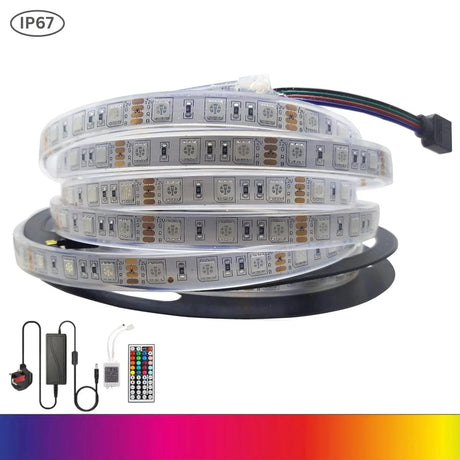
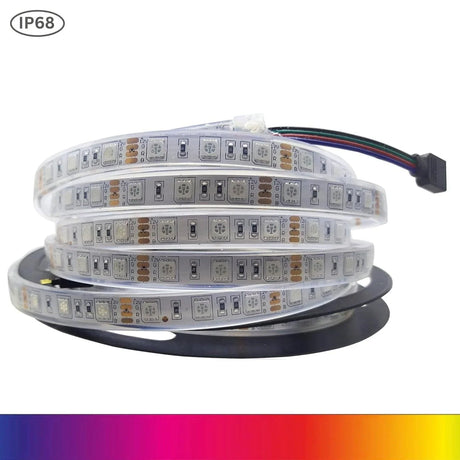
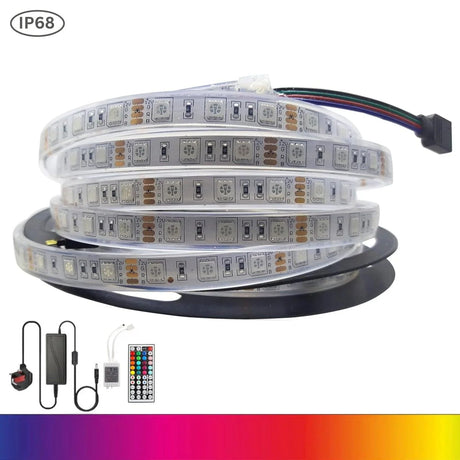
IP20 for dry interior locations — bedrooms, living rooms, kitchens inside profiles, home cinemas, offices. IP67 for permanent outdoor use — garden borders, patio features, decking, and bathroom wet zones. IP68 for continuous submersion — ponds, fountains, and water features. Do not use IP65 for permanent outdoor RGB strip installations in UK weather — it covers surface splashes only and fails under sustained rainfall, frost-thaw cycling, and ground-level damp.
RGB strip follows exactly the same IP rating logic as single colour strip. The colour-changing electronics add no additional water resistance — the IP rating depends entirely on the physical encapsulation of the strip. Key considerations specific to RGB installations:
-
IP20 RGB strip inside aluminium profiles: The most common residential setup. The profile provides heatsinking and physical protection. IP20 is the thinnest, most flexible option and typically produces the brightest output because there is no silicone sleeve absorbing light. Use this for every dry interior application.
-
IP67 RGB strip for outdoor colour features: Garden border colour washes, patio perimeter mood lighting, and architectural colour features on exterior walls. The silicone sleeve seals against sustained rain and frost. Mount inside an outdoor-rated profile with sealed end caps for maximum longevity. IP67 RGB COB from UK LED Lights handles the full UK climate — tested through autumn rain, winter frost, and summer UV exposure.
-
IP67 RGB strip for bathrooms: Zone 1 (above bath/shower to 2.25m) and Zone 2 (0.6m beyond Zone 1) require IP67 minimum under BS7671. Colour-changing bathroom lighting is increasingly popular in 2026 — warm pink for relaxation, cool blue for a wake-up shower, white for grooming.
-
IP68 RGB strip for water features: Fully encapsulated for continuous submersion. Pond edge colour-changing effects, fountain illumination, and swimming pool perimeter lighting. The full silicone encapsulation adds width (approximately 15mm) — check profile compatibility before ordering.
Not sure which IP rating your project needs? Call our technical team on 01952 370008 with the installation location and we will confirm the correct specification under current BS7671 guidance.
What driver and controller does RGB LED strip require?
Every RGB, RGBW, and RGBCCT strip requires two components: a non-dimmable constant-voltage LED driver sized to at least 120 percent of the total strip wattage, plus a separate dedicated RGB controller that handles colour mixing, dimming, and effects. Never use a dimmable driver with RGB strip — dimmable drivers interfere with the controller signal, causing visible flicker, erratic colour behaviour, and shortened component life.
This two-component setup is the most frequently misunderstood aspect of RGB strip installation. A standard single colour strip can dim through the driver alone. RGB strip cannot — the driver supplies steady DC power, and the controller modulates that power across the red, green, and blue channels independently to create different colours and effects. If the driver itself is varying its output (as a dimmable driver does when connected to a wall dimmer), the controller receives an unstable power supply and colour output becomes unpredictable.
Step-by-step driver and controller selection for a typical 2026 RGB project:
-
Calculate total wattage: Multiply strip wattage per metre by total run length. Example: 8 metres of RGB COB at 14W/m = 112W.
-
Add 20 percent headroom: 112W plus 20 percent = 134.4W minimum driver rating.
-
Choose driver: Select a non-dimmable constant-voltage 24V LED driver rated at 150W or above. Budget approximately 25 to 45 pounds for a quality unit at this wattage.
-
Match controller to strip type: 3-channel controller for RGB. 4-channel for RGBW. 5-channel for RGBCCT. Verify the controller current rating per channel matches or exceeds your strip requirements.
-
Wire: mains to driver, driver to controller, controller to strip. The controller sits between the driver and the strip — it receives steady 24V from the driver and distributes it across the colour channels according to your selected colour or effect.
Driver sizing matters more with RGB strip than single colour because peak current draw is higher. When all three colour channels (or all five on RGBCCT) are running at full brightness simultaneously, the strip draws its maximum rated wattage. An undersized driver will overheat, activate thermal protection, and shut down — cycling on and off repeatedly until either the driver fails or you reduce the load. Always size to 120 percent minimum, and consider 150 percent for commercial installations that run at full output for extended hours.
Browse our full LED controller range and LED driver range, or call 01952 370008 for help matching the right components to your strip.
Which WiFi controllers work with RGB strip for smart home control?
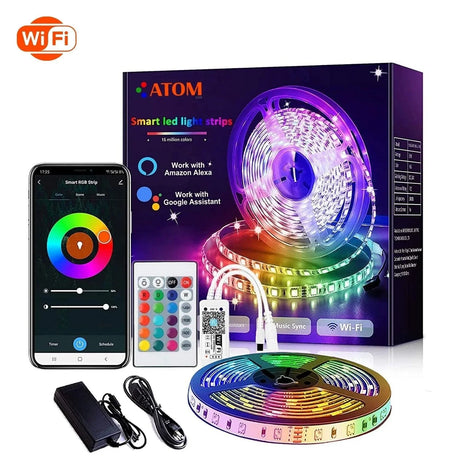
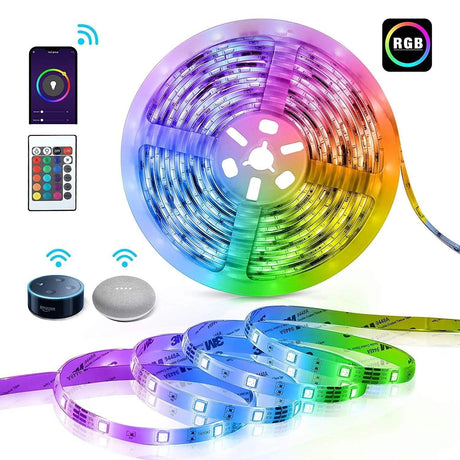
UK LED Lights stocks WiFi-enabled RGB controllers from Miboxer, Skydance, and GLEDOPTO — all three integrate with Alexa, Google Home, and Tuya Smart for voice control, app scheduling, and scene presets. GLEDOPTO controllers additionally support Zigbee for Apple HomeKit integration via a compatible hub. Most WiFi controllers connect directly to your 2.4GHz home network without a separate hub — setup takes under five minutes from unboxing to voice control.
Smart home integration is the fastest-growing driver of RGB strip sales in the UK in 2026. The ability to set colours, schedule scenes, and dim from a phone or voice command has moved colour-changing strip from a niche hobbyist product to a mainstream home lighting choice. Here is how the three controller brands compare:
-
Miboxer controllers: WiFi and 2.4GHz RF remote. Compatible with Alexa, Google Home, and Tuya Smart app. Available in 3-channel (RGB), 4-channel (RGBW), and 5-channel (RGBCCT) variants. Strongest range of physical wall-mount panel remotes — useful in bedrooms and living rooms where a wall switch is more practical than reaching for a phone. Popular in 2026 residential projects.
-
Skydance controllers: WiFi, RF remote, and DMX for commercial installations. 5-in-1 models handle RGB, RGBW, RGBCCT, single colour dimming, and CCT tuning from one unit — reducing stock requirements for electricians who install different strip types across multiple projects. Professional-grade build quality. The preferred choice for trade installers and commercial fit-outs.
-
GLEDOPTO controllers: Zigbee protocol with WiFi bridge option. Native Apple HomeKit support via a Zigbee hub (Philips Hue bridge, IKEA DIRIGERA, or similar). The only RGB strip controller option in our range that works natively within the Apple ecosystem. Also compatible with Alexa and Google Home through the Zigbee hub. Requires a hub — not standalone WiFi.
All three brands support group control — link multiple controllers across different rooms and change them all with one command. Set a "movie night" scene that dims the living room strip to deep blue, turns the kitchen strip to warm white at 20 percent, and switches the hallway to soft amber. Schedule changes to run automatically — cool white at 7am for the morning routine, warm white at 7pm for evening, colour cycle for a Friday evening gathering.
If you already use a specific smart home platform, start with the controller that integrates natively. Not sure which suits your setup? Email sales@ukledlights.co.uk with your smart home platform and strip type and we will recommend the right controller.
How do you install RGB LED strip lights correctly?
Clean the mounting surface with isopropyl alcohol, mount the strip inside an aluminium profile for heatsinking, peel the 3M adhesive backing in short sections, press firmly for ten seconds per section, wire the non-dimmable driver to the RGB controller then to the strip, and test all colour channels before making connections permanent. Never power RGB strip while coiled — heat damage is immediate. Never mount directly on bare metal without insulation — exposed copper traces can short-circuit.
Follow these steps for a professional-quality colour-changing strip installation in 2026:
-
Choose your driver and controller before starting: Calculate total strip wattage (W/m multiplied by total length) and add 20 percent. Select a non-dimmable 24V constant-voltage driver at or above this figure. Match the controller to your strip type — 3-channel for RGB, 4-channel for RGBW, 5-channel for RGBCCT. Have all components on the bench before you start mounting strip on the wall.
-
Plan the layout and locate the driver: Position the driver within 2 metres of the strip start point to minimise cable voltage drop. For runs over 5 metres, plan parallel wiring with separate cable runs back to the controller output. Identify your power source — a fused spur or unswitched socket for the driver mains input. Mark strip start points, cut points, and cable routes on the wall or profile before removing any adhesive backing.
-
Prepare the mounting surface: Wipe the entire profile channel or mounting surface with isopropyl alcohol. Remove all dust, grease, and residue. The 3M adhesive bonds permanently on clean, dry, degreased surfaces and fails within weeks on contaminated ones. For outdoor installations (IP67), ensure the profile is outdoor-rated and all end caps and joints are sealed with silicone.
-
Mount the strip inside an aluminium profile: Peel the adhesive backing in 30cm sections — not all at once. Press the strip firmly into the profile channel and hold each section for ten seconds. Do not stretch the strip around corners — use dedicated corner connectors from our LED profiles range. For RGB COB in 8mm or 10mm width, verify the profile channel accommodates the strip width. For RGBW or RGBCCT at 12mm, use a wider-channel profile.
-
Wire the system — driver to controller to strip: Connect mains input to the driver (brown for live, blue for neutral, green-yellow for earth per BS7671 colour coding). Connect the driver 24V output to the controller input terminals — red to positive, black to negative. Connect the controller output to the strip — matching each colour channel to the correct terminal (R, G, B, and W or WW/CW for RGBW and RGBCCT). Double-check polarity at every connection.
-
Test all channels before fixing permanently: Power on and cycle through red, green, blue, white (if RGBW/RGBCCT), and several mixed colours. Check for consistent brightness from the start to the end of the run. Verify the WiFi controller connects to your network and responds to app commands and voice control. If the far end appears dimmer than the start, add a power injection point or check your cable gauge. If any channel flickers, recheck all terminal connections for loose wires.
-
Seal, clip, and finish: Snap the diffuser cover onto the profile. Secure the profile to the wall or mounting surface using the supplied clips or brackets. For outdoor installations, apply a bead of clear silicone sealant around end caps and any junction points. Tidy all cables into trunking or behind the mounting surface. Label the driver and controller for future servicing — a simple label with voltage, wattage, and date of installation saves time for the next person who works on the circuit.
When should you choose 220V mains RGB strip instead of 24V?
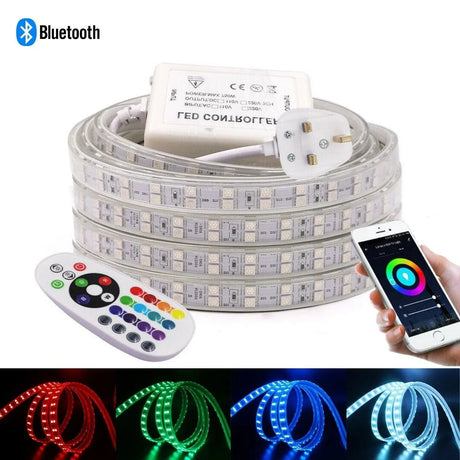
Choose 220V mains RGB strip when you need extremely long continuous colour runs — up to 50 metres from a single UK plug — without a separate driver, and when the installation does not require low-voltage safety classification. Mains RGB strip plugs directly into a standard UK socket, includes a controller and remote, and runs at full brightness across its entire length with no voltage drop. It is the fastest way to add colour lighting to a large outdoor area, event space, or commercial exterior in 2026.
The trade-offs compared to 24V RGB strip are important to understand before ordering:
-
Safety classification: 220V mains strip operates at full UK mains voltage. It does not qualify as SELV (Safety Extra-Low Voltage) and must not be hardwired permanently in most residential applications. 24V strip runs at safety-rated low voltage from an isolated driver, making it suitable for permanent hardwired installations in homes and commercial spaces.
-
Strip profile: 220V mains RGB strip is thicker and stiffer than 24V strip due to the higher insulation requirements. It does not fit inside standard slim aluminium profiles and is typically surface-mounted using clips.
-
Colour control: Most mains RGB strip ships with a basic IR remote offering preset colours and a limited number of effects. 24V strip paired with a WiFi controller offers app control, voice control, custom colour mixing, scheduling, and integration with Alexa, Google Home, or HomeKit.
-
Cutting intervals: Mains RGB strip cuts at intervals of approximately 1 metre (compared to every few centimetres on 24V strip). Less precise for custom-length installations.
-
Light quality: Both use SMD LED chips for colour. 24V COB RGB produces smoother, dot-free output. Mains RGB strip shows visible LED dots.
Best applications for 220V mains RGB strip in the UK market: temporary event lighting, Christmas and seasonal exterior decorations, garden perimeter colour washes over 20 metres, commercial building outline lighting, and pub or bar exterior features where long runs and plug-in simplicity outweigh the limitations listed above. For permanent interior installations, residential projects, and any application requiring precise colour control or smart home integration, 24V RGB strip with a dedicated controller is the better choice in virtually every case.
Why buy RGB LED strip lights from UK LED Lights?
UK LED Lights is a specialist LED lighting supplier based in Telford, Shropshire, stocking one of the widest colour-changing LED strip ranges available from any UK retailer in 2026. We hold physical UK stock of every RGB variant — COB, SMD, RGBW, RGBCCT, and 220V mains — and ship with free delivery across mainland UK. Our technical team specifies complete systems: strip, driver, controller, profiles, and accessories matched and tested to work together.
-
UK stock, same-day dispatch: Every product ships from our Telford warehouse — Unit D4, Stafford Park 4, TF3 3BA. No overseas dropshipping, no extended lead times. Order before 2pm on a working day and your strip dispatches the same afternoon.
-
Complete RGB systems, not just strip: We specify the non-dimmable driver, the correct-channel controller, the compatible profile, and the right connectors for your strip type. One order, one delivery, zero compatibility issues on site. This is where we differ from generalist retailers who sell strip without checking what driver or controller it actually needs.
-
Free UK delivery: Standard delivery free on all orders to mainland UK addresses. No minimum order value.
-
Bespoke cutting service: Send your exact measurements and we cut RGB strip to length before dispatch. No on-site waste, no guesswork with scissors.
-
Technical support from people who install this product: Call 01952 370008 Monday to Friday, 9am to 5pm, or email sales@ukledlights.co.uk. Our team answers driver sizing, controller compatibility, IP selection, and wiring layout questions directly — not from a script.
-
Trade and project pricing: Electricians, interior designers, hospitality fit-out teams, and commercial specifiers — contact us for volume pricing on larger RGB strip projects. We supply trade accounts across the UK.
-
Full ecosystem from one supplier: COB strip, drivers, controllers, aluminium profiles, and outdoor-rated strip — everything ships together, tested to work together.
-
RGB and RGBW strip is our most frequently supported category — we walk customers through colour mixing, zone setup, and app pairing every day.
-
We switched our entire RGB range to non-dimmable constant-voltage drivers in 2024 after seeing repeated flicker complaints industry-wide.
UK LED Lights Ltd · Company No: 12301805 · Unit D4, Stafford Park 4, Telford, Shropshire, TF3 3BA · 01952 370008 · sales@ukledlights.co.uk
How do RGB, RGBW, and RGB CCT strip compare?
RGB, RGBW, and RGB CCT strip each handle colour and white light differently — here is the comparison that matters for your project.
| Feature |
RGB |
RGBW |
RGB CCT |
| Colour channels |
3 (red, green, blue) |
4 (RGB + dedicated white) |
5 (RGB + warm white + cool white) |
| Clean white output |
No — cold violet-tinged white |
Yes — one fixed white temperature (3000K or 4000K) |
Yes — tuneable from 2700K to 6500K |
| Controller required |
3-channel RGB controller |
4-channel RGBW controller |
5-channel RGBCCT controller |
| Driver type |
Non-dimmable constant voltage |
Non-dimmable constant voltage |
Non-dimmable constant voltage |
| Strip width |
8-10mm |
12mm |
12mm |
| Best for |
Colour effects only — gaming, cinema, decorative |
Colour + everyday white — living rooms, bars |
Colour + tuneable white — open plan, circadian lighting |
| Price per metre |
Lowest of the three |
Moderate |
Highest of the three |
If you only need colour effects and never need white light from the same strip, RGB is sufficient. If you want both colour and usable white, RGBW is the most popular choice. If you want full circadian white tuning plus colour, RGB CCT is the premium specification. Need help deciding? Call 01952 370008.
Recommended setup for a 6-metre living room RGB mood lighting installation
-
Strip: 24V RGB COB strip, 10W/m, IP20 — dot-free colour output for visible ceiling cove or shelf runs
-
Driver: 24V 100W non-dimmable constant voltage (60W load + 20% headroom)
-
Controller: WiFi 5-in-1 controller (Miboxer or Skydance) — Alexa and Google Home compatible
-
Profile: Surface-mount aluminium with milky diffuser for smooth colour blending
-
Total cost guide: Approximately £45-65 for strip + £20-30 for driver + £25-40 for WiFi controller + £15-25 for profile per metre
RGB and RGBW setups vary by strip type, zone count, and controller choice — we will match the right combination to your project. Call 01952 370008 or email sales@ukledlights.co.uk for a free RGB specification.
When should you choose a different product instead of RGB LED strip?
RGB strip is built for colour — but colour is not always what you need. Here is when to choose a different product instead.
-
You need clean, accurate white light for daily use: RGB cannot produce true white — it outputs a cold, violet-tinged approximation. Choose RGBW for fixed white plus colour, or single colour COB for the highest white light quality.
-
You want to dim from a standard wall switch: RGB strip requires a dedicated controller, not a wall dimmer. If you want simple wall-switch dimming for white light, single colour strip with a triac dimmable driver is the correct setup.
-
Your primary use is task lighting (kitchens, offices, workshops): RGB strip is designed for decorative effects. For task lighting, single colour COB strip in natural white 4000K or cool white 6000K delivers higher CRI and more consistent output.
-
Budget is the primary concern: RGB strip costs more than single colour, requires a controller, and uses a wider 4-pin or 5-pin connector system. If you only need white light, single colour strip saves 30-40% on total installation cost.
If you are unsure whether this product suits your project, call 01952 370008 — our technical team will recommend the correct alternative if this is not the right match.
Frequently Asked Questions
Can RGB LED strip produce warm white light?
-
Not accurately. RGB strip blends red, green, and blue to approximate white, but the output has a noticeable violet-cold tinge that looks artificial next to any true white light source.
-
RGBW strip solves this by adding a dedicated warm white 3000K or natural white 4000K LED channel that produces clean, accurate white independently of the colour channels.
-
RGBCCT goes further — tuneable white from 2700K warm to 6500K cool, adjusted from your phone or voice assistant.
-
Rule of thumb: If you will ever use the strip for white light, choose RGBW or RGBCCT. If colour effects only, plain RGB is sufficient.
What is the maximum run length for RGB LED strip?
-
24V RGB COB and RGBW: 10 metres continuous from a single power point without visible voltage drop.
-
24V SMD 5050 RGB: 10 metres on 24V, 5 metres on 12V.
-
220V mains RGB: Up to 50 metres from a single UK plug.
-
For longer runs on 24V: Wire multiple sections in parallel from the same driver and use a signal amplifier to maintain consistent colour across all sections.
Do I need a special driver for RGB LED strip?
-
Yes — a non-dimmable constant-voltage driver is required. RGB strip must never be connected to a dimmable driver, which causes flicker, colour shifting, and premature failure.
-
Size the driver at a minimum of 120 percent of total strip wattage. Example: 6 metres at 14W/m = 84W. Add 20 percent = 100.8W minimum. Choose a 120W or 150W driver.
-
The driver feeds steady 24V DC to a separate RGB controller, which handles all colour mixing and dimming. Driver provides power — controller provides colour control.
Can RGB strip be used outdoors in UK weather?
-
Yes — with IP67 minimum. IP67 RGB strip is sealed against sustained rainfall, frost-thaw cycling, and ground-level damp.
-
Do not use IP65 for permanent outdoor installations — it covers surface splashes only and fails under prolonged UK weather exposure.
-
IP68 is required for any strip submerged in water — ponds, fountains, or water features.
-
Mount the driver in a weatherproof IP65 enclosure and keep all connections sealed.
Does RGB LED strip work with Alexa and Google Home?
-
Yes — with a compatible WiFi controller. Pair your RGB strip with a controller from Miboxer, Skydance, or GLEDOPTO for voice control.
-
Supported commands include on/off, dimming, colour selection by name ("Alexa, set the bedroom lights to blue"), scene activation, and scheduling.
-
Most WiFi controllers connect directly to your 2.4GHz home network — no separate hub required (except GLEDOPTO Zigbee models, which need a compatible hub).
-
Apple HomeKit users: GLEDOPTO Zigbee controllers work natively with HomeKit through a compatible Zigbee hub.
What is the difference between RGBW and RGBCCT strip?
-
RGBW has four channels — red, green, blue, plus one fixed-temperature white (either warm 3000K or natural 4000K, depending on the product).
-
RGBCCT has five channels — red, green, blue, plus a tuneable white that adjusts continuously from 2700K warm to 6500K cool.
-
RGBW is simpler and slightly cheaper — choose it if you know which white temperature you want and it will not change.
-
RGBCCT is more versatile — choose it if you want to shift white temperature throughout the day or between different uses of the room.
-
Controller difference: RGBW needs a 4-channel controller. RGBCCT needs a 5-channel controller. Verify compatibility before purchasing.
Can I cut RGB LED strip to a custom length?
-
Yes. RGB COB and SMD strip can be cut at marked intervals — typically every 50mm to 100mm on COB, and every 3-LED section (approximately 50mm on 24V, 100mm on 12V) on SMD 5050.
-
Cut only on the marked lines. Cutting between marks damages the circuit and renders that section unusable.
-
After cutting, seal the exposed end with an end cap or electrical tape to prevent short circuits.
-
Bespoke cutting service: Send your measurements to sales@ukledlights.co.uk and we cut to length before dispatch.
Is RGB COB strip better than SMD 5050 RGB strip?
-
For visual quality, yes. COB RGB produces smooth, dot-free colour output with superior close-range colour mixing. SMD 5050 shows visible dots and can display separate R/G/B pinpoints at close range rather than a blended colour.
-
For budget projects, SMD 5050 wins. Lower cost per metre, widely available in 12V and 24V, and perfectly adequate for hidden locations, garages, workshops, or situations where viewing distance exceeds 3 metres.
-
Inside aluminium profiles: COB RGB is the clear choice — dot-free output through the diffuser. SMD 5050 dots remain partially visible even through a frosted diffuser.
-
For maximum colour accuracy: COB RGB at close range. The dense chip packing blends colours on the strip surface itself.
How do I wire multiple RGB strips to one driver?
-
Wire in parallel — never in series. Each strip section connects back to the controller output with its own pair of cables. Parallel wiring helps ensure each section receives full 24V independently.
-
Use a signal amplifier for additional sections beyond the first 10-metre run. The amplifier repeats the colour signal to maintain consistent colour across all sections.
-
Total wattage of all sections must not exceed the driver output rating minus 20 percent headroom.
-
Example: Three runs of 5 metres at 14W/m = 210W total. Add 20 percent = 252W. Choose a 300W driver, one 5-channel controller, and two signal amplifiers for the second and third runs.
Can RGB strip be used in a bathroom?
-
Yes — with the correct IP rating for the zone. UK bathrooms are divided into zones under BS7671 wiring regulations.
-
Zone 0 (inside the bath or shower tray): IP68 required.
-
Zone 1 (above bath/shower to 2.25m): IP67 minimum.
-
Zone 2 (0.6m beyond Zone 1): IP67 recommended, IP20 acceptable if inside a sealed profile away from direct water.
-
Colour-changing bathroom lighting is popular in 2026 — RGBW for a spa-like warm white that switches to colour accents, or RGBCCT for tuneable white plus colour.
What is the power consumption of RGB LED strip?
-
Typical consumption ranges from 7W/m to 19W/m depending on the strip type, LED density, and colour output.
-
Peak consumption occurs when all colour channels are at full brightness simultaneously (producing white or near-white colours). Individual colour modes (pure red, green, or blue) draw approximately one-third of peak.
-
Annual running cost example: 5 metres of 14W/m RGB strip at full brightness for 4 hours daily = 70W multiplied by 4 hours multiplied by 365 days = 102.2 kWh/year. At approximately 25p/kWh (2026 UK average), that is around 25.55 pounds per year — less than 50p per week.
-
Dimming reduces consumption proportionally — running at 50 percent brightness uses approximately 50 percent of the power.
Do you offer bespoke custom lengths for RGB strip?
-
Yes. Send your exact measurements to sales@ukledlights.co.uk or call 01952 370008, and we cut and prepare your RGB strip before dispatch.
-
Standard strip cuts at marked intervals — typically every 50mm to 100mm depending on the product. We cut to the nearest mark for your specified length.
-
Connectors can be pre-fitted for plug-and-play installation on site — specify this when ordering.
-
Bespoke lengths ship free to mainland UK addresses, same as standard orders.
Can I mount RGB LED strip on bare metal surfaces?
-
No — never mount any LED strip directly on bare uninsulated metal. The underside of the strip PCB has exposed copper traces that will short-circuit against conductive surfaces.
-
Always use an aluminium profile with an anodised finish, or apply an insulating barrier between the strip and any bare metal surface such as steel brackets or metal ducting.
What happens if I power RGB strip while it is still coiled?
-
Heat builds up rapidly because airflow cannot circulate through coiled strip. The adhesive softens, LEDs overheat, and permanent damage can occur within minutes.
-
Always uncoil strip fully and mount on a surface or inside a profile before connecting to power — no exceptions, regardless of how short the test will be.
Can RGB strip be used for kitchen under-cabinet lighting?
-
RGB alone is not suitable for kitchen task lighting because it cannot produce clean white light — the "white" mode has a violet-cold tinge that makes food look unappetising.
-
RGBW or RGBCCT strip is the correct choice if you want both colour effects and usable task lighting in a kitchen. The dedicated white channel produces accurate warm or natural white independently.
-
For task lighting only with no colour effects, a single-colour COB strip in 4000K natural white is more efficient and cheaper.
Is IP65 RGB strip suitable for outdoor use in the UK?
-
No — IP65 is not recommended for permanent outdoor installations. It protects against surface splashes only and fails under sustained UK rainfall, frost-thaw cycling, and ground-level damp.
-
IP67 is the minimum for any RGB strip installed permanently outdoors in the UK.
-
IP68 is required for any strip submerged in water — ponds, fountains, or water features.
Can I dim RGB strip from a standard trailing-edge wall dimmer?
-
No — RGB strip must be dimmed through a dedicated RGB controller, not a mains wall dimmer. The controller handles colour mixing, brightness, and effects via PWM on the low-voltage side.
-
The driver must be non-dimmable constant voltage. Using a dimmable driver with a wall dimmer on an RGB circuit causes flicker, colour shift, and premature component failure.
-
For on/off switching from a wall plate, wire a standard switch on the mains side of the non-dimmable driver.
How do I troubleshoot one dead colour channel on my RGB strip?
-
Check the wiring at the controller output. If one colour channel is disconnected or has a loose terminal, that colour will not illuminate.
-
Test the controller by cycling through individual colours: If the controller outputs the correct signal but the strip does not respond on one channel, the strip itself may be damaged at that channel.
-
Inspect all connector joints — a partial connection at a push-fit connector can leave one channel disconnected while the others work normally.
What smart home systems work with RGB LED strip in the UK?
-
Amazon Alexa and Google Home: WiFi controllers from Miboxer and Skydance connect directly through Tuya or Smart Life apps — no hub required.
-
Apple HomeKit: GLEDOPTO Zigbee controllers work natively with HomeKit through a compatible Zigbee hub such as a Philips Hue Bridge.
-
Home Assistant: Both WiFi and Zigbee controllers integrate for local network control without cloud dependency.
-
All controllers sit on the 24V DC side between the non-dimmable driver and the strip.
Browse our full RGB LED strip lights range above, or contact our technical team for help specifying the right strip, driver, controller, and profile for your project.
01952 370008 · sales@ukledlights.co.uk · RGB COB Strip · All LED Strip · LED Drivers · Controllers · LED Profiles · Outdoor Strip
Last reviewed: March 2026 — UK LED Lights technical team, Telford, Shropshire. Specifications current as of 2026.
🏭 UK LED specialist, Telford, Shropshire · ☎️ 01952 370008 · 🚚 Free UK delivery




 £29.08Unit price /Unavailable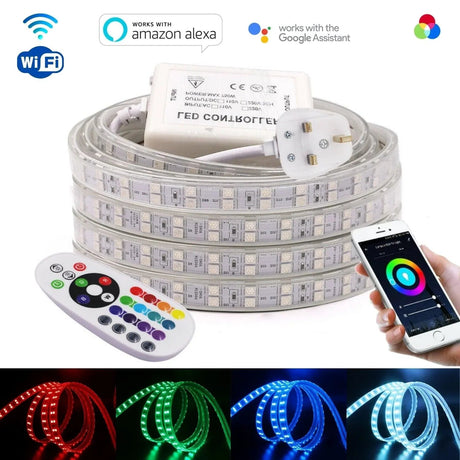
 £114.85Unit price /Unavailable
 £45.08Unit price /Unavailable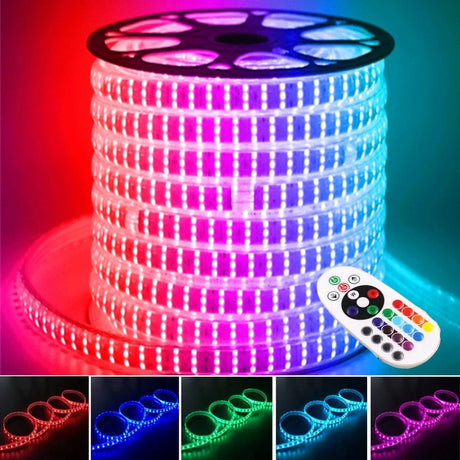
 £40.37Unit price /Unavailable


