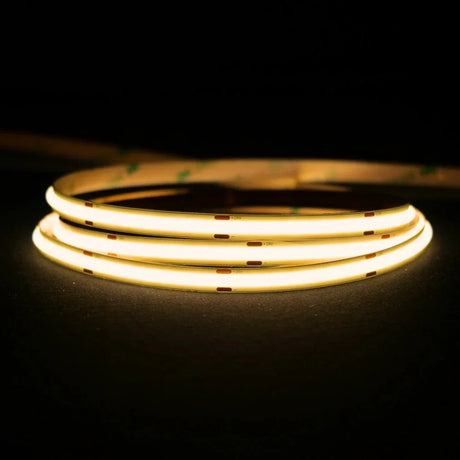
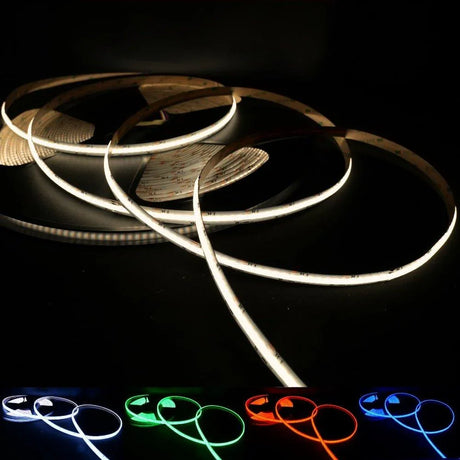
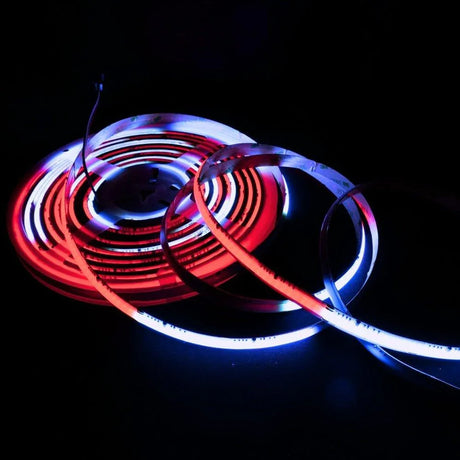
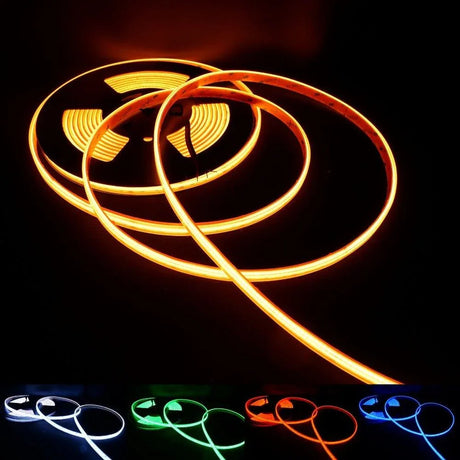
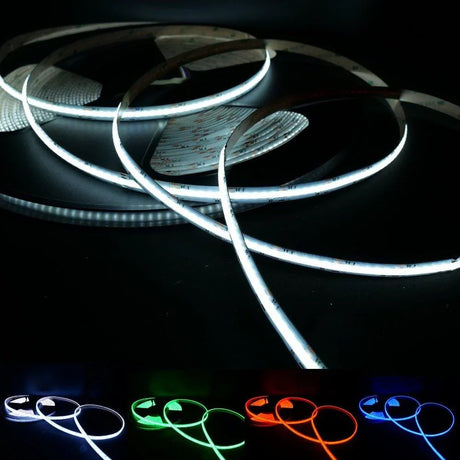
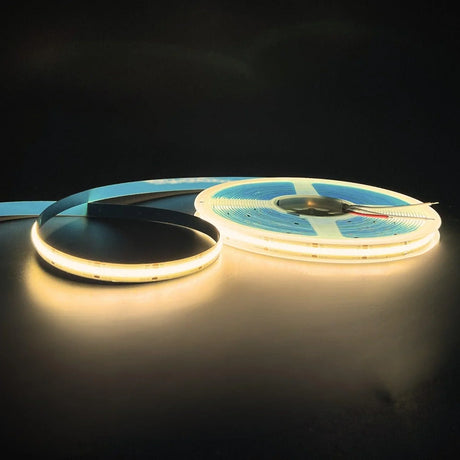
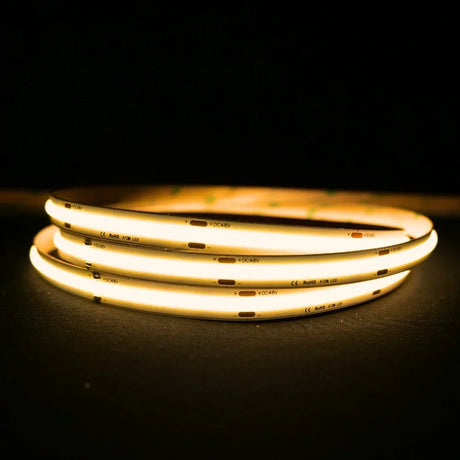
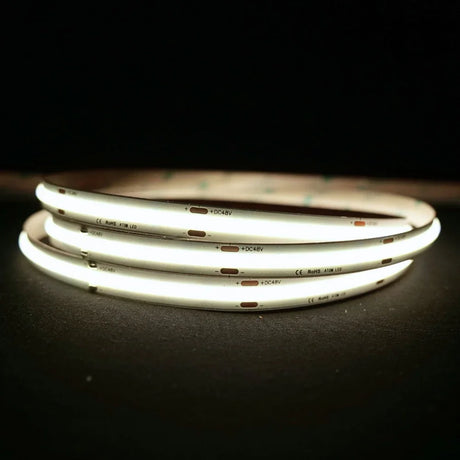
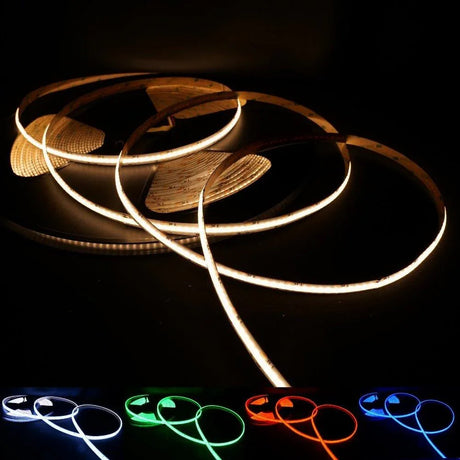
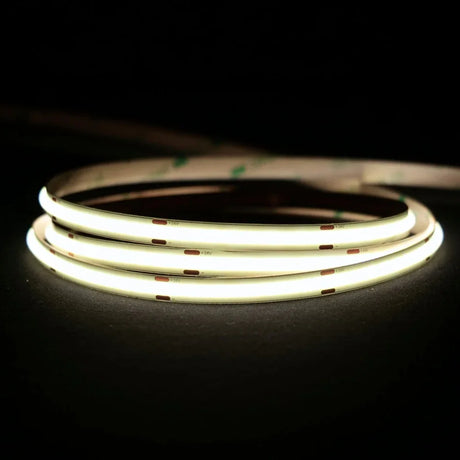
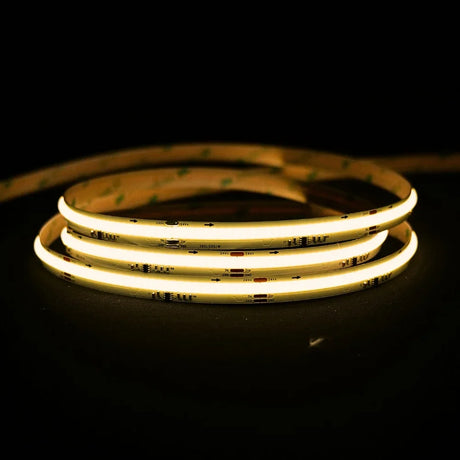
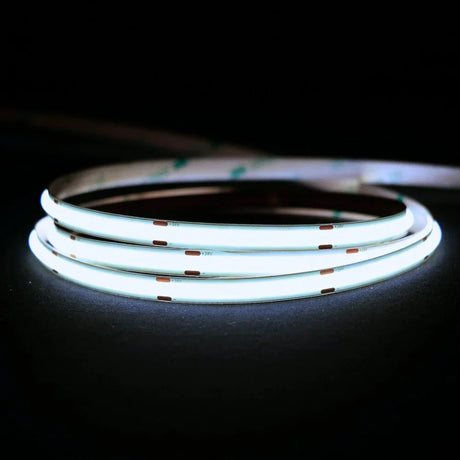
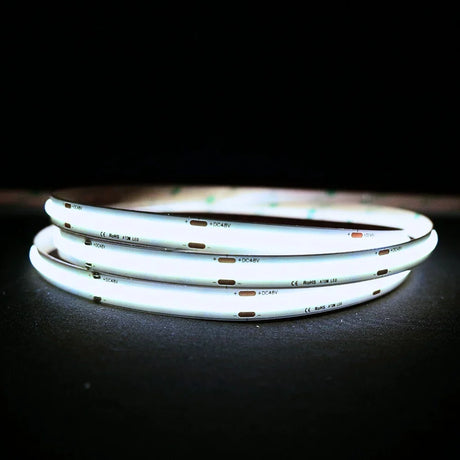
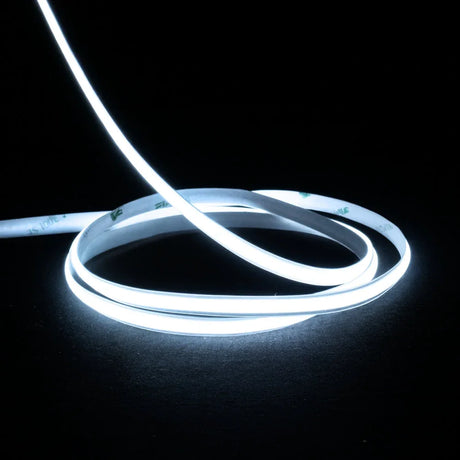
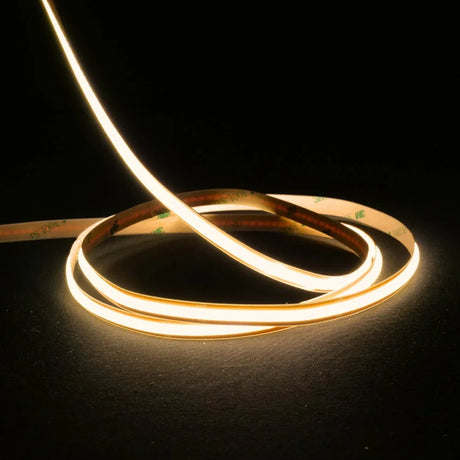
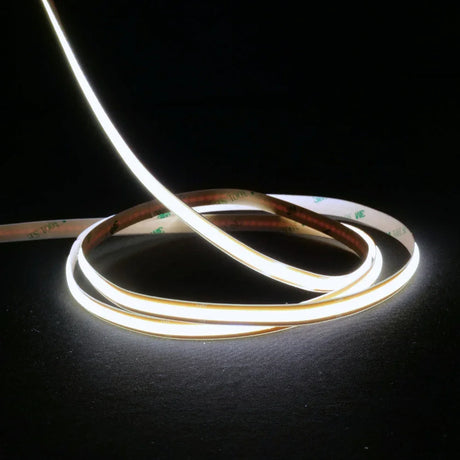
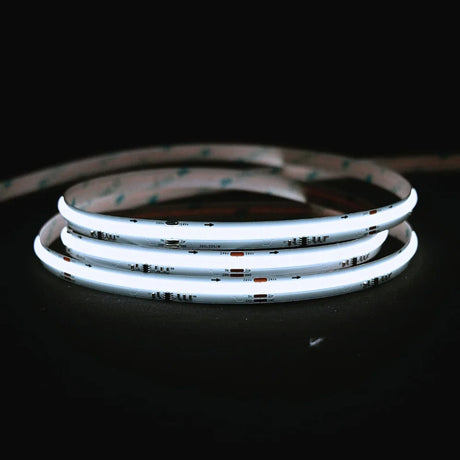
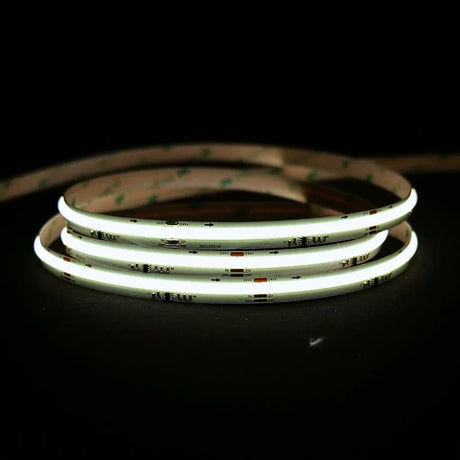
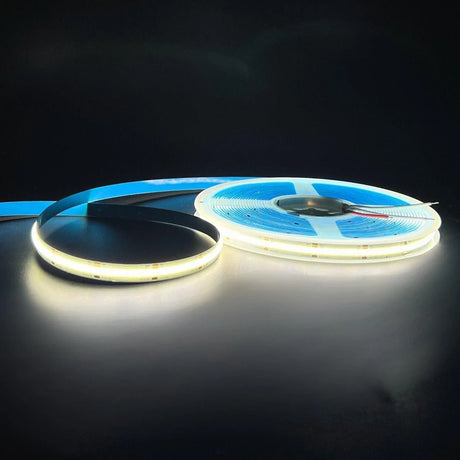
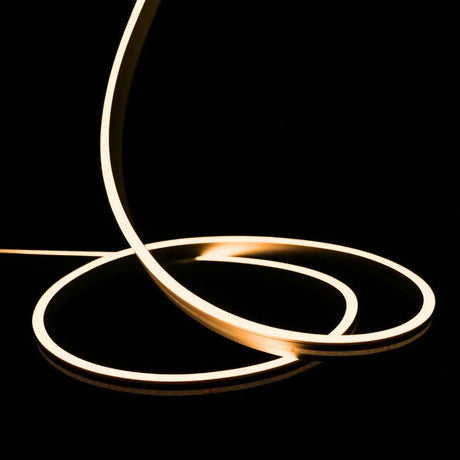
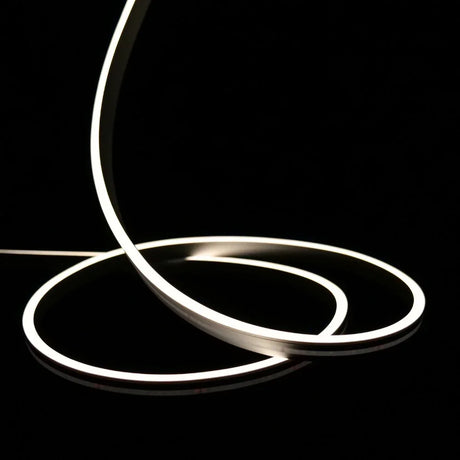
Your living room already has the furniture, the layout, and the paint colour — what it almost certainly lacks is a lighting layer that actually matches how the room is used after dark. UK LED Lights supplies 26 living room LED strip lights in 2026: warm white COB for cove lighting, RGB CCT for adaptable scenes, and smart-compatible strip for voice and app control — all from UK stock with free delivery.
Our living room LED strip collection includes 24V COB dot-free strip for ceiling coves and visible shelf runs, RGB CCT tuneable strip that shifts from 2700K evening warmth to 5000K daylight, and IP20-rated strip for every dry interior application. Every option pairs with our aluminium profiles and trailing-edge dimmers. Questions about your room? Call 01952 370008 or email sales@ukledlights.co.uk.
24V · COB Dot-Free · Warm White 2700K · RGB CCT Tuneable · IP20 · Smart Control · Dimmable · Aluminium Profiles · Circadian-Friendly · Free UK Delivery
Quick decision guide:
-
Ceiling cove or cornice lighting: 24V COB strip in warm white 2700K, inside a shallow aluminium profile set back from the cove lip — the most popular living room LED strip we supply in 2026.
-
TV backlight to reduce eye strain: 24V COB strip in 3000K or RGB CCT mounted behind the TV panel — provides bias lighting that softens the contrast between the screen and the wall behind it.
-
Shelf and alcove accent lighting: 24V COB strip in warm white 2700K, recessed inside a slim profile on the underside of each shelf — highlights books, artwork, and display items without visible LED dots.
-
Floating furniture effect (under sofa, sideboard, or TV unit): 24V COB strip in warm white 2700K, IP20, mounted to the underside of the furniture frame facing the floor — creates a soft wash of light that makes heavy furniture appear to hover.
-
Full room layered scene (cove + shelves + TV + furniture): Multiple 24V runs on separate drivers wired in parallel — call 01952 370008 for a free layout plan.
Who living room LED strip lights are for: Homeowners upgrading from a single ceiling pendant to layered ambient lighting, interior designers specifying accent and architectural lighting for residential projects, electricians wiring in new living room circuits to BS7671 standards, and media room owners building feature walls with integrated LED backlighting. If you want a professional finish in your living room that eliminates visible LED dots on any surface, COB strip inside a profiled channel is the specification to follow in 2026.
Who living room LED strip is NOT for: If your living room needs high-output task lighting for a home office desk, our COB LED strip lights page covers higher-output options better suited to work surfaces. If you need outdoor lighting for a patio that adjoins your living room, our outdoor LED strip lights range covers IP67 and IP68 rated products designed for UK weather.
Common buying mistakes to avoid:
-
Running exposed strip across a visible ceiling or shelf edge: Bare LED strip without a profile and diffuser projects harsh individual chip dots onto walls and ceilings. In a living room, where every surface is visible at eye level, this looks unfinished. Always mount inside an aluminium profile with a frosted diffuser for a clean, continuous line of light.
-
Using a leading-edge dimmer with your LED driver: Leading-edge dimmers cause flicker at low brightness levels — precisely the dim, relaxed setting most living rooms need in the evening. A trailing-edge dimmer costs approximately £15 and solves the problem completely.
-
Choosing cool white 5000K–6500K as your only living room strip: Cool white creates a clinical feel that works against relaxation. For a living room, start with warm white 2700K–3000K as the base. If you want daytime flexibility, choose RGB CCT tuneable strip that shifts between warm and cool as needed.
-
Powering LED strip while still coiled on the reel: Coiled strip cannot dissipate heat — adhesive softens, LEDs overheat, and the strip degrades permanently. Always uncoil, mount, and secure strip to a surface or profile before switching on.
-
Mounting strip directly onto bare metal brackets or fixings: Exposed metal behind shelving or inside alcove frames can short-circuit unprotected strip. Mount inside an aluminium profile with an insulated base, or ensure a non-conductive barrier between strip and metal.
- What are the best LED strip lights for a living room in 2026?
- Which colour temperature should you choose for living room strip lighting?
- How do you install LED strip lights in a living room ceiling cove?
- What is circadian lighting and why does it matter in a living room?
- How do you create a floating furniture effect with LED strip?
- What driver and dimmer setup do living room LED strips need?
- Can you use LED strip lights as a TV backlight?
- COB versus SMD strip — which is right for a living room?
- How do you light shelves and alcoves with LED strip?
- Why buy living room LED strip lights from UK LED Lights?
What are the best LED strip lights for a living room in 2026?
The best living room LED strip lights in 2026 are 24V COB strip in warm white 2700K for fixed accent installations and RGB CCT tuneable strip for rooms that need to shift between relaxation and daytime activity. Both should be mounted inside aluminium profiles with frosted diffusers, powered by a constant voltage driver, and controlled through a trailing-edge dimmer or smart controller.
Living rooms demand more from LED strip than any other residential space. The strip is nearly always visible — running along a shelf edge, inside a ceiling cove, or behind a TV — so dot-free light quality matters. COB strip technology places hundreds of micro LED chips in one continuous line, producing an unbroken ribbon of light instead of the repeating dot pattern that standard SMD strip creates.
For rooms where lighting needs change throughout the day, RGB CCT tuneable strip provides the most flexibility. A single strip run can output warm white at 2700K for evening viewing, shift to neutral white at 4000K for afternoon activity, or produce colour accents for entertaining. The LED controller handles the transitions — either through a wall-mounted panel, a handheld remote, or a smart home app compatible with Alexa or Google Home.
-
Fixed warm accent lighting (cove, shelf, alcove): 24V COB strip in warm white 2700K — the single most specified living room strip in our 2026 range.
-
Adaptable scene lighting (day-to-evening flexibility): 24V RGB CCT tuneable strip — one strip run handles warm, neutral, cool, and colour modes.
-
TV backlight and media wall: 24V COB strip in 3000K or RGB CCT — reduces eye strain during evening viewing while adding depth to the wall behind the screen.
-
Under-furniture floating effect: 24V COB strip in 2700K, IP20 — mounts to the furniture base, faces the floor, and washes a soft glow across the surface below.
Which colour temperature should you choose for living room strip lighting?
Warm white at 2700K is the default colour temperature for living room LED strip lighting in the UK — it produces a soft amber-toned light that supports relaxation and evening use. For living rooms that double as daytime working spaces, RGB CCT tuneable strip allows you to shift from 2700K in the evening to 4000K–5000K during the day without changing any hardware.
Colour temperature is the single specification that determines whether your living room feels welcoming or clinical. Every lighting designer working in residential interiors in 2026 starts with 2700K as the base and adjusts from there. Here is how the standard Kelvin ranges apply to a living room:
| Colour Temperature |
Kelvin Range |
Living Room Application |
Best For |
| Warm white |
2700K |
Cove lighting, shelf accent, under-furniture glow |
Evening relaxation, film watching, winding down |
| Warm white |
3000K |
TV backlight, alcove feature, general ambient |
Social entertaining, general evening use |
| Natural white |
3500K–4000K |
Daytime task areas, reading nooks |
Afternoon activity, home office crossover rooms |
| Cool white |
5000K–6500K |
Not recommended as sole living room source |
Daylight simulation only — use as part of tuneable strip |
The colour temperature you experience in the evening has a measurable effect on sleep preparation. Research into circadian rhythms shows that exposure to cool white light (above 4000K) after sunset suppresses melatonin production and delays the body's natural sleep onset. Warm white at 2700K sits below that threshold, making it the responsible specification for evening-dominant living rooms. RGB CCT tuneable strip gives you the ability to set warm tones automatically at a scheduled time each evening — the circadian lighting approach that is becoming standard in 2026 residential installations.
How do you install LED strip lights in a living room ceiling cove?
Installing LED strip in a living room ceiling cove requires a recessed or surface-mounted aluminium profile set back from the cove lip, with the strip facing the ceiling to create an indirect wash of reflected light. The profile is fixed into the cove channel, the strip is pressed into its base, the driver is wired to a fused spur or plug, and a trailing-edge dimmer controls brightness.
Ceiling cove lighting is the most popular living room LED strip installation we help customers plan at UK LED Lights. The technique works because the light source is hidden — you see only the reflected glow on the ceiling above, which bounces diffused light back into the room. The result is soft, even ambient light with no visible glare or hardware.
Step-by-step installation for a living room ceiling cove (2026 best practice):
-
Plan the cove dimensions and strip run length: Measure the total linear metres of cove channel around the room perimeter. Allow a 50mm–80mm gap between the cove lip and the aluminium profile so the strip is hidden from direct sight lines at standing and seated height. Sketch the layout and note driver position, cable entry point, and dimmer location.
-
Select the correct driver wattage and wire in parallel: Calculate total strip wattage (watts per metre multiplied by total length) and select a constant voltage driver rated to at least 120% of the total load. For cove runs exceeding 10 metres, use two or more drivers wired in parallel rather than one oversized unit — this prevents voltage drop across long single runs. A qualified electrician should wire the driver to a dedicated fused spur for a permanent hardwired installation.
-
Fix the aluminium profile into the cove channel: Use the mounting clips supplied with the profile, or screw directly through the profile base into the cove surface. Ensure the profile sits flat with no gaps — uneven mounting causes shadows in the reflected ceiling wash. For corners, use 45-degree profile connectors or mitre-cut the profile ends for a flush joint.
-
Apply COB strip into the profile and connect to the driver: Peel the 3M adhesive backing and press the strip firmly into the profile channel. Connect the strip to the driver using the correct polarity (red to positive, black to negative). If using solderless connectors, ensure the contact pads align cleanly and the connector clip is fully closed. Do not power on while the strip is still loose or coiled.
-
Install the trailing-edge dimmer and test the full run: Fit a trailing-edge dimmer at the wall switch position. Power on and dim to minimum brightness first — check for flicker, uneven glow, or any dark sections. Walk the full perimeter of the room at seated and standing height to confirm the strip is hidden from every viewing angle. Adjust the profile setback if any LED glow is visible over the cove lip.
-
Clip the diffuser cover onto the profile: Once the strip position and brightness are confirmed, press the frosted diffuser cover into the profile channels. This protects the strip from dust accumulation and softens the light output further — particularly important if the cove gap allows any partial direct view of the profile.
For free cove lighting layout advice specific to your living room dimensions, call 01952 370008 or email sales@ukledlights.co.uk with your room measurements and ceiling photos.
What is circadian lighting and why does it matter in a living room?
Circadian lighting adjusts the colour temperature of your LED strip automatically throughout the day — cooler white in the morning and afternoon to promote alertness, transitioning to warm white in the evening to support natural melatonin production and sleep preparation. In a living room, this means the same strip run serves daytime activity and evening relaxation without manual switching.
The living room is the one space in most UK homes where people spend time across the full day-to-night cycle — morning coffee, afternoon reading, evening television, late-night winding down. Fixed colour temperature strip forces a compromise: warm white feels relaxing at 9pm but dull at 11am. Cool white is alert and clear at midday but harsh and sleep-disrupting at 10pm.
RGB CCT tuneable strip eliminates that compromise. A single installed strip run shifts from approximately 5000K during daylight hours to 2700K in the evening. In 2026, this transition can be automated through smart controllers with scheduling features, so the living room light adapts to the time of day without anyone touching a switch or opening an app.
-
Morning (7am–10am): 4000K–5000K neutral to cool white — supports alertness and mimics natural morning daylight entering through windows.
-
Afternoon (12pm–5pm): 3500K–4000K natural white — clear, comfortable light for reading, conversation, or home working.
-
Evening (6pm–9pm): 2700K–3000K warm white — relaxing amber tones that signal to the body that the day is winding down.
-
Late night (9pm onwards): 2700K at reduced brightness — minimal blue light content, supporting melatonin release and sleep onset.
How do you create a floating furniture effect with LED strip?
The floating furniture effect is created by mounting LED strip to the underside of a sofa, TV unit, sideboard, or coffee table so the light washes downward onto the floor beneath. The furniture appears to hover on a cushion of light. Use 24V COB strip in warm white 2700K, IP20, set approximately 10mm–20mm inboard from the furniture edge to keep the strip hidden from direct view.
This is one of the most visually effective LED strip applications in any living room, and it requires less hardware and effort than ceiling cove lighting. The technique works best with furniture that already has a recessed base or legs that create a shadow gap between the furniture body and the floor.
-
TV units and sideboards: Mount strip along the rear and both sides of the underside. The floor below becomes a soft pool of warm light that extends the visual footprint of the furniture without adding any table lamps or floor fixtures.
-
Sofas with legs: Mount strip along the front rail of the sofa base, facing downward. The glow extends forward across the floor area in front of the seating — particularly effective on darker flooring or rugs.
-
Coffee tables and console tables: Mount strip around the full underside perimeter. Glass-topped tables create a double reflection effect that adds a second layer of depth.
For the cleanest result, use an ultra-slim aluminium profile (9mm wide or less) to house the strip. This prevents dust buildup on the adhesive side, improves heat dissipation, and helps ensure a straight light line even on furniture undersides that are not perfectly flat.
What driver and dimmer setup do living room LED strips need?
Living room LED strip lights need a 24V constant voltage driver rated to at least 120% of the total strip wattage, paired with a trailing-edge dimmer for smooth brightness control down to low levels. For RGB CCT tuneable strip, use a non-dimmable constant voltage driver combined with a dedicated RGB CCT controller — never a standard wall dimmer, which will cause colour shift and flicker.
The driver and dimmer combination is where most living room LED strip installations succeed or fail at the dimming stage. Living rooms are dimmed more frequently and to lower levels than any other room in the house — film watching, relaxing, entertaining — so smooth, flicker-free dimming is critical.
| Strip Type |
Driver Type |
Dimmer / Controller |
Typical Living Room Use |
| Single colour (warm white COB) |
24V constant voltage, dimmable |
Trailing-edge wall dimmer |
Cove lighting, shelf accent, under-furniture glow |
| Dual white (tuneable CCT) |
24V constant voltage, non-dimmable |
Dedicated CCT controller |
Circadian lighting, adaptable living spaces |
| RGB |
24V constant voltage, non-dimmable |
RGB controller (remote or smart) |
Colour accent, entertainment, feature walls |
| RGB CCT (RGBCCT) |
24V constant voltage, non-dimmable |
RGBCCT 5-channel controller |
Full flexibility — colour, white, circadian scheduling |
-
Never use a dimmable driver with RGB or RGBCCT strip: The controller handles all brightness and colour mixing. A dimmable driver interferes with the controller signal and causes flicker, colour shift, and premature component failure.
-
Oversize the driver by 20% minimum: A strip drawing 60W needs a driver rated to at least 72W. Running a driver at 100% continuous load generates excess heat and reduces lifespan — the 20% headroom is standard UK specification practice in 2026.
-
Trailing-edge, not leading-edge: Leading-edge dimmers are designed for incandescent and halogen loads. On LED drivers, they cause visible flicker at low brightness. A trailing-edge dimmer, typically £15 or less, resolves this entirely.
Browse our LED driver range and RGB LED strip collection for compatible components. Not sure which driver and controller combination you need? Call our technical team on 01952 370008 with your strip type and total run length — we will specify the correct setup for your living room.
Can you use LED strip lights as a TV backlight?
Yes — LED strip mounted behind a television is one of the most practical living room applications. It creates bias lighting that reduces the contrast between the bright screen and the dark wall behind it, which lowers eye fatigue during extended viewing. Use 24V COB strip in warm white 3000K or RGB CCT tuneable strip mounted along all four edges of the TV rear panel.
TV backlighting is not just decorative — it serves a measurable ergonomic function. When you watch a bright screen in a dark room, your pupils constantly adjust between the screen brightness and the surrounding darkness. This adjustment cycle causes eye strain, headaches, and fatigue, particularly during long evening viewing sessions. A strip of warm light behind the TV lifts the ambient light level around the screen edge, reducing pupil fluctuation and making viewing noticeably more comfortable.
-
Best colour temperature for TV backlighting: 3000K warm white provides a neutral bias that does not distort on-screen colours. Avoid cool white behind a TV — it creates a blueish halo that interferes with accurate colour perception during films.
-
RGB CCT option: Tuneable strip lets you match the backlight warmth to the on-screen content or time of day. Some smart controllers offer music and video sync modes that shift the backlight colour dynamically.
-
Mounting method: Clean the rear TV panel surface, apply the strip with 3M adhesive along all four edges approximately 50mm from the panel edge. For wall-mounted TVs, route the cable through the wall bracket channel or behind a cable management trunking for a clean finish.
COB versus SMD strip — which is right for a living room?
COB LED strip is the better choice for living rooms in 2026 because it produces a continuous line of light with zero visible LED dots. In a living room, strip is typically installed in visible or semi-visible locations — shelf edges, cove lips, behind glass — where the dot pattern from SMD strip would be distracting. COB strip reflects as a smooth, continuous glow on walls, ceilings, and furniture surfaces.
Standard SMD strip (2835 or 5050 chip types) uses individual LED chips spaced at regular intervals along the circuit board. Each chip creates a bright point source. When this light reflects off a painted wall, a gloss shelf, or a ceiling surface, you see a row of dots rather than a line of light. In kitchens, this is a known problem on worktops. In living rooms, it affects every reflective surface at eye level — TV screens, picture glass, mirrors, polished furniture, and even matt-finish walls at close range.
| Feature |
COB Strip (Living Room) |
SMD Strip (Living Room) |
| Light appearance |
Continuous unbroken line |
Visible dot pattern |
| Reflection on walls and ceilings |
Smooth even wash |
Dotted pattern visible on closer surfaces |
| Beam angle |
180 degrees |
120 degrees typical |
| Flexibility for curved coves |
Excellent — bends with no dark gaps |
Good — slight gaps possible at tight curves |
| Profile and diffuser |
Recommended for dust protection and heat |
Necessary to mask dot pattern |
| Cost per metre |
Higher |
Lower |
| Recommended for living rooms 2026 |
Yes — professional standard |
Hidden-only locations or budget installs |
If budget is a primary concern and the strip will be entirely hidden from view (for example, recessed deep inside a ceiling cove with no direct sight line), SMD strip behind a diffuser can still produce a respectable result. For any installation where the strip or its reflection is partially visible, COB is the specification to follow. Browse our full COB strip collection for living room options.
How do you light shelves and alcoves with LED strip?
LED strip lights inside shelving units and alcoves create focused accent lighting that highlights displayed items and adds depth to the wall. Mount a slim aluminium profile with COB strip on the underside of each shelf, facing downward, to illuminate the shelf below. This method keeps the light source hidden from eye level and casts an even downward wash across books, ornaments, and artwork.
Shelf and alcove lighting is the second most popular living room LED strip application after ceiling cove lighting. It transforms flat, shadowed recesses into focal features, and it replaces the need for table lamps that take up surface space on the shelves themselves.
-
Underside mounting (most common): Fix a slim aluminium profile (9mm–15mm wide) to the underside of each shelf, with the strip facing downward. This illuminates the shelf surface below and any objects sitting on it. The profile is hidden by the shelf lip above.
-
Rear wall mounting (for glass shelves): Fix a vertical strip run to the rear wall of the alcove, behind the shelves. Light passes through glass shelves and creates a stacked glow effect from top to bottom — particularly effective with coloured glass or translucent objects.
-
Top-of-alcove wash: Mount a single horizontal profile at the very top of the alcove, facing downward. This produces a single wash that cascades down the rear wall, grazing the surface texture and highlighting wall colour or feature wallpaper.
For alcoves flanking a fireplace — one of the most common UK living room layouts — symmetrical strip placement on matching shelves creates balanced accent lighting that frames the fireplace as the room's centrepiece. Use warm white 2700K for a traditional living room scheme or 3000K for a slightly cleaner contemporary tone. See our full LED strip lights collection for all available colour temperatures and outputs. Our aluminium profile range includes ultra-slim options that fit inside standard 18mm shelf thickness.
Why buy living room LED strip lights from UK LED Lights?
UK LED Lights is a specialist LED supplier based in Telford, Shropshire, carrying 26 living room-ready LED strip products from UK stock. We provide free technical specification support by phone and email, free UK delivery, and every strip in our 2026 range is tested and dispatched from our Telford warehouse. Company registration number 12301805.
-
UK stock, not drop-shipped: Every product in our living room LED strip collection ships from our Telford warehouse. No third-party fulfilment, no overseas shipping delays, no mystery stock origins.
-
Free layout advice: Call 01952 370008 (Monday to Friday, 9am–5pm) or email sales@ukledlights.co.uk with your living room dimensions and photos. We will recommend the correct strip type, profile, driver, and controller for your room — at no charge.
-
Full ecosystem in one order: Strip, profiles, drivers, dimmers, controllers, and connectors — all compatible, all from one supplier. No cross-referencing datasheets from three different websites to check whether components work together.
-
Specification-grade accuracy: Every product listing includes wattage per metre, lumens per metre, colour temperature, CRI rating, voltage, and IP rating. No vague marketing descriptions — just the numbers you need to specify correctly.
-
Sister brand expertise: UK LED Lights operates alongside ATOM LED, House of LEDs, and Glow LEDs. The technical knowledge behind our product selection comes from supplying LED strip across four specialist brands since the early days of the UK residential LED market.
-
Living room cove lighting is our fastest-growing residential specification — warm white COB strip in aluminium profiles is the combination we recommend most.
-
Our team has guided customers through shadow-gap, pelmet, and floating-shelf installations for every major room layout.
Ready to light your living room properly? Browse the 26 products below, or call 01952 370008 to speak with our technical team. Email sales@ukledlights.co.uk any time. Free UK delivery on every order.
Living room LED strip lights — frequently asked questions
-
What colour LED strip light is best for a living room?
- Warm white at 2700K is the most popular choice for living room LED strip lighting in 2026. It creates a relaxed, amber-toned ambient glow suited to evening use. For rooms that need daytime flexibility, RGB CCT tuneable strip shifts between 2700K and 5000K on demand.
-
Are LED strip lights bright enough to light a living room on their own?
- LED strip provides excellent ambient and accent lighting, but most living rooms benefit from a layered approach. A ceiling cove strip run at 800–1000 lumens per metre adds strong ambient light. Pair it with shelf accent strips and a pendant or floor lamp for a balanced scheme that covers all activities.
-
Can you dim LED strip lights in a living room?
- Yes. Single-colour LED strip dims smoothly with a trailing-edge dimmer and a dimmable constant voltage driver. RGB and RGBCCT strip dims through its dedicated controller — never connect these types to a standard wall dimmer. Trailing-edge dimmers are available from approximately £15.
-
Do LED strip lights use a lot of electricity?
- No. A typical 5-metre warm white COB strip run draws approximately 50W–70W — comparable to a single old-style incandescent bulb. Running that strip for 5 hours per evening costs roughly 10p–14p per day at 2026 UK electricity rates, making LED strip one of the most energy-efficient living room lighting options available.
-
What IP rating do living room LED strip lights need?
- IP20 is sufficient for all standard living room installations. IP20 means the strip is rated for dry indoor environments with no water exposure. Higher IP ratings (IP65, IP67, IP68) are designed for bathrooms, kitchens, and outdoor use — they add unnecessary cost and bulk for a dry living room.
-
How long do LED strip lights last in a living room?
- Quality LED strip typically lasts 30,000–50,000 hours at rated output. At 5 hours of use per evening, that equates to approximately 16–27 years before brightness drops noticeably. Lifespan depends on heat management — mounting strip inside an aluminium profile improves heat dissipation and extends operational life.
-
Can you connect LED strip lights to Alexa or Google Home?
- Yes. Our RGB CCT tuneable strip range is compatible with smart controllers that connect to Alexa, Google Home, and other smart home platforms via Wi-Fi. Voice control allows you to change colour temperature, brightness, and scenes without a remote or app. Scheduling features enable automatic circadian transitions from cool to warm throughout the day.
-
Do you need an electrician to install living room LED strip lights?
- For plug-in installations using a plug-in driver, no electrician is required. For hardwired installations connected to a fused spur or integrated into a lighting circuit, a qualified electrician should carry out the wiring to BS7671 standards. This is a legal requirement for permanent fixed wiring in England and Wales under Part P of the Building Regulations.
-
What is the difference between RGB and RGBCCT LED strip?
- RGB strip produces red, green, and blue colours but cannot generate a clean, natural white — its white mode produces a cold violet-tinged tone. RGBCCT strip adds dedicated warm white and cool white LED chips alongside the RGB chips, delivering accurate whites at any colour temperature plus the full RGB colour range. For a living room where white light quality matters, RGBCCT is the correct specification.
-
Does UK LED Lights offer free delivery on living room LED strip?
- Yes. Every order from UK LED Lights includes free UK delivery as standard. All products ship from our Telford, Shropshire warehouse. For specification questions before ordering, call 01952 370008 or email sales@ukledlights.co.uk.
Can I install living room LED strip without an electrician?
- Plug-in installations using a plug-in driver require no electrician. Hardwired installations connected to a fused spur or lighting circuit require a qualified electrician under BS7671 Part P.
What profile width do I need for living room COB strip?
- Most COB strip is 8–10mm wide and fits standard 10mm or 12mm channel profiles. Check the strip width in the product listing and match to a profile with an internal channel at least as wide.
Can I use IP65 strip outdoors on a patio adjoining my living room?
- No — IP65 is not suitable for permanent UK outdoor use. IP65 covers surface splashes only and does not withstand sustained rainfall or frost-thaw cycling. Use IP67 minimum for any outdoor installation.
Can RGB strip produce clean warm white light for a living room?
- No — RGB strip mixing red, green, and blue channels produces a cold, violet-tinged white that looks unnatural. RGBCCT strip adds dedicated warm white and cool white chips for accurate whites alongside the full colour range.
How do I prevent LED strip flickering when dimming in the living room?
- Replace any leading-edge dimmer with a trailing-edge model — this costs approximately £15 and typically resolves the most common cause of flickering. Ensure the driver is TRIAC dimmable and rated for trailing-edge operation.
Should I mount strip directly on bare metal shelving brackets?
- Never mount LED strip directly on bare, uninsulated metal. Exposed copper traces short-circuit against conductive surfaces. Mount inside an anodised aluminium profile or apply a non-conductive insulating barrier first.
Can I power LED strip while it is still coiled on the reel?
- Never power strip while coiled. Heat cannot escape — adhesive softens, LEDs degrade, and fire risk increases. Always uncoil and mount fully before connecting power.
Does UK LED Lights offer trade pricing for living room projects?
- Yes — electricians, interior designers, and commercial teams can contact sales@ukledlights.co.uk or call 01952 370008 for trade pricing on bulk and project orders.
What warranty covers living room LED strip from UK LED Lights?
- Warranty covers manufacturing defects on all strip, drivers, and controllers. Contact 01952 370008 or email sales@ukledlights.co.uk for warranty enquiries. UK LED Lights Ltd, Company No: 12301805, Unit D4, Stafford Park 4, Telford, TF3 3BA.
Does UK LED Lights deliver living room strip for free?
- Yes — free UK mainland delivery on every order, no minimum spend. Orders before 2pm Monday to Friday dispatch same day from our Telford warehouse.
Recommended setup for a 12-metre living room ceiling cove installation
-
Strip: 24V COB warm white 2700K, 10W/m, IP20 — even ambient glow reflected from the ceiling
-
Driver: 24V 200W triac dimmable constant voltage (120W load + 20% headroom = 144W minimum)
-
Profile: Surface-mount aluminium with milky diffuser, set 50-80mm back from cove lip
-
Dimmer: Trailing-edge triac wall dimmer for full brightness to ambient evening levels
-
Wiring: Two 6-metre strips wired in parallel from a central driver location
-
Total cost guide: Approximately £70-100 for strip + £35-50 for driver + £10-20 for profile per metre + £15 for dimmer
Living room cove depths, shelf widths, and TV wall sizes vary — adjust strip length and driver wattage to suit your room dimensions. Call 01952 370008 or email sales@ukledlights.co.uk for a free living room lighting specification.
When should you choose a different product instead of living room LED strip?
LED strip works in most living room layouts — but there are specific situations where a different lighting solution is the better choice.
-
You need bright general illumination for the entire room: LED strip excels at ambient accent and architectural lighting, not primary room illumination. A ceiling pendant, recessed downlights, or an LED panel provides higher overall lumen output for general tasks.
-
You want colour-changing outdoor lighting for an adjoining patio: Indoor IP20 strip will fail immediately outdoors. Our outdoor LED strip collection covers IP67 and IP68 products designed for UK weather.
-
You need a portable light source you can move between rooms: LED strip is a fixed installation. A floor lamp, table lamp, or rechargeable LED light is more practical for portable use.
-
Your living room ceiling has no cove, pelmet, or recess to hide the strip: Exposed strip on a flat ceiling looks unfinished. If there is no architectural feature to conceal the strip, consider creating a shadow gap detail or using a suspended profile instead.
If you are unsure whether this product suits your project, call 01952 370008 — our technical team will recommend the correct alternative if this is not the right match.
Last reviewed: March 2026 — UK LED Lights technical team, Telford, Shropshire. Specifications current as of 2026.
🏭 UK LED specialist, Telford, Shropshire · ☎️ 01952 370008 · 🚚 Free UK delivery