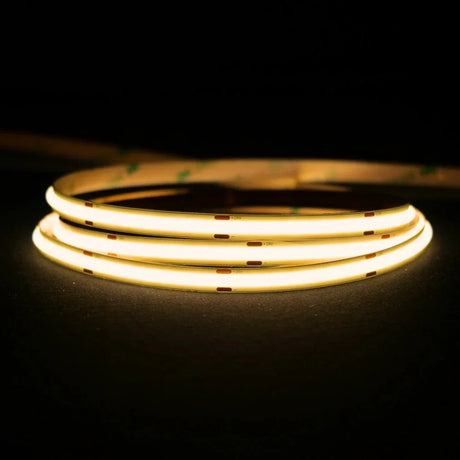
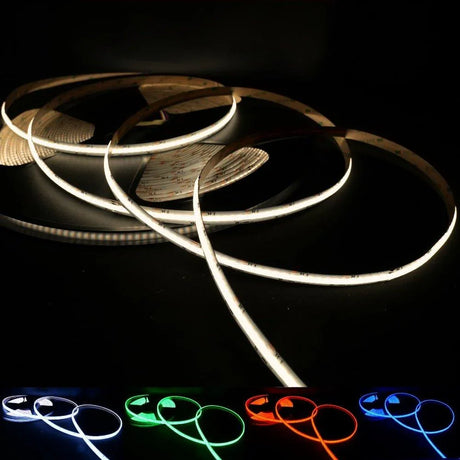
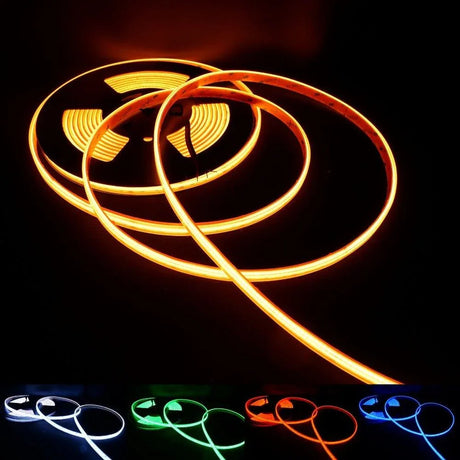
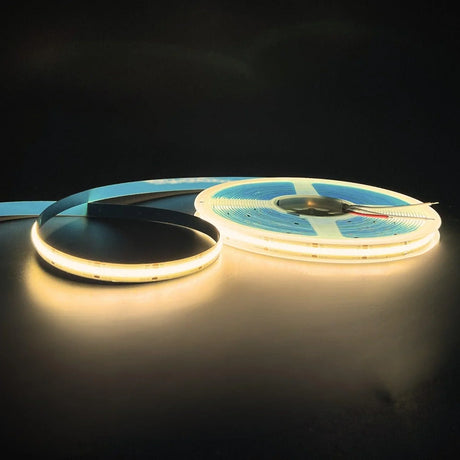
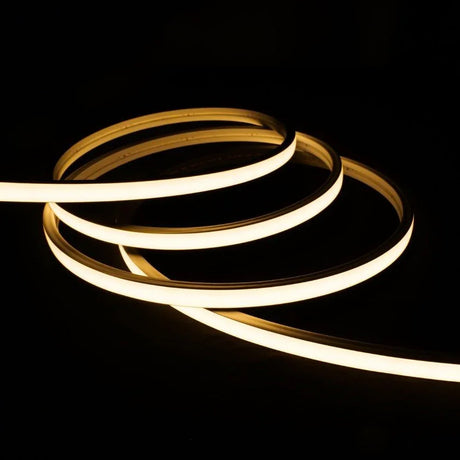
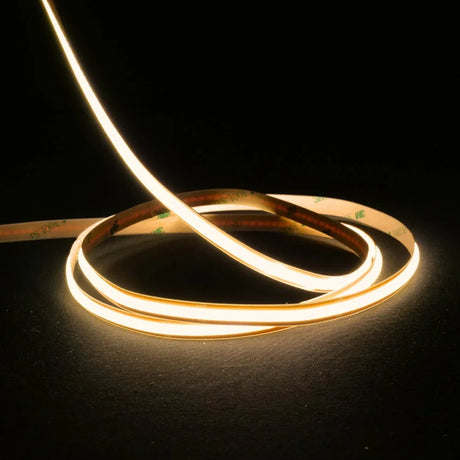
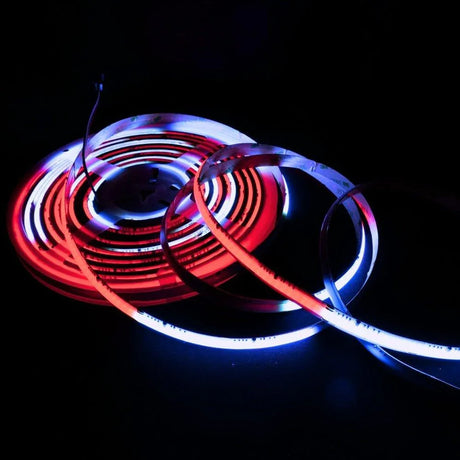
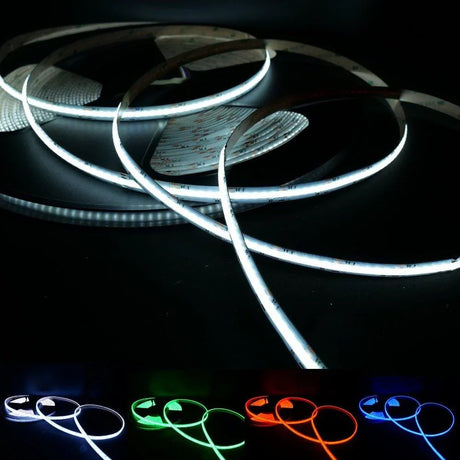
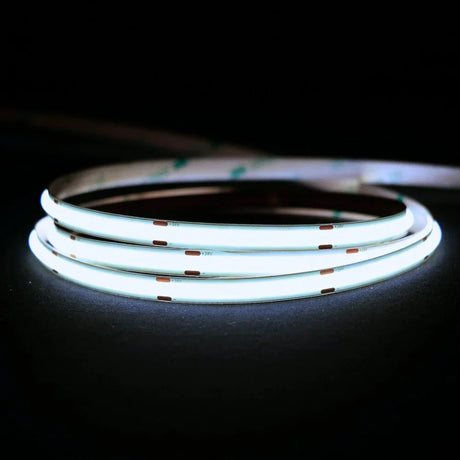
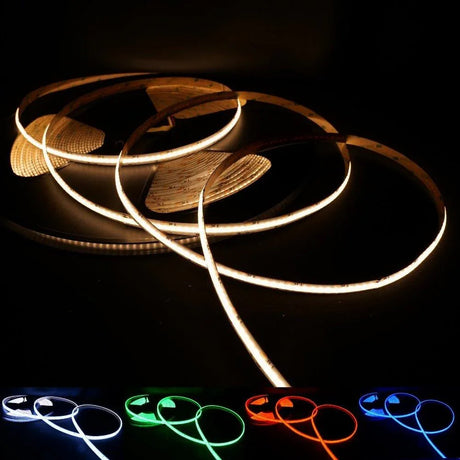
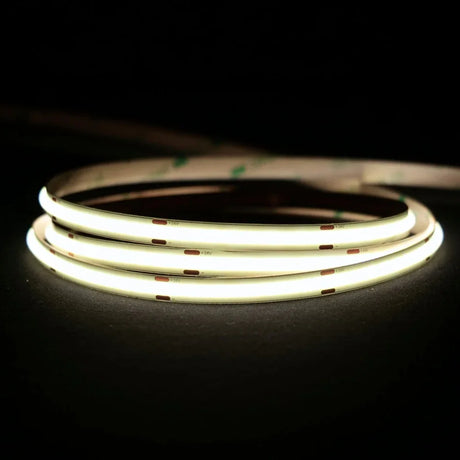
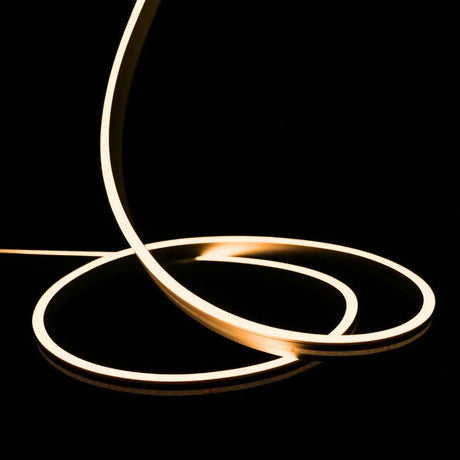
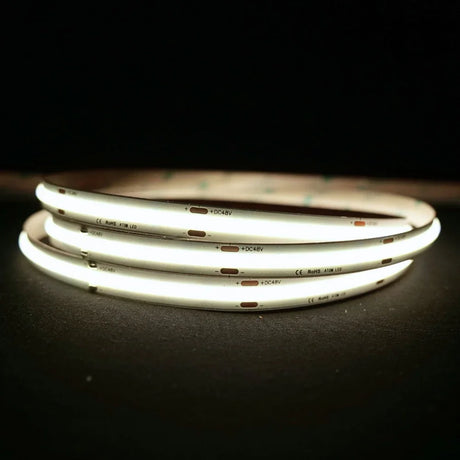
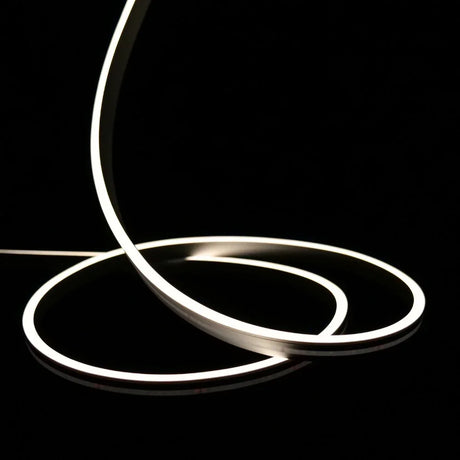
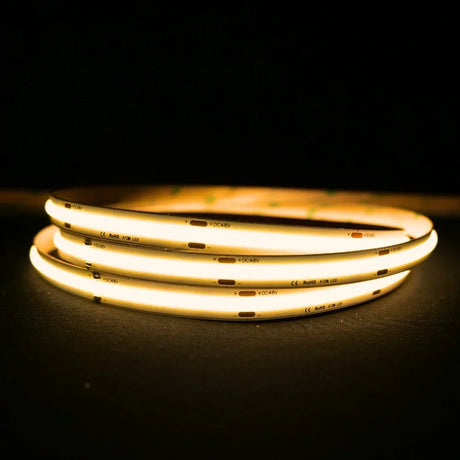
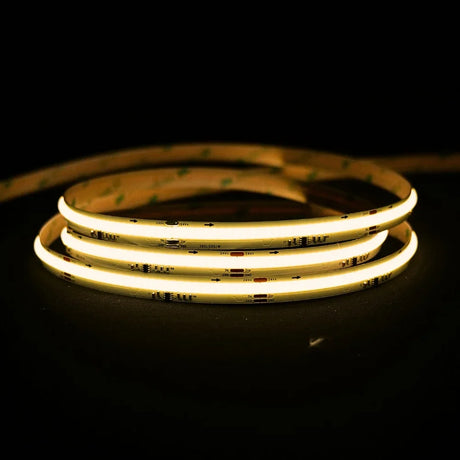
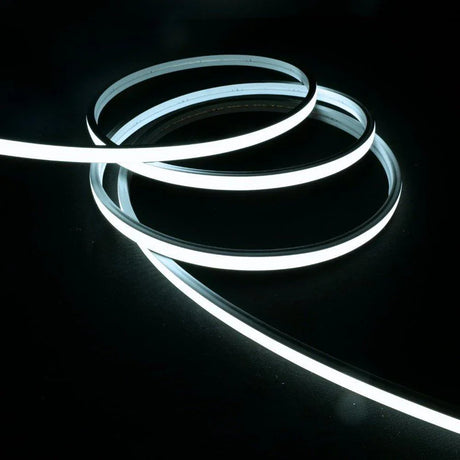
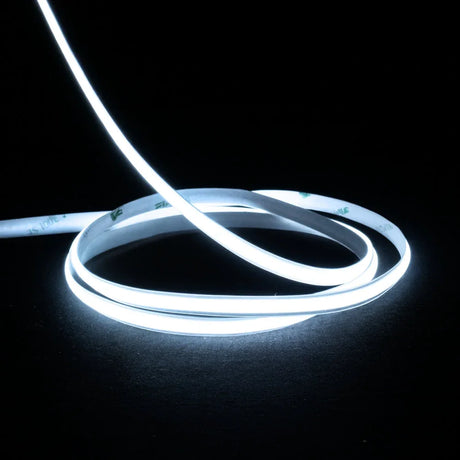
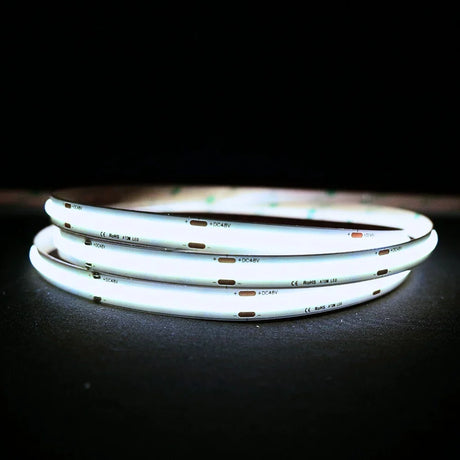
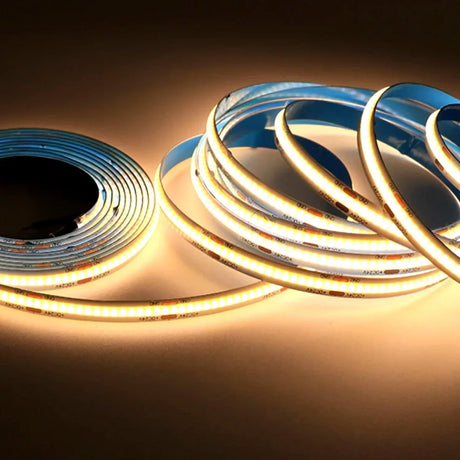
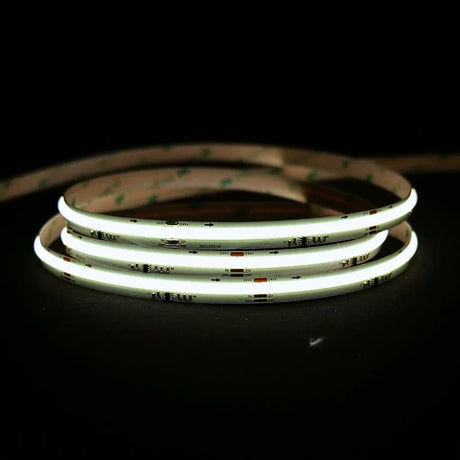
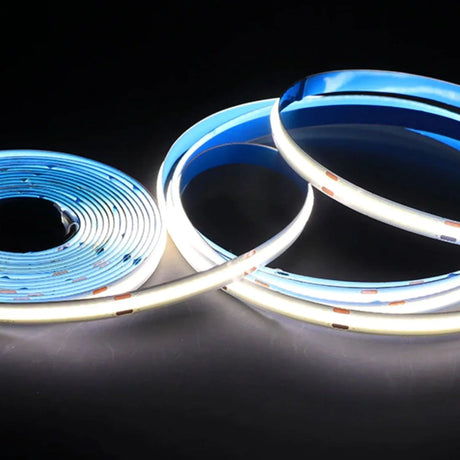
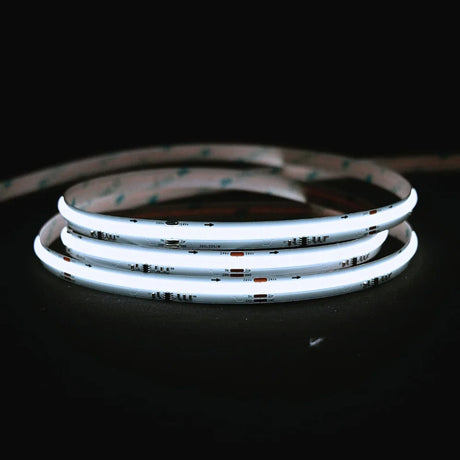
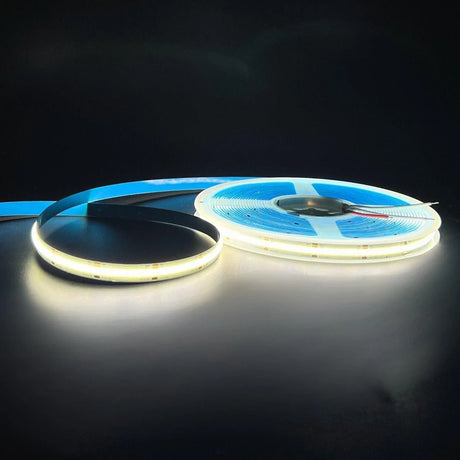
Kitchen lighting has to work harder than any other room in the house — task brightness for prep, softer warmth for dining, and a clean finish that does not show dots reflecting off worktops. UK LED Lights supplies the full range of kitchen-ready LED strip in 2026: COB dot-free strip, single colour, warm and natural white, IP20 and IP67, with CRI 90+ across every option for accurate colour rendering where it matters most.
Our kitchen LED strip lights collection covers 24V COB strip for dot-free under-cabinet runs up to 20 metres, CRI 90+ for true food and surface colour accuracy, and IP67-rated strip for near-sink and splashback zones. Every strip is compatible with our slim aluminium profiles for a clean, recessed or surface-mounted finish. Need help specifying for your kitchen layout? Call 01952 370008 or email sales@ukledlights.co.uk.
24V · COB Dot-Free · Warm White 3000K · Natural White 4000K · CRI 90+ · IP20 · IP67 · Triac Dimmable · Slim Profiles · Under-Cabinet · Kickboard · Island · Free UK delivery
Quick decision guide:
-
Under-cabinet task lighting for worktops: 24V COB strip in natural white 4000K, IP20, mounted inside a slim aluminium profile — the most popular kitchen LED strip we sell in 2026.
-
Breakfast bar or dining island: 24V COB strip in warm white 3000K — softer tone for sitting areas where food prep glare is unwanted.
-
Near-sink or behind-hob splash zone: 24V COB strip in IP67 — sealed against water ingress from splashing or steam condensation.
-
Kickboard or plinth accent lighting: 24V COB strip in warm white 3000K, IP20, inside a shallow surface profile along the toe-kick — creates a floating effect after dark.
-
Full kitchen perimeter (cabinets + island + kickboard): Multiple 24V COB runs on separate drivers wired in parallel — call 01952 370008 for a free layout plan.
Who kitchen LED strip lights are for: Homeowners fitting a new kitchen or upgrading existing lighting, kitchen designers specifying under-cabinet or in-cabinet illumination, electricians installing to BS7671 Part P standards, and property developers adding value with functional task lighting. If you want a professional finish that shows zero LED dots on glossy worktops, splashbacks, or tiled surfaces, COB strip inside an aluminium profile is the 2026 standard.
Who kitchen LED strip is NOT for: If your only goal is the cheapest possible light source and you do not mind visible dots on reflective worktops, standard SMD strip costs less per metre. If you need colour-changing RGB effects for a kitchen feature wall, our RGB controller and strip range is a better starting point than single-colour kitchen strip.
Common buying mistakes to avoid:
-
Choosing IP65 and assuming it is waterproof: IP65 covers surface splashes only — it does not meet BS7671 requirements for zones near sinks or hobs where direct water contact occurs. Use IP67 minimum for any kitchen wet zone.
-
Picking low-CRI strip for a kitchen: Strip rated below CRI 90 distorts the appearance of food, worktop colours, and cabinet finishes under artificial light. Every kitchen strip we stock is CRI 90+ as standard.
-
Using a leading-edge dimmer: Leading-edge dimmers cause visible flicker with most LED drivers. A trailing-edge dimmer costs approximately £15 and typically resolves the problem — the single cheapest upgrade in any kitchen LED strip installation.
-
Mounting strip directly onto bare metal surfaces: Cabinet interiors with exposed metal brackets or steel support rails will short-circuit unprotected strip. Always mount inside an aluminium profile with an insulated base, or use strip with a silicone IP-rated sleeve.
-
Running strip while still coiled on the reel: Heat cannot escape from coiled strip — the adhesive softens, LEDs overheat, and you risk permanent damage. Always uncoil, mount, and secure before powering on.
- Why choose COB LED strip for kitchens over standard SMD?
- Which colour temperature works best for kitchen lighting?
- What IP rating do kitchen LED strip lights need?
- How do you install LED strip lights under kitchen cabinets?
- What driver and dimmer setup does kitchen strip need?
- How much LED strip do you need for a typical UK kitchen?
- Where else can LED strip be used in a kitchen besides under cabinets?
- What profiles work best for kitchen LED strip?
- How does CRI affect kitchen lighting quality?
- Why buy kitchen LED strip lights from UK LED Lights?
Why choose COB LED strip for kitchens over standard SMD?
COB LED strip places hundreds of micro chips in a continuous line on the circuit board, producing one continuous ribbon of light with zero visible dots. In a kitchen, this matters because glossy worktops, splashbacks, and tiled surfaces reflect every individual LED chip from standard SMD strip as a row of bright dots — COB strip reflects as a single clean line of even light.
The kitchen is the one room in the house where reflective surfaces are everywhere. Granite, quartz, glass, polished porcelain, stainless steel — all of these act as mirrors for anything mounted underneath wall cabinets. An SMD 5050 or 2835 strip mounted under a cabinet will project its dot pattern directly onto the worktop below. Move along the counter and the dots follow you. COB strip removes that problem entirely.
Beyond the visual finish, COB technology offers three practical advantages for kitchen installations in 2026:
-
Even heat distribution: Heat spreads across the full board surface rather than concentrating at individual chip points. Inside a slim profile tucked under a wall cabinet, this reduces peak temperatures — important in kitchens where ambient heat from cooking is already elevated.
-
180-degree beam angle: COB strip throws light wider than the 120-degree beam of most SMD strip, meaning fewer shadow gaps at the junction between wall cabinets and the worktop edge.
-
Higher CRI as standard: Our kitchen-grade COB strip is rated CRI 90+ across the full range, ensuring food, surfaces, and cabinet finishes appear in their true colours under artificial light.
| Feature |
COB LED Strip (Kitchen) |
SMD LED Strip (Kitchen) |
| Dot visibility on worktops |
None — even reflection |
Visible dot pattern on glossy surfaces |
| Beam angle |
180 degrees |
120 degrees |
| CRI (UK LED Lights range) |
90+ across all kitchen options |
80–90 typical |
| Heat distribution |
Even across full board |
Concentrated at each chip |
| Appearance inside profiles |
Uniform glow through diffuser |
Dot pattern partially visible |
| Cost per metre |
Higher |
Lower |
| Recommended for new kitchens 2026 |
Yes — industry standard |
Budget installs only |
Which colour temperature works best for kitchen lighting?
Natural white at 4000K is the most popular choice for kitchen task areas in 2026 — worktops, hobs, and food preparation zones — because it renders food and surface colours accurately without the yellow cast of warm white. Warm white at 3000K is better suited for breakfast bars, dining islands, and display shelving where a relaxed atmosphere matters more than task visibility.
Most kitchens we help specify at UK LED Lights end up using two colour temperatures in the same room. This is not a marketing upsell — it reflects how kitchens are actually used. The section of counter where you chop vegetables, read recipes, and check whether chicken is cooked through needs clear, neutral light. The island where the family sits for breakfast or guests gather during a dinner party benefits from a warmer, more inviting tone.
A practical breakdown by kitchen zone:
-
Under wall cabinets (worktop task lighting): Natural white 4000K — provides clear, accurate illumination for food preparation, reading, and detailed tasks without the harshness of cool white.
-
Breakfast bar or dining island underside: Warm white 3000K — creates a softer, more comfortable ambience for seating areas where bright task light feels intrusive.
-
Kickboard and plinth lighting: Warm white 3000K — the floating glow effect at floor level looks best in a warmer tone, especially in the evening.
-
Inside glass-fronted display cabinets: Warm white 3000K — enhances the appearance of crockery, glassware, and decorative items without washing out colours.
-
Above-cabinet uplight (pelmet lighting): Match to the room's general lighting — typically warm white 3000K for consistency with ceiling downlights.
Avoid cool white (5000K–6500K) in any residential kitchen. It produces a clinical, commercial look that clashes with warm-toned cabinetry and makes the space feel sterile rather than welcoming — a common regret we hear from customers who chose cool white based on maximum brightness alone.
What IP rating do kitchen LED strip lights need?
IP20 is correct for the majority of kitchen LED strip installations — inside aluminium profiles mounted under wall cabinets, inside display cabinets, and along kickboards. IP67 is required for strip mounted near sinks, behind hobs, or in any zone where direct water splashing or steam condensation occurs. IP65 is not sufficient for kitchen wet zones under BS7671 guidance.
The IP rating question causes more confusion in kitchen lighting than almost any other topic. Here is how to apply it correctly in a UK kitchen in 2026:
-
IP20 (no water protection): Standard for under-cabinet runs that are enclosed inside an aluminium profile and positioned away from direct water sources. This covers the majority of kitchen strip — typically 70–80 percent of the total installation length.
-
IP67 (temporary immersion rated): Required for strip near the sink area, behind or beside a hob where steam condenses, and inside any zone that BS7671 classifies as a water exposure area. IP67 strip uses a silicone extrusion sleeve that seals the circuit board against moisture ingress.
-
IP65 — the common mistake: IP65 is splash-resistant only, not submersion-resistant. In a kitchen where a tap splashes directly onto a splashback with strip behind it, or where steam from a boiling pan condenses on nearby surfaces, IP65 may not provide adequate long-term protection. We recommend IP67 minimum for any kitchen wet zone to avoid premature strip failure.
If you are unsure which zones in your kitchen need IP67, call our technical team on 01952 370008 — we will walk through your layout and recommend the correct rating for each run.
How do you install LED strip lights under kitchen cabinets?
Mount 24V COB strip inside a slim aluminium profile, fix the profile to the underside of each wall cabinet using the supplied brackets or adhesive tape, wire all runs in parallel back to a single Triac-dimmable driver, and connect that driver to a trailing-edge dimmer switch. The full installation for a typical three-metre run takes an experienced fitter approximately 90 minutes including wiring.
Step-by-step installation for under-cabinet kitchen LED strip in 2026:
-
Measure each cabinet run: Measure the underside of every wall cabinet where strip will be installed. Note the total length in metres — this determines how much strip and how many profiles you need. A typical UK kitchen has between 4 and 8 metres of under-cabinet run across all sections. Order 10 percent extra strip length to allow for cutting waste.
-
Select and cut aluminium profiles: Choose a slim surface-mount or recessed aluminium profile that fits the cabinet depth. Cut profiles to length using a fine-tooth hacksaw or mitre saw. Deburr cut ends with a file to prevent sharp edges damaging the strip or wiring.
-
Mount profiles to cabinet undersides: Fix profiles using the supplied mounting clips, screws, or high-bond adhesive tape. Position profiles towards the front edge of the cabinet — this throws light onto the worktop and down the splashback rather than against the wall. Leave a 10mm gap from the cabinet front edge for a cleaner visual line.
-
Cut and apply LED strip inside profiles: Cut COB LED strip at the nearest cut point to your measured length. Peel the 3M adhesive backing and press the strip firmly into the base channel of each profile. Do not power the strip while it is still on the reel — always mount first, then connect.
-
Wire all runs in parallel to the driver: Run cable from each strip section back to a central Triac-dimmable LED driver mounted inside a cabinet void or utility cupboard. Wire in parallel — never series — to ensure consistent brightness across all runs. Parallel wiring means each strip section receives the full 24V regardless of total cable length.
-
Connect driver to mains via trailing-edge dimmer: Install a trailing-edge dimmer switch on the mains side of the driver. Trailing-edge dimmers are compatible with most LED drivers and eliminate the flicker that leading-edge dimmers cause. This is a £15 component swap that makes the difference between a professional result and a frustrating one.
-
Test, fit diffuser covers, and finish: Power on and check every section for even brightness, correct colour temperature, and smooth dimming from 100 percent down to minimum. Once confirmed, click the milky or clear diffuser covers into each profile and fit the end caps. Clean any fingerprints from diffuser surfaces with a dry microfibre cloth.
For installations longer than 10 metres total, or kitchens with complex layouts, contact sales@ukledlights.co.uk for a free wiring diagram tailored to your specific kitchen.
What driver and dimmer setup does kitchen strip need?
A 24V constant-voltage Triac-dimmable LED driver paired with a trailing-edge dimmer switch is the correct setup for single-colour kitchen LED strip in 2026. Size the driver at 80 percent maximum load — if your total strip wattage is 40W, choose a 50W driver. This leaves headroom for safe continuous operation and longer driver lifespan.
Choosing the right driver and dimmer combination is where many kitchen LED strip installations go wrong. Get this right and the strip dims smoothly from full brightness to a low evening glow with no flicker. Get it wrong and you end up with buzzing, strobing, or strip that refuses to dim below 40 percent.
| Component |
Correct Choice for Kitchen Strip |
Common Mistake |
| Driver type |
24V constant-voltage, Triac-dimmable |
Non-dimmable driver (no dimming possible) |
| Driver sizing |
80% max load (e.g. 50W driver for 40W strip) |
Exact wattage match (driver runs at 100%, overheats) |
| Dimmer type |
Trailing-edge (also called ELV) |
Leading-edge (causes flicker with LED drivers) |
| Dimmer cost |
Approximately £15–£30 |
Re-using existing halogen dimmer (wrong type) |
| Wiring method |
Parallel — each run gets full 24V |
Series — voltage drops across each run |
| RGB/RGBW kitchen accent |
Non-dimmable driver + dedicated controller |
Dimmable driver with RGB (causes colour shift) |
Browse our full LED driver range and Triac-dimmable driver collection — or call 01952 370008 to confirm the correct wattage for your kitchen layout.
How much LED strip do you need for a typical UK kitchen?
A typical UK kitchen requires between 4 and 8 metres of LED strip for under-cabinet lighting alone. Add kickboard lighting and you can expect 6 to 12 metres total. A large kitchen with island, under-cabinet, kickboard, and display cabinet lighting may need 15 to 20 metres across all zones — still comfortably within 24V capability when wired in parallel.
Here is how to calculate strip length for each kitchen zone:
-
Under wall cabinets: Measure the front edge of every wall cabinet where you want task lighting. Most UK kitchens have between 3 and 6 metres of wall cabinet run. L-shaped and U-shaped kitchens sit at the higher end.
-
Kickboard or plinth: Measure the total length of base cabinet frontage at floor level. Typically 3 to 6 metres in a standard kitchen. The strip mounts inside a shallow profile recessed into or fixed behind the kickboard panel.
-
Kitchen island underside: Measure the perimeter or the front edge of the island, depending on whether you want light on all sides or just the seating side. A standard island is 1.5 to 2.5 metres long.
-
Inside glass-fronted cabinets: Measure each shelf or the top interior edge. Typically 0.5 to 1.5 metres per cabinet.
-
Above-cabinet pelmet uplighting: Measure the top of the wall cabinet run. Usually mirrors the under-cabinet length — 3 to 6 metres.
Order 10 percent extra beyond your measured total to allow for cut-point waste and connection overlaps. All our LED strip lights can be cut at marked intervals — COB strip typically every 50mm, giving precise length matching for kitchen cabinet runs.
Where else can LED strip be used in a kitchen besides under cabinets?
Kitchen LED strip works in at least six zones beyond standard under-cabinet task lighting: kickboard plinths, island undersides, inside glass-fronted display cabinets, above-cabinet pelmet uplighting, open shelving, and splashback accent lighting. Each zone serves a different purpose — from practical task light to ambient evening atmosphere — and most can run from the same driver when wired in parallel.
The most popular secondary kitchen lighting zones our customers install in 2026:
-
Kickboard and plinth lighting: Warm white 3000K strip mounted inside a slim profile behind or recessed into the kickboard panel at base cabinet level. Creates a floating effect that transforms the kitchen after dark. Use IP20 unless the kitchen floor is regularly wet-mopped — in which case IP67 provides extra protection at floor level.
-
Island underside: Mount strip on the underside lip of a kitchen island to illuminate the floor below or the seating side for diners. Warm white 3000K works best for islands used as dining or social areas.
-
Glass-fronted display cabinets: A single strip along the top interior edge of each glass-fronted cabinet highlights crockery, glassware, and decorative items. Warm white at low brightness — dim to approximately 30 percent for an evening display glow.
-
Open shelving: Mount strip along the underside of each shelf to light the contents of the shelf below. Particularly effective with floating shelves where the profile can be recessed into a routed channel.
-
Above-cabinet pelmet uplighting: Strip on top of wall cabinets aimed upward washes the ceiling with indirect light, adding height and warmth to the room without any additional ceiling fixtures.
-
Splashback feature lighting: In kitchens with glass splashbacks, strip mounted behind the glass creates a backlit panel effect. Requires IP67 strip behind a hob splashback due to steam and heat exposure.
What profiles work best for kitchen LED strip?
Slim surface-mount aluminium profiles between 7mm and 17mm deep are the most popular for kitchen under-cabinet installations in 2026 — they mount flush to the cabinet underside, manage heat effectively, and accept a milky diffuser that blends the light into a clean, even line. Recessed profiles routed into shelving or kickboards provide a completely flush finish for higher-specification kitchen fit-outs.
Why aluminium profiles are not optional in kitchens — three reasons beyond aesthetics:
-
Heat management: The aluminium body acts as a heatsink, drawing heat away from the LED strip. Kitchens generate higher ambient temperatures from cooking, and strip adhesive weakens faster without proper heat dissipation. A profile extends the working life of the strip by years.
-
Protection from damage: Bare strip mounted to a cabinet underside is exposed to knocks from pan handles, cleaning, and general kitchen activity. The profile's housing and diffuser cover protect the strip and wiring from physical damage.
-
Light quality: The milky diffuser cover blends individual light points — even from COB strip — into a perfectly even wash with no bright centre line. It also reduces direct glare for anyone sitting at a lower eye level, such as children at a kitchen table.
Browse our full aluminium profile range to find the right depth and mounting type for your kitchen. For help choosing between surface-mount, recessed, and corner-mount profiles, call 01952 370008.
How does CRI affect kitchen lighting quality?
CRI (Colour Rendering Index) measures how accurately a light source renders colours compared to natural daylight, on a scale from 0 to 100. In a kitchen, CRI 90+ is the minimum professional standard — it helps ensure food looks fresh and appetising, worktop materials appear in their true tones, and cabinet finishes are not washed out or colour-shifted under artificial light.
Below CRI 90, specific colour distortions become noticeable in a kitchen environment:
-
Red tones appear dull: Raw meat, tomatoes, red peppers, and wooden chopping boards lose vibrancy under low-CRI lighting. At CRI 80, reds can look brownish or flat — problematic when judging whether food is fresh or properly cooked.
-
Greens shift towards grey: Salad leaves, herbs, and green vegetables look less fresh under low-CRI strip. A CRI 90+ source keeps greens looking natural and vibrant.
-
Worktop and cabinet colour accuracy: The oak, walnut, or painted finish you selected for your kitchen was chosen under showroom lighting — typically CRI 95+. Install CRI 80 strip and those surfaces will not look the same at home. CRI 90+ preserves the colour accuracy you paid for.
-
Skin tones for social kitchens: Open-plan kitchen-diners and islands used for entertaining mean people spend time under this light. CRI 90+ renders skin tones naturally — CRI 80 can give faces a greenish or sallow cast.
Every kitchen LED strip in the UK LED Lights 2026 range is rated CRI 90+ as standard. We do not stock low-CRI strip for kitchen applications because the difference in real-world appearance does not justify the small cost saving.
Why buy kitchen LED strip lights from UK LED Lights?
UK LED Lights is a specialist LED lighting supplier based in Telford, Shropshire, stocking the full range of kitchen-grade LED strip, profiles, drivers, and accessories in UK warehouses for next-day dispatch. Every kitchen strip we sell is CRI 90+, and our technical team has specified lighting for hundreds of kitchen installations — from single-run under-cabinet upgrades to full multi-zone new-build fit-outs.
-
UK stock, fast delivery: All kitchen strip, profiles, and drivers dispatched from our Telford warehouse — free UK delivery on every order in 2026.
-
CRI 90+ across the entire kitchen range: No low-CRI strip in the kitchen category. Every option meets the professional standard for accurate food and surface colour rendering.
-
Technical support from people who install: Our team specifies kitchen LED strip lighting daily — call 01952 370008 for free layout advice, wiring diagrams, and driver sizing.
-
Complete system supply: Strip, profiles, drivers, dimmers, connectors, and accessories — all from one supplier, all confirmed compatible. No guesswork matching components from different sellers.
-
5-year warranty on single colour COB strip: UK LED Lights single colour COB strip carries a 5-year warranty — one of the longest in the UK LED strip market in 2026. For kitchen under-cabinet installations, that means years of confidence.
-
Bespoke cutting service: Need strip cut to an exact cabinet length? We cut to your measurements — contact sales@ukledlights.co.uk with your dimensions.
-
Trade and project pricing: Kitchen fitters, electricians, and developers fitting multiple kitchens — contact us for trade account pricing and volume discounts.
-
Kitchen LED strip is our most specified room category — fitted by over 400 UK kitchen installers who reorder from us.
-
We supply CRI 90+ as standard on every kitchen strip — because food preparation demands accurate colour rendering.
Ready to order? Browse our full LED strip range, or call 01952 370008 (Monday to Friday, 9am–5pm) to speak with our kitchen lighting team. Email sales@ukledlights.co.uk with your kitchen dimensions for a free specification and wiring plan.
Kitchen LED Strip Lights — Frequently Asked Questions
Can I install kitchen LED strip lights myself or do I need an electrician?
You can install the strip and profiles yourself as a DIY project — mounting profiles, cutting strip, and applying adhesive requires no specialist tools. However, the mains wiring connection from the driver to your household circuit must be carried out by a qualified electrician under BS7671 Part P regulations. The LED strip side operates at safe 24V DC, but the driver input is 240V AC mains.
-
DIY-safe steps: Mounting profiles, cutting strip to length, connecting strip to driver using push-fit or screw connectors.
-
Electrician-required steps: Mains connection to driver, dimmer switch wiring, any work inside a consumer unit or junction box.
Do kitchen LED strip lights use a lot of electricity?
A typical 5-metre under-cabinet kitchen LED strip installation uses between 25W and 50W total — roughly the same as a single traditional incandescent bulb. Running for 6 hours per day, a 40W LED strip installation costs approximately £3 to £5 per year at 2026 UK electricity rates.
-
Low wattage per metre: Kitchen-grade COB strip typically draws 8W to 14W per metre depending on brightness level.
-
Dimming saves further: A Triac dimmer reduces power consumption proportionally — at 50 percent brightness, you use roughly 50 percent of the rated wattage.
How long do kitchen LED strip lights last?
LED strip lights rated at L70 typically maintain at least 70 percent of their original brightness for 50,000 hours of use. In a kitchen running 6 hours per day, that equates to over 22 years before noticeable brightness reduction — far beyond the typical kitchen refit cycle of 10 to 15 years.
-
Heat is the main lifespan factor: Mounting inside an aluminium profile extends strip life by keeping operating temperatures lower.
-
Driver lifespan: Quality LED drivers typically last 30,000 to 50,000 hours — the driver is more likely to need replacement before the strip itself.
Can kitchen LED strip lights be dimmed?
Yes — single-colour kitchen LED strip dims smoothly when paired with a Triac-dimmable driver and a trailing-edge dimmer switch. This combination allows adjustment from full task brightness for food preparation down to a low ambient glow for evening use. Avoid leading-edge dimmers — they cause visible flicker with most LED drivers.
-
Trailing-edge dimmers: Compatible with LED drivers, flicker-free operation, cost approximately £15 to £30.
-
Leading-edge dimmers: Designed for older halogen loads — cause flicker, buzzing, and limited dimming range with LEDs.
What is the difference between warm white and natural white for kitchens?
Warm white (3000K) produces a soft, yellowish tone suited to dining areas, islands, and ambient accent lighting. Natural white (4000K) produces a cleaner, neutral tone that renders food and surface colours more accurately — the preferred choice for worktop task lighting and food preparation areas in 2026 UK kitchens.
-
Warm white 3000K best for: Breakfast bars, kickboard lighting, display cabinets, above-cabinet uplighting, evening ambience.
-
Natural white 4000K best for: Under-cabinet worktop lighting, food prep, reading recipes, detailed kitchen tasks.
Do I need an aluminium profile for kitchen LED strip?
An aluminium profile is strongly recommended for every kitchen LED strip installation. The profile acts as a heatsink to manage strip heat in a warm kitchen environment, protects the strip from physical damage, and holds a diffuser cover that blends light into an even wash without glare or visible bright lines.
-
Without a profile: Strip adhesive weakens faster in kitchen heat, strip is exposed to knocks and cleaning contact, and bare LEDs create a bright line that can cause glare.
-
With a profile: Heat managed, strip protected, diffuser creates professional even light output, clean visual finish.
Can I use LED strip behind a glass splashback?
Yes — LED strip behind a glass splashback creates a backlit panel effect that works as both task lighting and a design feature. Use IP67-rated strip behind any glass splashback near a hob or sink, because steam and condensation from cooking will reach the strip over time. Mount inside a slim profile between the wall and the glass for an even backlight.
-
IP rating: IP67 minimum behind any splashback near a heat or water source.
-
Colour temperature: Match to your under-cabinet strip for visual consistency across the kitchen.
How do I connect multiple runs of kitchen LED strip to one driver?
Wire all strip runs in parallel back to a single driver — each run connects independently to the driver output so every section receives the full 24V. Never wire kitchen strip runs in series, as voltage drops across each connection point, causing the furthest run to appear noticeably dimmer than the nearest.
-
Parallel wiring: Each run receives full voltage — consistent brightness on every section, regardless of cable length.
-
Series wiring (avoid): Voltage divides across runs — last section is visibly dimmer, especially on longer total installations.
-
Need a wiring diagram? Email sales@ukledlights.co.uk with your kitchen measurements and we will send a free layout plan.
Is IP65 LED strip suitable for kitchen wet zones?
-
No — IP65 covers surface splashes only and does not meet BS7671 requirements for zones near sinks or hobs where direct water contact and steam condensation occur.
-
Use IP67 minimum for any kitchen wet zone. IP67 silicone-sealed strip handles direct water spray and sustained steam exposure without degradation.
Can I use RGB strip for kitchen under-cabinet lighting?
-
RGB alone is not suitable for kitchen task lighting because it cannot produce clean white light — the "white" mode has a visible violet-cold tinge that makes food look unappetising.
-
RGBW strip is the alternative if you want colour effects plus usable white task lighting from the same strip.
-
For task lighting only, single-colour COB strip in 4000K natural white is more efficient and cheaper.
What causes kitchen LED strip to flicker?
-
A leading-edge dimmer is the most common cause. Leading-edge dimmers create voltage spikes that LED drivers cannot process cleanly. A trailing-edge replacement costs approximately fifteen pounds and typically resolves the flicker.
-
An undersized driver running above 85% capacity can trigger thermal protection cycling, which appears as intermittent flickering.
-
Loose wiring connections at terminals or push-fit connectors create intermittent contact that causes visible flicker.
Can LED strip be used for kitchen island lighting?
-
Yes — mount strip on the underside lip of the island to illuminate the floor below or the seating side for diners.
-
Warm white 3000K works best for islands used as dining or social areas where bright task light feels intrusive.
-
For islands with both prep and dining functions, consider RGBCCT tuneable white strip that shifts from 4000K for prep to 2700K for dining.
Can I mount kitchen LED strip on bare metal cabinet interiors?
-
Never mount LED strip directly on bare uninsulated metal. The PCB underside has exposed copper traces that will short-circuit against conductive metal surfaces.
-
Always use an aluminium profile with an anodised finish, or apply an insulating barrier between the strip and any bare metal bracket or shelf support.
What is the running cost of kitchen LED strip lights?
-
A typical 5-metre under-cabinet installation at 10W/m draws 50W total. Running for 6 hours per day at 2026 UK electricity rates (approximately 25p/kWh), that costs around four to five pounds per year.
-
Dimming to 50% brightness halves the power consumption proportionally — a common setting for evening kitchen use.
How do I choose between warm white and natural white for my kitchen?
-
Natural white 4000K is recommended for worktop task areas — it renders food and surface colours accurately without the yellow cast of warm white.
-
Warm white 3000K is better for dining areas, islands, and accent lighting where a relaxed atmosphere matters more than colour accuracy.
-
Many kitchens use both: 4000K under wall cabinets and 3000K for kickboards, islands, and display cabinets, on separate circuits.
Is it safe to leave kitchen LED strip on overnight?
-
Yes, when correctly installed with a properly rated driver and aluminium profile. LED strip operates at low voltage (24V DC) and generates minimal heat compared to mains-voltage alternatives.
-
Never leave strip powered while coiled on the reel — always mount and secure before connecting power.
-
For overnight use, dim to 10-20% as low-level orientation lighting rather than running at full brightness.
Can kitchen LED strip lights be controlled by a smart home system?
-
Yes — with a WiFi-enabled controller between the driver and strip. Compatible with Alexa, Google Home, and most smart home platforms via Tuya or Smart Life apps.
-
Schedule kitchen lights to turn on at sunset and dim or turn off at bedtime — all automated through the app.
-
Single-colour strip with a Triac dimmable driver can also be controlled via a smart dimmer switch on the mains side.
What warranty covers kitchen LED strip from UK LED Lights?
-
All kitchen LED strip carries a manufacturer warranty. Warranty periods vary by product — check the individual listing for specific terms.
-
Warranty typically covers manufacturing defects and premature LED failure under correct installation conditions.
-
Not covered: Physical damage, incorrect wiring, use of incompatible dimmers or drivers, and operation while coiled on the reel.
-
For claims, contact 01952 370008 with your order number and photos of the issue.
Do you offer bespoke cut lengths for kitchen LED strip?
-
Yes — send your exact cabinet measurements to sales@ukledlights.co.uk and we cut each strip to length before dispatch.
-
No on-site cutting waste, no guesswork with scissors, and no paying for strip lengths you do not use.
-
Bespoke lengths ship free to mainland UK addresses, same as standard orders.
Recommended setup for a 6-metre L-shaped kitchen under-cabinet installation
-
Strip: 24V COB warm white 3000K, 10W/m, IP20 — dot-free output reflecting cleanly on worktops
-
Driver: 24V 100W triac dimmable constant voltage (60W load + 20% headroom)
-
Profile: Slim surface-mount aluminium with milky diffuser, positioned 30-50mm from cabinet front edge
-
Dimmer: Trailing-edge triac wall dimmer — approximately £15
-
Wiring: Two strip sections wired in parallel to one driver — one per wall leg
-
Total cost guide: Approximately £45-65 for strip + £25-35 for driver + £15-25 for profile per metre + £15 for dimmer
Kitchen cabinet runs, island lengths, and plinth depths differ on every project — we will match the correct driver wattage and profile to your layout. Call 01952 370008 or email sales@ukledlights.co.uk for a free kitchen strip specification.
When should you choose a different product instead of kitchen LED strip?
LED strip handles most kitchen lighting tasks — but not all. Check these situations before ordering.
-
You only need a single overhead light for general kitchen illumination: A ceiling-mounted LED panel or pendant provides even general lighting without the installation complexity of strip. Strip excels at targeted task and accent lighting — not whole-room general illumination.
-
You want colour-changing effects for a kitchen feature wall: Dedicated RGB or RGBW strip with a controller is the starting point, not single-colour kitchen strip.
-
The strip will be mounted directly above a commercial hob or deep fryer: Extreme heat and grease exposure beyond normal domestic cooking may exceed the operating range of standard silicone-coated strip. Specialist commercial luminaires are more appropriate for professional kitchen canopy installations.
-
Budget is tight and dot visibility does not concern you: Standard SMD strip costs less per metre. If the strip is hidden above a pelmet or behind a light shield, SMD is a practical budget option.
If you are unsure whether this product suits your project, call 01952 370008 — our technical team will recommend the correct alternative if this is not the right match.
Last reviewed: March 2026 — UK LED Lights technical team, Telford, Shropshire. Specifications current as of 2026.
🏭 UK LED specialist, Telford, Shropshire · ☎️ 01952 370008 · 🚚 Free UK delivery