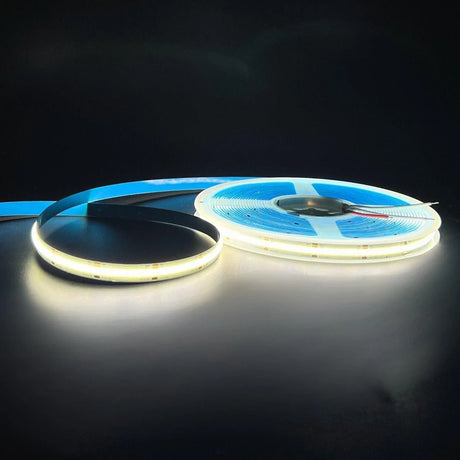
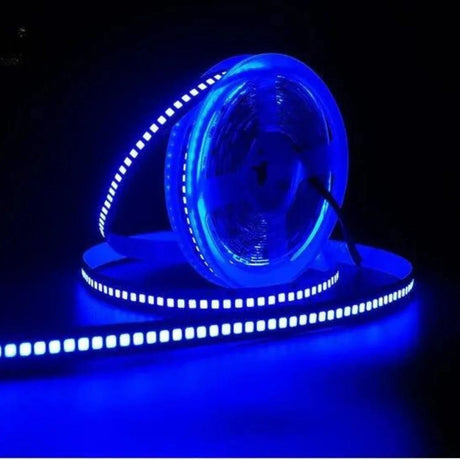
Flickering LED strip lights are almost never the strip's fault — in nine out of ten cases it is the dimmer. UK LED Lights stocks every component you need to build a smooth, flicker-free dimmable LED strip setup in 2026: TRIAC dimmable drivers for wall dimmer control, PWM controllers for precision low-voltage dimming, and WiFi-enabled systems that put brightness control on your phone, Alexa, or Google Home.
Our dimmable LED strip range covers single colour, RGB, RGBW, and CCT colour-tunable strips, paired with trailing-edge compatible TRIAC dimmable drivers from 30W to 400W and PWM controllers with 0–100% flicker-free dimming. Whether you are replacing a flickering kitchen install or specifying a full smart lighting fit-out, our Telford-based technical team will match the correct driver, controller, and dimmer to your exact strip — call 01952 370008 or email sales@ukledlights.co.uk.
Single Colour · RGB · RGBW · CCT · TRIAC Dimmable · PWM Dimmable · WiFi · Alexa · Google Home · 12V · 24V · 48V · IP20 · IP67 · IP68 · Free UK delivery
Quick decision guide:
-
Single colour strip with a wall dimmer: Choose a TRIAC dimmable driver + trailing-edge wall dimmer. This is the simplest setup and the most common for kitchens, bedrooms, and cove lighting.
-
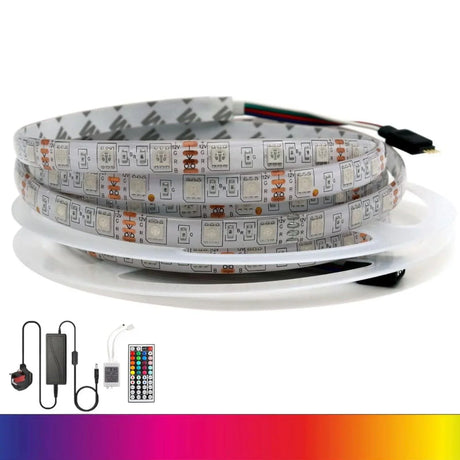
RGB or RGBW colour-changing strip: Use a non-dimmable constant-voltage driver + dedicated RGB controller. The controller handles both colour selection and dimming — a dimmable driver will cause flicker and colour shift.
-
Smart home voice-controlled dimming: Pair any strip with a WiFi controller from Miboxer, Skydance, or GLEDOPTO. Works with Alexa, Google Home, and Apple HomeKit for voice and app control.
-
Long commercial run over 10 metres: Use a 48V strip and matching 48V TRIAC dimmable driver — voltage drop occurs at half the rate of 24V, so brightness stays consistent over the full length.
-
Existing install that flickers: Replace your leading-edge dimmer with a trailing-edge model. This costs approximately £15 and fixes the problem immediately in most cases.
Who dimmable LED strip is for: Homeowners who want adjustable brightness from a wall switch, smart home users who control lighting by voice or app, electricians specifying dimmable circuits for new builds and refurbishments, interior designers creating layered lighting schemes, and commercial installers fitting dimmable task or accent lighting in hospitality, retail, and office environments. If you need your LED strip to do anything other than run at fixed full brightness, you need a dimmable setup.
Who dimmable LED strip is NOT for: If you only need fixed-brightness accent lighting and will never adjust it — a standard non-dimmable driver is cheaper and simpler. If you want colour effects from RGB strip, the controller already includes dimming, so you do not need a separate TRIAC dimmable driver. Buying a dimmable driver for an RGB setup is a common and expensive mistake.
Common buying mistakes to avoid:
-
Using a leading-edge dimmer with an LED driver: Leading-edge dimmers were built for incandescent and halogen loads. They chop the front of the AC waveform, which most LED drivers cannot process cleanly — the result is visible flicker, buzz, and reduced driver lifespan. This is the single most common cause of LED strip flickering complaints in the UK in 2026.
-
Buying a dimmable driver for RGB or RGBW strip: RGB and RGBW strips must use a non-dimmable constant-voltage driver paired with a dedicated controller. The controller handles dimming via PWM. Connecting a dimmable driver causes flicker, colour shifting, and premature LED failure.
-
Oversizing the dimmer, undersizing the driver: Your driver wattage must exceed total strip wattage by at least 20 percent. Your trailing-edge dimmer must be rated for the driver's input wattage. Getting either wrong causes performance issues that look identical to dimmer incompatibility.
-
Assuming all LED dimmers are the same: A dimmer labelled "LED compatible" may still be leading-edge. Always confirm trailing-edge operation for LED strip driver circuits. Check the dimmer datasheet — if it does not specify trailing edge, assume leading edge.
- What is a dimmable LED strip light and how does dimming actually work?
- Why do dimmable LED strip lights flicker — and how do you fix it?
- What is the difference between trailing-edge and leading-edge dimmers for LED strip?
- How do you dim single-colour LED strip with a wall dimmer?
- How do you dim RGB and RGBW LED strip without a wall dimmer?
- What is PWM dimming and why does it matter for LED strip?
- Can you control dimmable LED strip lights with Alexa, Google Home, or Apple HomeKit?
- How do you install a dimmable LED strip light system step by step?
- How do you choose the right driver wattage for dimmable LED strip?
- Why buy dimmable LED strip lights from UK LED Lights?
What is a dimmable LED strip light and how does dimming actually work?
A dimmable LED strip light is any LED strip connected to a system that allows you to adjust its brightness from 0 to 100 percent. The strip itself is not inherently dimmable or non-dimmable — it is the driver and control method that determines whether dimming is possible. Every LED strip UK LED Lights sells can be made dimmable with the correct driver and controller combination.
There is a persistent misconception that only certain LED strips can be dimmed. In reality, any low-voltage LED strip — 12V, 24V, or 48V — will dim smoothly when the correct signal reaches it. The question is not whether a strip can dim, but how you deliver the dimming signal. Two paths exist, and choosing the wrong one is where most 2026 installations go wrong:
-
TRIAC mains dimming (single colour): A TRIAC dimmable driver sits between the mains supply and the strip. A trailing-edge wall dimmer adjusts the AC signal going into the driver, the driver translates that into a reduced DC output, and the strip dims smoothly. This is the standard approach for warm white, cool white, and natural white installations where you want a conventional wall switch.
-
PWM low-voltage dimming (single colour, RGB, RGBW, CCT): A standard non-dimmable driver supplies constant voltage to a PWM controller, and the controller rapidly pulses the DC output to the strip at frequencies above 1,000 Hz. At that speed, the human eye perceives smooth dimming with zero visible flicker. This is the correct method for any colour-changing strip and the preferred method for smart home setups.
Understanding this distinction before you buy a single component saves time, money, and the frustration of troubleshooting a system that was wired incorrectly from the start. Our technical team at 01952 370008 will confirm which path suits your project in a single phone call.
Why do dimmable LED strip lights flicker — and how do you fix it?
LED strip flickering on a dimmer is almost always caused by an incompatible dimmer switch — specifically a leading-edge dimmer being used with an LED driver that requires trailing-edge control. Replacing the dimmer with a trailing-edge model costing approximately £15 from any UK electrical wholesaler fixes the problem immediately in the majority of cases.
This is the number one complaint UK LED Lights' technical team handles. A customer installs perfectly good LED strip with a perfectly good dimmable driver, connects it to their existing wall dimmer, and the strip flickers, buzzes, or refuses to dim below 40 percent. The strip is not faulty. The driver is not faulty. The dimmer is a leading-edge type — and it is fighting the driver on every AC cycle.
Here is a practical troubleshooting sequence that resolves flickering in over 90 percent of cases we see in 2026:
-
Check your dimmer type: Remove the dimmer faceplate and read the model number. Search the manufacturer datasheet. If it says "leading edge", "L type", or "RL type" — that is your problem.
-
Replace with trailing edge: Swap to a trailing-edge dimmer rated for LED loads. The Varilight V-Pro and Hamilton Litestat Chroma are two widely available UK options, both under £20.
-
Verify driver compatibility: Confirm your TRIAC dimmable driver is rated for trailing-edge dimming — most quality drivers from Meanwell, Inventronics, and our own range are compatible with both types, but always check.
-
Check the minimum load: Leading-edge dimmers typically need 25–60W minimum load. If your total LED strip wattage is below the dimmer's minimum, flickering occurs even on trailing-edge models. Verify that your total strip wattage meets the dimmer's minimum threshold.
-
Inspect connections: Loose screw terminals, poor solder joints, and degraded push-fit connectors all introduce micro-interruptions that look identical to dimmer-related flicker. Reseat every connection in the circuit.
If you have tried all five steps and the strip still flickers, contact our team at sales@ukledlights.co.uk with your dimmer model, driver model, and strip part number. We will diagnose it remotely in most cases.
What is the difference between trailing-edge and leading-edge dimmers for LED strip?
A trailing-edge dimmer cuts the end of the AC mains waveform to reduce power, producing a smooth, gradual transition that LED drivers process cleanly. A leading-edge dimmer cuts the front of the waveform with a sharp spike that causes most LED drivers to flicker, buzz, or fail to dim below 30–50 percent. For LED strip installations in 2026, trailing-edge is the correct choice in nearly every scenario.
The difference is electrical, but the consequence is visible and audible. Leading-edge dimmers were engineered in the 1960s for incandescent and halogen loads — resistive loads that tolerate abrupt voltage changes. LED drivers are electronic loads. They contain capacitors and switching circuits that react badly to the leading-edge voltage spike, producing the flicker and audible buzz that frustrates so many homeowners.
| Feature |
Trailing-Edge Dimmer |
Leading-Edge Dimmer |
| Waveform cut position |
End of AC cycle (smooth transition) |
Start of AC cycle (abrupt spike) |
| Designed for |
Electronic loads (LEDs, electronic transformers) |
Resistive loads (incandescent, halogen) |
| LED driver compatibility |
Compatible with most TRIAC dimmable LED drivers |
Causes flicker with most LED drivers |
| Audible noise |
Silent or near-silent operation |
Audible buzz at mid-range settings |
| Minimum load |
Typically 1–10W |
Typically 25–60W |
| Dimming range |
Smooth 0–100% on compatible drivers |
Often limited to 30–100% with LEDs |
| Typical UK retail price (2026) |
£12–£25 |
£5–£15 |
| Best LED strip application |
All single-colour TRIAC dimmable installs |
Not recommended for LED strip circuits |
The cost difference between a leading-edge and trailing-edge dimmer is roughly £10–£15. For that amount, you eliminate the most common cause of LED strip flickering in UK homes. If you are building a new dimmable circuit or replacing an existing dimmer, always specify trailing edge. Browse our LED controllers and dimmers range or call 01952 370008 for guidance on which dimmer pairs with your driver.
How do you dim single-colour LED strip with a wall dimmer?
To dim single-colour LED strip from a wall switch, you need three components: the LED strip itself, a TRIAC dimmable constant-voltage driver matched to the strip's voltage and wattage, and a trailing-edge wall dimmer rated for LED loads. The dimmer adjusts the mains AC input to the driver, the driver converts that into a proportional DC output, and the strip dims smoothly from 0 to 100 percent.
This is the setup most homeowners want — a familiar wall switch that dims the strip exactly like a ceiling light. It suits warm white kitchen under-cabinet lighting, bedroom cove lighting, and hallway accent strips where a conventional switch is already wired into the wall.
The components in order:
-
LED strip: Any single-colour strip from our LED strip lights range — warm white, cool white, or natural white in 12V, 24V, or 48V.
-
TRIAC dimmable driver: Must match the strip voltage exactly. Wattage must exceed total strip wattage by at least 20 percent. Browse our TRIAC dimmable LED drivers — available from 30W to 400W across 12V, 24V, and 48V output.
-
Trailing-edge wall dimmer: Rated for LED loads, minimum load below your total strip wattage. Typically £12–£25 from any UK electrical supplier in 2026.
Wiring is simple: mains live and neutral into the dimmable driver via the trailing-edge dimmer on the live feed, then DC positive and negative from the driver to the strip. If you are running more than 10 metres of strip, parallel wiring from the driver to each run is best practice — series wiring multiplies voltage drop and creates uneven brightness across the length.
How do you dim RGB and RGBW LED strip without a wall dimmer?
RGB and RGBW LED strip is dimmed through a dedicated controller, not a wall dimmer. The controller sits between a standard non-dimmable constant-voltage driver and the strip, handling colour selection, colour mixing, and brightness adjustment via PWM. Never connect RGB or RGBW strip to a TRIAC dimmable driver — it causes flicker, colour shift, and reduces the lifespan of both driver and strip.
This is one of the most common and most expensive mistakes in LED strip lighting. A customer buys RGB strip, buys a dimmable driver, and wires it through a wall dimmer expecting to control brightness. The result is uneven colour output, visible flicker at certain brightness levels, and audible buzz from the driver. The correct approach for any colour-changing strip in 2026 is:
-
Non-dimmable constant-voltage driver: Supplies steady 12V or 24V DC to the controller. Choose from our LED drivers range — match voltage and ensure wattage exceeds total strip load by at least 20 percent.
-
Dedicated RGB or RGBW controller: Handles all colour and brightness commands via PWM at frequencies typically above 1,000 Hz. Browse our LED strip controllers for RF remote, touch panel, and WiFi options.
-
WiFi controller for smart dimming: Controllers from Miboxer and Skydance connect to your home WiFi and allow voice control through Alexa, Google Home, and Apple HomeKit. Set brightness, colour, schedules, and scenes from your phone.
The controller dims the strip by adjusting the PWM duty cycle — the percentage of time each colour channel is switched on within each pulse cycle. At 50 percent duty cycle, each channel is on for half the time and off for half, producing 50 percent perceived brightness with zero colour shift. This is fundamentally different from TRIAC dimming and produces measurably smoother results across the full 0–100 percent range.
What is PWM dimming and why does it matter for LED strip?
PWM (Pulse Width Modulation) dimming controls LED strip brightness by rapidly switching the DC power supply on and off at frequencies above 1,000 Hz — far too fast for the human eye to detect. By varying the ratio of on-time to off-time within each cycle, the controller delivers precise brightness adjustment from 0 to 100 percent with no colour shift, no audible noise, and no visible flicker at any level.
TRIAC mains dimming works well for single-colour strip behind a wall switch, but PWM dimming is the technically superior method when precision, colour accuracy, and smart control matter. Here is why PWM matters in practical terms:
| Characteristic |
PWM Dimming (Controller) |
TRIAC Mains Dimming (Wall Dimmer) |
| Dimming range |
True 0–100% on most controllers |
Typically 10–100% depending on driver and dimmer match |
| Colour consistency |
No colour shift at any brightness level |
Slight warm shift possible below 20% |
| Flicker |
None visible at frequencies above 1,000 Hz |
Possible if dimmer and driver are mismatched |
| Audible noise |
Silent |
Possible buzz from driver or dimmer |
| Smart home integration |
WiFi, Zigbee, Bluetooth, RF remote |
Wall switch only (unless paired with smart dimmer) |
| RGB/RGBW support |
Full colour and brightness control |
Not suitable — causes flicker and colour shift |
| Installation complexity |
Requires controller between driver and strip |
Simple — dimmer on mains side of driver |
| Cost |
Controller £15–£60 depending on features |
Trailing-edge dimmer £12–£25 |
For colour-changing installations, PWM is not just preferred — it is the only correct method. For single-colour installations where smart control, timer scheduling, or ultra-smooth dimming at very low levels matters, PWM via a dedicated controller also outperforms TRIAC. The practical rule: if you want a wall switch, use TRIAC. If you want app control, voice control, or colour effects, use PWM.
Can you control dimmable LED strip lights with Alexa, Google Home, or Apple HomeKit?
Yes — any LED strip in the UK LED Lights range can be voice-controlled through Alexa, Google Home, or Apple HomeKit when paired with a compatible WiFi controller. Miboxer, Skydance, and GLEDOPTO controllers connect to your home WiFi network and expose the strip as a smart device, allowing you to dim, change colour, set schedules, and create scenes using voice commands or a phone app.
Smart dimming has moved from niche to mainstream in 2026, and the setup is simpler than most buyers expect. The system architecture is simple:
-
Non-dimmable driver: Supplies constant voltage to the controller. No TRIAC dimmable driver needed — the controller handles all dimming.
-
WiFi controller: Connects to your 2.4 GHz WiFi network. Miboxer controllers use the Tuya platform and pair with Alexa and Google Home natively. Skydance controllers offer both Tuya and standalone app options. GLEDOPTO controllers support Zigbee and pair with Philips Hue bridges, Amazon Echo Plus, and Apple HomeKit via compatible hubs.
-
Voice commands: "Alexa, dim the kitchen lights to 30 percent" — "Hey Google, set the bedroom strip to warm white" — "Siri, turn off the living room lights at 11pm."
Scheduling is where smart dimming adds real value beyond the novelty of voice control. Set the strip to 80 percent brightness at 6am, 40 percent at 9pm, and off at midnight — automatically, every day, without touching a switch. Pair that with colour temperature scheduling on CCT strip and you have lighting that follows your daily routine. Browse our Miboxer controllers and Skydance controllers to find the right match for your strip type.
How do you install a dimmable LED strip light system step by step?
Installing a dimmable LED strip light system requires planning the circuit layout, selecting matched components, mounting the strip on a clean surface or inside an aluminium profile, wiring the driver and dimmer or controller correctly, and testing before final fixing. The process takes one to three hours for a typical single-room installation and does not require Part P certification for low-voltage DC circuits in most cases.
Follow these steps for a single-colour TRIAC dimmable installation — the most common residential setup in 2026:
-
Measure and plan the run: Measure the total length of strip needed. Add 5–10 percent for cutting waste and corners. Note the strip wattage per metre and multiply by total length to get your load figure. For runs over 10 metres on 24V, plan parallel feeds from the driver to each strip section to prevent voltage drop.
-
Select matched components: Choose a TRIAC dimmable driver with output voltage matching the strip (12V, 24V, or 48V) and wattage at least 20 percent above total strip load. Select a trailing-edge wall dimmer rated for LED loads with a minimum load specification below your total strip wattage. Our technical team at 01952 370008 can confirm compatibility for any combination.
-
Prepare the mounting surface: Clean with isopropyl alcohol and allow to dry completely. If mounting on metal — aluminium profiles, steel shelving, or metal cabinets — ensure the strip has an insulating backing or use a profile with an insulating channel. Mounting bare strip directly on conductive metal risks short circuits across the exposed copper pads on the underside.
-
Mount the strip: Peel the 3M adhesive backing and press firmly along the prepared surface. Do not stretch the strip around tight corners — cut at the nearest cut mark and use a corner connector or short wire link. Never power the strip while it is still coiled on the reel — heat builds up rapidly in a coil, degrading the adhesive and LEDs within minutes.
-
Wire the circuit: Connect mains live through the trailing-edge dimmer to the dimmable driver's live input terminal. Connect neutral directly to the driver's neutral terminal. Connect the driver's DC positive and negative outputs to the strip's corresponding input pads. For parallel runs, wire each strip section independently back to the driver's output terminals.
-
Test at full brightness first: Before adjusting the dimmer, run the strip at full brightness for ten minutes to confirm even illumination, consistent colour temperature, and no hot spots. Check every connection for warmth — warm terminals indicate a loose or high-resistance joint that needs resoldering or retightening.
-
Test the dimming range: Slowly reduce brightness from 100 percent to the lowest level. Listen for buzz from the driver or dimmer. Watch for flicker at low levels. If flicker appears below 15–20 percent, adjust the dimmer's low-end trim if available, or verify that the total strip load meets the dimmer's minimum wattage specification.
For RGB or RGBW installations, the process is identical except you skip the wall dimmer entirely. Wire the non-dimmable driver to the controller input, wire the controller output to the strip, and pair the controller's RF remote or WiFi app. The controller manages all dimming and colour commands.
How do you choose the right driver wattage for dimmable LED strip?
Calculate the total wattage of your LED strip installation — watts per metre multiplied by total metres — then add a minimum 20 percent safety margin. A 10-metre run of 14.4W/m strip draws 144W total, so the driver must be rated at least 173W. Always round up to the next available driver size. Undersized drivers overheat, flicker under dimming, and fail prematurely.
This 20 percent margin is not a suggestion — it is essential for reliable dimming performance. A driver running at 95 percent capacity cannot deliver the stable, consistent output a TRIAC dimmable circuit needs for smooth dimming at low levels. You will see flicker, inconsistent brightness, and hear audible buzz from a driver that is working at its thermal limit.
-
5 metres at 9.6W/m: 48W total load — select a 60W driver minimum.
-
10 metres at 14.4W/m: 144W total load — select a 180W or 200W driver.
-
15 metres at 14.4W/m on 24V: 216W total load — select a 250W or 300W driver. Wire as two or three parallel runs to manage voltage drop.
-
20 metres at 10W/m on 48V: 200W total load — select a 240W or 250W 48V TRIAC dimmable driver. A 48V system handles this length from a single feed point with half the voltage drop of an equivalent 24V run.
Browse our full TRIAC dimmable LED driver range and standard LED driver range. If your calculation falls between two driver sizes, always choose the larger one. The cost difference between a 150W and 200W driver is typically a few pounds — the cost of replacing a failed undersized driver mid-install is significantly more. For help with wattage calculations on complex multi-zone installations, email sales@ukledlights.co.uk with your strip model and total run lengths.
Why buy dimmable LED strip lights from UK LED Lights?
UK LED Lights is a specialist LED strip supplier based in Telford, Shropshire, holding verified UK stock across every component needed for dimmable installations — strip, TRIAC dimmable drivers, PWM controllers, WiFi controllers, and connectors. We do not dropship from overseas warehouses. Every order ships from our Telford facility with free UK delivery and arrives within one to three working days in 2026.
-
Matched component expertise: Our technical team verifies driver-dimmer-strip compatibility before you buy. Call 01952 370008 with your project details and we will confirm the exact combination you need — no guesswork, no incompatible returns.
-
Full dimmable ecosystem in one order: Strip, driver, controller, connectors, and profiles — all from one supplier, all verified compatible, all delivered together. No waiting for three separate deliveries from three separate sellers.
-
Free UK delivery on every order: No minimum spend. No surcharges for Scottish Highlands, Northern Ireland, or offshore locations.
-
Real technical support from Telford: Not a chatbot. Not an overseas call centre. A UK-based technical team that has physically installed and tested every product we sell. Available Monday to Friday, 9am to 5pm on 01952 370008 or sales@ukledlights.co.uk.
-
Sister brands you can trust: UK LED Lights is part of the same family as UK LED Lights, House of LEDs, and Glow LEDs — four specialist LED brands under one roof, serving UK customers since 2019.
-
Company registration: UK LED Lights Ltd, Company No: 12301805. Unit D4, Stafford Park 4, Telford, Shropshire, TF3 3BA.
-
Dimming issues account for the majority of our technical support calls — and the fix is almost always a £15 trailing-edge dimmer, not a strip replacement.
-
We test every dimmable driver we sell against trailing-edge and leading-edge dimmers and publish the results on the product page.
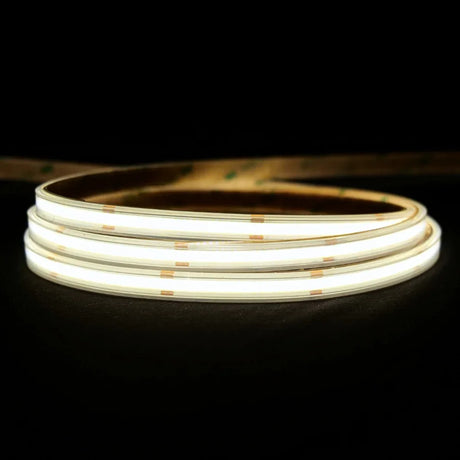
Ready to order? Browse our full LED strip lights range, explore our COB LED strip collection for dot-free dimmable lighting, or call 01952 370008 to discuss your dimmable installation with our technical team.
How does triac dimming compare to PWM dimming for LED strip?
Triac and PWM dimming work on different sides of the circuit and suit different installation types — here is the direct comparison.
| Feature |
Triac (Wall Dimmer) |
PWM (Controller) |
| Control method |
Standard wall dimmer on mains side |
Controller between driver and strip (DC side) |
| Dimming range |
Typically 10-100% |
True 0-100% |
| Colour shift |
Slight warm shift possible below 20% |
No colour shift at any level |
| Smart home support |
Wall switch only (or smart dimmer) |
WiFi, Zigbee, Bluetooth, voice |
| RGB/RGBW support |
Not compatible |
Full colour and brightness control |
| Best for |
Single colour with wall switch |
Any strip type with app or voice control |
Triac dimming is the simplest approach for single-colour strip with a wall switch. PWM is the correct method for any colour-changing strip and any smart home setup. Call 01952 370008 for dimming advice.
What are the most common questions about dimmable LED strip lights?
Are all LED strip lights dimmable?
-
Yes — every LED strip can be dimmed when paired with the correct driver and control method.
-
Single-colour strips dim via a TRIAC dimmable driver and trailing-edge wall dimmer, or via a PWM controller.
-
RGB and RGBW strips dim via a dedicated controller connected to a non-dimmable driver — the controller handles both colour and brightness.
What dimmer switch do I need for LED strip lights?
-
A trailing-edge dimmer rated for LED loads is the correct choice for single-colour TRIAC dimmable setups in 2026.
-
Avoid leading-edge dimmers — they were designed for incandescent bulbs and cause flicker, buzz, and poor dimming range with LED drivers.
-
Typical trailing-edge dimmers cost £12–£25 and are available from any UK electrical wholesaler or retailer.
Why do my LED strip lights flicker when dimmed?
-
The most common cause is a leading-edge dimmer being used with a TRIAC dimmable LED driver — swap to trailing edge for approximately £15.
-
Minimum load mismatch is the second most common cause — if total strip wattage is below the dimmer's minimum load threshold, flicker occurs at low brightness.
-
Loose connections at terminals, solder joints, or push-fit connectors also produce intermittent flicker.
Can I use a dimmable driver with RGB LED strip?
-
No — RGB and RGBW strip requires a non-dimmable constant-voltage driver paired with a dedicated RGB controller.
-
The controller handles dimming via PWM — it does not need or want a varying voltage input from a dimmable driver.
-
Using a dimmable driver causes flicker, colour shift, and premature failure of both driver and strip.
What is the difference between PWM and TRIAC dimming for LED strip?
-
TRIAC dimming works on the mains AC side via a wall dimmer and dimmable driver — best for simple single-colour wall switch control.
-
PWM dimming works on the low-voltage DC side via a controller — provides true 0–100% dimming, zero colour shift, and smart home integration.
-
For RGB, RGBW, and CCT strip, PWM is the only correct method — TRIAC is not compatible with multi-channel colour-changing strip.
Can I dim LED strip lights with Alexa or Google Home?
-
Yes — pair any strip with a WiFi controller from Miboxer, Skydance, or GLEDOPTO for voice control through Alexa, Google Home, or Apple HomeKit.
-
Miboxer and Skydance use the Tuya smart platform — pair natively with Alexa and Google Home via the Tuya or Smart Life app.
-
GLEDOPTO supports Zigbee — pairs with Philips Hue bridges, Amazon Echo Plus, and Apple HomeKit-compatible hubs.
How much does it cost to make LED strip dimmable?
-
TRIAC wall dimmer route: A trailing-edge dimmer costs £12–£25 — the dimmable driver typically costs £5–£15 more than a non-dimmable equivalent of the same wattage.
-
PWM controller route: Basic RF remote controllers start from £15, WiFi-enabled smart controllers from £25–£60 depending on features and channel count.
-
Fixing an existing flickering install: Replacing a leading-edge dimmer with trailing edge costs approximately £15 and takes under ten minutes.
Do dimmable LED strip lights change colour when dimmed?
-
Quality single-colour strip maintains consistent colour temperature across the full dimming range when using PWM control.
-
TRIAC dimming may produce a slight warm shift below 15–20 percent on some driver and strip combinations — this is subtle and generally unnoticeable in residential settings.
-
RGB strip maintains colour accuracy at all brightness levels when dimmed via a PWM controller, because the controller adjusts pulse width without changing the voltage or current to each colour channel.
What wattage driver do I need for dimmable LED strip?
-
Calculate total strip wattage: watts per metre multiplied by total metres of strip in the circuit.
-
Add a minimum 20 percent margin: a 100W total strip load needs a driver rated at least 120W.
-
Always round up to the next available driver size — a few extra watts of headroom improves dimming stability and extends driver life.
Can I dim 48V LED strip lights?
-
Yes — 48V strip dims identically to 12V and 24V strip when paired with a matching 48V TRIAC dimmable driver and trailing-edge dimmer.
-
48V offers a practical advantage for long dimmable runs: voltage drop occurs at half the rate of 24V at the same wattage over the same distance, so brightness remains more consistent over 15–30 metre lengths.
-
48V DC falls within the SELV voltage threshold under BS7671 (120V DC ripple-free maximum), provided it is supplied from a suitably isolated, safety-rated driver — it does not eliminate shock risk entirely but significantly reduces it under dry conditions.
How do I wire dimmable LED strip for runs over 10 metres?
-
Use parallel wiring: Run separate positive and negative cables from the driver output to each strip section, rather than daisy-chaining one strip into the next.
-
Series wiring multiplies voltage drop: A 15-metre series run on 24V may lose 10–15 percent brightness at the far end. The same length wired as three 5-metre parallel runs maintains even brightness throughout.
-
For runs over 20 metres, consider 48V: A 48V system handles longer distances from a single feed point with measurably lower voltage drop than 24V at equivalent wattage.
Is it safe to dim LED strip lights to very low levels?
-
PWM dimming is safe at any level down to 0 percent — the strip simply receives shorter pulses of full-voltage power, with no heat buildup or electrical stress.
-
TRIAC dimming at very low levels depends on the driver: Some drivers have a minimum output threshold below which the circuit becomes unstable. Most quality dimmable drivers from our range operate smoothly down to 5–10 percent.
-
If flicker appears at very low levels only, adjust the dimmer's low-end trim setting (available on most trailing-edge dimmers) to raise the minimum to just above the flicker threshold.
Do I need an electrician to install dimmable LED strip lights?
-
Low-voltage DC wiring (12V, 24V, 48V) does not require Part P certification in England and Wales — a competent DIYer can install the strip, driver, and controller without notifying Building Control.
-
Mains connections to the driver do require competent electrical work: If you are connecting a dimmable driver to a mains lighting circuit, an electrician is recommended unless you are confident working with 230V AC.
-
Replacing a dimmer switch on an existing circuit is a simple task that most DIYers can complete safely — isolate the circuit at the consumer unit before removing the old dimmer.
Can I use dimmable LED strip in a bathroom?
-
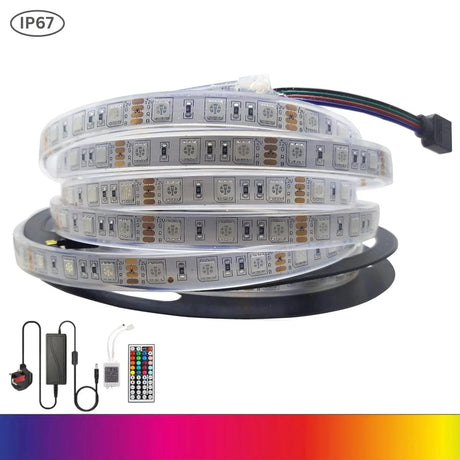
Yes — use IP67-rated strip minimum in Zone 1 and Zone 2 under BS7671 bathroom zoning requirements.
-
IP68 is required for Zone 0 (inside a bath or shower enclosure) where continuous water contact occurs.
-
Do not use IP65 in wet zones. IP65 covers surface splashes only and is not suitable for sustained bathroom moisture.
Can dimmable LED strip be used outdoors?
-
Yes — use IP67 minimum for any permanent outdoor installation. IP65 is not suitable for UK outdoor conditions.
-
The driver must be housed in a weatherproof IP66+ enclosure or mounted indoors with low-voltage cable running to the outdoor strip.
-
All mains-side wiring for permanent outdoor circuits must comply with BS7671 Part P, typically requiring a qualified electrician.
What is the cost difference between dimmable and non-dimmable LED strip setups?
-
TRIAC dimmable drivers cost approximately £5–£15 more than non-dimmable equivalents of the same wattage.
-
A trailing-edge wall dimmer adds £12–£25 to the total installation cost.
-
Total dimming premium is typically £20–£40 for a standard single-room installation — a modest cost for full brightness control over the lifespan of the installation.
Should I mount LED strip directly on bare metal surfaces?
-
Never mount LED strip directly on bare, uninsulated metal. Exposed copper traces on the strip PCB will short-circuit against conductive surfaces.
-
Mount inside an anodised aluminium profile which provides the necessary insulating barrier.
-
If a profile is not practical, place a non-conductive insulating layer between the strip and the metal surface before adhering.
Can I power LED strip while it is still coiled on the reel?
-
Never power strip while coiled. Heat builds up rapidly in a coil, softening adhesive, degrading LEDs, and creating a fire risk.
-
Always uncoil and mount strip fully on a surface or inside an aluminium profile before connecting power.
-
This applies to all strip types — single colour, RGB, RGBW, and CCT.
Does UK LED Lights offer free delivery on dimmable strip and drivers?
-
Yes — free UK mainland delivery on every order. No minimum spend required.
-
Orders before 2pm Monday to Friday dispatch same day from our Telford warehouse — Unit D4, Stafford Park 4, TF3 3BA.
-
For specification questions before ordering, call 01952 370008 or email sales@ukledlights.co.uk. Our technical team matches driver, dimmer, and strip combinations daily.
What warranty covers dimmable LED strip products from UK LED Lights?
-
Warranty covers manufacturing defects on all strip, drivers, and controllers in the UK LED Lights 2026 range.
-
Warranty does not cover: Damage from incorrect wiring, use of incompatible dimmers (leading-edge on TRIAC drivers), mounting on bare metal, or powering strip while coiled.
-
Contact: Call 01952 370008 or email sales@ukledlights.co.uk for warranty enquiries. UK LED Lights Ltd, Company No: 12301805, Unit D4, Stafford Park 4, Telford, Shropshire, TF3 3BA.
Last reviewed: March 2026 — UK LED Lights technical team, Telford, Shropshire. Specifications current as of 2026.
🏭 UK LED specialist, Telford, Shropshire · ☎️ 01952 370008 · 🚚 Free UK delivery





 £114.85Unit price /Unavailable